Feeds:
Posts
Comments

In my recent blog on Big Towner I added a link to the viewfromthegrandstand American blog on the influence of Meadow Skipper (Skipper, Skipper Everywhere) which noted the passing of one of Big Towner’s last siring sons – and the domination of Meadow Skipper blood in the “top” and “bottom” lines of many sires. He listed those few sires who are relatively Meadow Skipper-free, amongst them In The Pocket and his son Christian Cullen, both of which are powerful elements in the breeding industry in New Zealand.

The proposition is that when a siring line dies out, we lose an important ability to outcross. We risk getting too much of one bloodline, and our pacing breed is worse off for that.

I agree with that in general. But almost all our siring lines descend from Hambletonian, so what really is an outcross sire? Siring lines branch and develop, and those branches take on their own characteristics. They ebb and flow in what contribution they make to the overall breed. Some don’t survive, but overall I think the desirability of outcrossing ensures that remote branches often become sought after and revive their fortunes when a certain “saturation” level of one dominant siring line is reached.

Of course “market forces” in breeding may not quite line up with the timeframes required for this to happen i.e. a siring line may die out before there is enough interest in outcrossing to it. With Direct Scooter, it was quite a close call.

Meadow Skipper himself now sits usually 4 or more generations removed in most pedigrees, so his influence becomes mixed with a range of many other genes and types – often including outcross sires like Big Towner, Direct Scooter and Abercrombie appearing in the maternal lines – for the very reason that breeders have looked for for that difference to get some “hybrid vigour” or to avoid “too much of a good thing” or just as likely have looked for a certain type of sire to complement their type of mare (stamina sire over smaller speedy mare, etc). So to a large extent the tendency to overdose on one line or branch of a line will self correct over time as breeders turn to other options.

Having said that, there was a long period in North America where it seemed the Dale Frost (Meadow Skipper) line and the Adios (Abercrombie) line sires were in a dance of their own.  The Gene Abbe (Big Towner) siring line was thin on the ground, and Steady Star was the last of the Tar Heel siring line. Thank heavens for Direct Scooter!

In The Pocket to the rescue
In The Pocket is a son of Direct Scooter from a Tar Heel mare,  who actually has Meadow Skipper as her damsire (which is an unusual juxtaposition because Tar Heel was really a generation before Meadow Skipper but Tar Heel’s enduring 28 years at stud allowed him to overlap in this sort of way with the early siring careers of horses like Meadow Skipper).  In The Pocket was otherwise pretty much an outcross sire with his two closest double ups being to Billy Direct  and Scotland.

In The Pocket stood here in New Zealand from 1994 until his death in 2010 and two of his best sons bred sons – Christian Cullen and Courage Under Fire – are making longterm impressions as sires, starting to look very nice as damsires and potentially (particularly Christian Cullen) as sires of sires. Several other top performing sons of In The Pocket have also stood at stud but need more time to see what they will deliver as sires – the tough New Zealand Cup winner Changeover is one with a lot of potential and received good numbers of mares in his first couple of years at stud, and his first yearlings are fairly well represented at the 2013 yearling sales next February.

I would like to make a comment on the list in the Skipper, Skipper Everywhere blog I referred to earlier – Christian Cullen is listed as having Meadow Skipper on his bottom line only but in fact he has Meadow Skipper in both his sire’s family (In The Pocket’s grandamsire) and his dam’s family (his damsire Bo Scots Blue Chip is a son of Most Happy Fella, a son of Meadow Skipper of course).  I’m not sure if by ‘top line’ the writer is referring to the siring line only rather than the sire’s paternal and maternal lines. But it is certainly true that compared to many North American sires, Christian Cullen brings a very different genetic mix to the table.

Influence through maternal lines
It is important to remember that in terms of lines like Tar Heel and Big Towner “dying out”, we are only talking about siring lines. The lines that have become siring ‘stubs’ are some of the most potent influences on our pacing breed and have produced sires that have made a huge contribution through maternal lines. I’ve done some blogs on Overtrick and Big Towner and also Shadow Wave as examples of this. It’s just worth repeating the observation because their genetic contribution is just as (if not more) vital to the future of breeding as the more commercially promoted siring lines.

In a very real way, these bloodlines have found their optimum influence – a way to ensure their best assests are carried forward into future generations with less danger of being made “redundant” as a sire of sires. If you buy into the x factor/heart size theory (and there is a lot of evidence to support it), then we should be more concerned about identifying and nurturing potent damsires among those lines who may struggle to deliver a succession of sire sons, so that we make sure the ‘baby’ is not thrown out with the ‘bathwater’. Bret Hanover-Warm Breeze-Falcon Seelster is one sequence that I’d flag up in that regard. In each case, as sires they have produced top racehorses, but their enduring contribution is more in the bottom line of pedigrees through their daughters. The sons of Falcon Seelster (Elsu and McArdle) may well be continuing this.

Outcross sires in the New Zealand breed
The impact of In The Pocket and another outcross sire Falcon Seelster here in New Zealand has been phenomenal in the past 20 years – these were two sires with plenty of “outcross” blood, and hence our smallish breeding pool has developed in recent decades in a different way than the North American mare population. These sires crossed well with the Meadow Skipper line sires that had stood here – Albatross sons Vance Hanover, Holmes Hanover and Soky’s Atom, and Most Happy Fella sons Smooth Fella and New York Motoring – none of which were the Meadow Skipper line stars that North America accessed.  Readers from North America will recognise New York Motoring perhaps as the brother of Happy Motoring. But these sires did a great job with our mares and produced many excellent racehorses. Interestingly, none of them left a really successful siring son but they carried classy maternal lines that have become an important part of our breeding pedigrees.

We sort of skipped all the Artsplace/Western Hanover excitement that happened in North America, except for Dream Away and later Badlands Hanover,  and we tried only a few Abercrombie line sires (including a brief fling with Life Sign when he was past his peak in North America, but that didn’t really go anywhere either). We had a few sons of Cam Fella come out to New Zealand  (covered in another of my blogs) but nothing that really worked for us except Presidential Ball, and we missed access to Cam Fella’s best sons in Camluck, Cambest and Cam’s Card Shark.

We were extremely lucky that In The Pocket and then Falcon Seelster came along.

(In nearby Australia, it was quite a different story, with much more influence from Cam Fella line and Abercrombie line sires over that same period.)

Well, those are some musings on how New Zealand has ended up with such a good quality but different genetic pool.  The quality of our pedigrees started much further back than what I’ve mentioned here – there were some great ‘colonial’ breeds, and also the injection of absolute classy genes like those U Scott and Light Brigade brought with them (when imported from America by Roydon Lodge) was a turning point in the 1930s/40s, and Bachelor Hanover in the 1970s, among others.

It seems to be a story of solid building up of quality, with some spectacular injections of outcross sires with classy maternal lines at just the right moment.

Are Bettor’s Delight and Art Major going to be two of the same, in hindsight? I’m not sure about Art Major, but Bettor’s Delight (from the Cam Fella sire lines and no Direct Scooter anywhere at all) is going gangbusters to the point of saturation (more of that in my next blog), and Real Desire (from the Abercromie sire line and no Direct Scooter at all) could be another Mr Right – standout sires that leave a lasting impression on the development of our breed.
It’s a year since I last recapped on how my virtual stable of picks from the 2011 yearling sales were going – very early days for them, at that stage. Now they are 3yos and it is interesting to see how they have shaped up.

My “virtual yearling stable” of four horses from the 2011 sales were:

  • Lot 79 Outlaw (Bettors Delight – Gift of Grace) – sold for $50,000. He qualified and had 3 starts as a 2yo for Cran Dalgety, and so far this season has had another 3 starts as a 3yo for 1 win, and earnings of just $5330. But fingers cross, there may be more to come.
  • Lot 154 Alta Christiano (Christian Cullen – Right This Time) – sold for $50,000. Six starts for4 wins as a 2yo and he looked a very, very nice horse in the making. Sold to Australia for serious money, then injury has ended his 3yo season and I am not sure what the longer term prognosis is yet. Lifetime earnings to date: $72,584.
  • Lot 92 Eye for a Deal (American Ideal – Illmakemyname). Sold for just $10,000. He’s been racing well in Australia, mainly at Albion Park, with 9 starts for 4 wins and 1 place. That’s only earned him $9,567 to date but he may keep stepping up.
  • Lot 179 Sugar Ray Brogden (Grinfromeartoear-Swift Mirage).  Trialled well, then 2 starts for no wins, and it became apparent he had developed a palate issue that needed an operation, which the owner didn’t want to proceed with. So sold as a hack.

Kym Kearns’ picks from that 2011 sale included the nice Mexicano, a Christian Cullen colt who looks to have a bit of class about him; Los Amante who had 3 placings from 7 starts as a 2yo but yet to appear this season; Assassin (sold to Australia, not yet raced); and Isa Smiling the filly trotter that she bred, who has a ton of ability and qualified but yet to learn manners.

Of my 2012 yearling sales virtual stable, understandably nothing has started yet although two of my picks Derringer (now renamed, oddly for a handsome colt, Strawberry Heart) and my own-bred Destination Moon have been noted by their trainers as looking forward 2yos. The other 2 colts I picked were Crixus Brogden (now renamed Real Impulse) and Charlie Chuckles. So I will be keeping my eyes out for those as 2yos – and for the picks that a couple of other blog readers chose.

While the virtual stable is just a fun thing, it does remind me that for breeders and buyers the odds of getting a successful result on the track or financially are a huge challenge.

That’s why it is worth doing the homework to increase the chances of success and minimise the odds of making a real mistake!

Rich N Elegant’s legacy

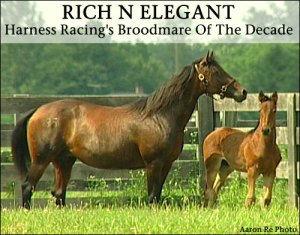
Rich N Elegant died on 19 November at the age of 22 – a remarkable mare whose foals included 6 in 1.54 and 5 with earnings over half a million dollars. She was a good racehorse herself, earning over $97,000 and taking a 1.56.8 mark at 3yo.

You can find a 3-part blog about her siring sons in my blog archives 2011 – and I can see a number of North American readers have already followed a forum link to those blogs.

Her son Rocknroll Hanover has certainly cemented his siring success in North America but will need more foals on the ground downunder for us to see what happens here, and he is already under stiff competition from his own classy son Rock N Roll Heaven. After very small frozen semen crops the last few years, he served 56 mares in 2012 in New Zealand.

All that aside, Rich n Elegant had the ability to produce extremely good racehorses, particularly her colts.  All of us breeders know it is hard to produce one top race horse, let alone sever

al and from different sires – and that is a sign that your mare is something very, very special.

She is one of the few dams of top racehorses who had Direct Scooter so directly accessible (he was her damsire) and therefore, for those who follow the x factor/heart size theory, the ability to pass that on to her colt foals. They in turn, as sires,  have the ability to pass it on to their filly foals only. Other dams of successful and upcoming sires that have Direct Scooter in their maternal lines almost always do so through his role as the sire of Matts Scooter, rather than directly Direct.

Her bottom line was the very, very potent Shifting Sands/Golden Miss family, which has proven to be one of the most powerful maternal lines of the modern era. It underscores sires like Real Desire, Panorama, Safely Kept who have all been successful in Australia and New Zealand.

So a tip o’ the hat to one of pacing greatest mares ever.

Google Rich N Elegant horse to get many more articles and accolades, but here is a very nice one on the Canadian Hall of Fame website that gives the mare a lovely credit as a great mum:

http://horseracinghalloffame.com/standardbred/2009/rich_n_elegant.html

There’s been a lot of discussion in recent years about the trend for sports to try to stay alive by making their “product” more attractive to the mobile, easily distracted, entertainment focused younger generation.

In New Zealand, our big national sports are rugby, cricket, rugby league and netball, and 3 of those 4 have made big efforts internationally to provide shorter versions of the game packaged in a way that suits the modern restless audience in an environment where there are many alternative forms of entertainment competing for their attention. I say “audience” (could say “consumer”) because we are not just talking about attendees at an event.

Rugby has the very popular Sevens version, with an international circuit and a party atmosphere. Cricket has 50-over matches and now Twenty20 cricket. Even netball has recently experimented with a 5-a-side team format.

You can see and hear those in charge of those sports and those following them debate the pros and cons fiercely. They are tampering with traditional formats and in a very real sense trying to reinvent the game.

But racing, our other big but shrinking national sport, has a huge advantage over these others. In fact two big advantages.

  • Firstly, we are not constrained by cumbersome, politically tangled international governing bodies.
  • Secondly, we already have one of the shortest, most exciting formats in any sport. It’s called a race.

Recently two different columns in the New Zealand Harness Racing Weekly – one the McCarthy Files of October 10, and the other JC’s I’ve Been thinking column of October 3 – have been stirring my little grey cells. JC was talking about the omnipresent mobile phone and how betting via cellphones and smartphones is already changing the way punters get information and place a bet. David McCarthy was discussing the lack of on-course crowds an how to make our races more attractive to younger people who seem to have much shorter attention spans. More mile races with shorter time between races were a couple of his suggestions to make race meeting attendance more exciting as events to attend.

Both make some very good points. Perhaps it is time to accept that, ever since the advent of radio, we have audiences who experience racing in different ways. At a very simple level, on course/off course. Or perhaps serious punter/those wanting entertainment.

OK – if you have got this far, you might be thinking…what has this got to do with breeding? Lots. Breeders, like all participants in this industry, need to be part of discussing future solutions to keep it alive and well.

Let me say again: We (racing) have a really tightly packaged product – a race – which is short, sharp excitement for (in harness racing) about 3 minutes. And yet we are in danger of losing sight of that advantage because of the way we organise and market our events. We just line up races one after another, and call it a programme.

Think of a race meeting (say, 9 to 10 races spread over an afternoon or evening) as a cricket match.  The race meeting would be like watching one over of cricket being bowled full on, then having to wait 30 minutes before the next over to be played.  Would the crowd stay engaged and excited? Probably pissed and bored before the 3rd over !  I am comparing harness racing to cricket, one of the strangest, slowest games on earth!, and yet coming away thinking the Twenty20 cricket match might be a more entertaining option to go to this weekend.

Yes, I know all the problems and costs involved in trainer and driver commitments, steward reports, warm ups and post race vetting etc etc.  (I do attend meetings).  But if something as intrinsically long-winded as cricket can invent an internationally acceptable short form of the game, then surely harness racing can come up with some fresh ideas, given it has the advantage of nice 3 minute ‘bites’ as the basis for promotion.

The TAB betting agency has jumped ahead of us. In the absence of more exciting race products, they have come up with ‘virtual’ races between individual drivers (the drivers challenge), head to head betting on two horses in the same race, and first 4 betting. This is telling us what appeals to an important section of the public – and may give us ideas for how to present our races more attractively and imaginatively.

Perhaps it is time for us to think outside the square in terms of what type of racing we offer and how we deliver it for our very different audiences.

Here’s some ideas, just throwing them into the wind – and some of these are borrowed from the traditional racing formats…

  1. Head to head challenges in reality, as they used to do, perhaps with 2 or 3 horses over a sprint distance and with bonuses for those racing within a certain time as an incentive not to dawdle and sprint. Imagine Gold Ace vs Terror To Love, with no excuses over 2000m? Two gladiators, one winner! Stakes get split 80/20, so there would be a good incentive to race (and win) even if stake money tightens further.
  2. Heat racing, where 4 or 5 horses race against each other 2 or 3 times in the course of a meeting, from separate draws over shorter (mile or thereabouts) distances. This takes the “bad luck” out of races that you can get with larger fields and poor draws (which can put punters off) and also addresses the issue of smaller fields when you try to match like against like. It also brings back the concept of soundness and heart into our horse racing. And it provides interesting betting options over the sequence of heats.
  3. Time incentive bonuses to help prevent races being a boring spectacle.
  4. Shorter race programmes that are properly designed to combine with additional forms of entertainment for those attending.
  5. Clearly identify race meetings and venues that are designed for best remote electronically-delivered action for punters versus  meetings and venues designed for on-course participation and entertainment. The two are quite different and too many of our venues end up in a compromise that pleases neither. Money needs to be invested in more sophisticated electronic systems for remote viewers/punters, with only small sophisticated areas for those who wish to attend on course or monitor particular horses ‘in the flesh’. Some of the “punter product” racing venues are more likely to be associated with a new era of on course training tracks, either public or private. The business venues compared to the entertainment venues.
  6. Improvements for remote viewing might involve GPS tracking devices on horses/drivers so individual punters can select and follow a horse’s position through a race (it is often not easy to see what is happening during a race, which can be a factor in viewers losing interest), but it could be even more personalised so a remote viewer (via smart phone or live streaming) can view the race in several different modes simultaneously to follow their horse/s’ progress. The race caller and cameraman are good, but could be combined with today’s technological advances.
  7. Much improved camera angles – the high wire camera at Flemington on Melbourne Cup Day blew me away – I got a much better understanding of the early part of the race, distance between runners, interference etc than I ever had from a side on or head on camera. Yes, putting overhead cameras on courses would be horrifically expensive, but what a selling point, what a product!
  8. Developing some very cool apps for smart phones might include packages where you can place a bet and order the product (race) to be delivered to your phone live or recorded. No need to interrupt what other entertaining you are doing, you will be reminded at the time and the race sent to your phone in the format you selected – “GPS overhead view plus voice commentary with results/time/dividends.” Or whatever suits your needs. Subscriber services could have a field day – perhaps this is already available somewhere?
  9. If a track is going to be an on-course entertainment venue – and I see fewer and fewer fitting this category – then it needs to offer a real night or afternoon out, so that the gaps between races are not just filled with an endless stream of alternative racing product on TV screens (this audience has not come to watch Wagga Wagga dogs or Singapore gallops) but with true hospitality and entertainment options. Alexander Park has headed in the right direction, with restaurant, betting, cafe and viewing facilities that meet a range of needs.
  10. Design boutique areas into racecourses – take a leaf out of the cinema book, and see how they have reinvented the movie goers experience in the face of competition from DVDs and TVs. I can go into a comfortable lounge, watch a movie and order a glass of wine and cake which is brought to me in my seat.

We can – have to – adapt and use new technology and smarten up our use of “the race” to maximise the excitement of involvement in harness racing and keep it as a competitive entertainment and betting option.

Here’s another blog about one of those hard working broodmare sires that add so much value to pedigrees, particulary when they have specific compatibilities to the mare/family.

As I mentioned in my blog about Overtrick, Big Towner is part of a Hambletonian “stub” – one of those Hambletonian lines that struggled to keep extending its siring line. But the Gene Abbe “stub”  has continued to thrive and to drive many of the best aspects of standardbred racing through its potent influence in damsires, much like Tar Heel has done for another “shortened” line of Hambletonian. Thank heavens for the maternal lines of our pedigrees – many of these damsires have enduring influence on the quality of our current and future stock.

Big Towner

So for me, Big Towner makes it to my list of all time greats in terms of contribution to the cause. Just for a start, look at his influence as the granddamsire of Art Major, Perfect Art, Real Artist and Panspacificflight.

Why? The primary reason is that he ADDS something. He doesn’t just lurk around as a ‘nice to have’. What he adds through the maternal lines appears to be heart size (x factor) but also speed. Yes, these are linked, but not always so. Not automatically so.

I’ve mentioned Big Towner’s contribution in some of my other blogs, for example in looking at Big Jim as a potential sire. And in a recent blog about Overtrick, Tony Dickinson examined his foundation mare Ballie Hanover and her Barbara Direct lineage – but Ballie Hanover also has Big Towner as her damsire, potentially adding quite a bit of value there.

Here is a lovely summary of Big Towner’s contribution, made by another blogger very recently – that’s serendipity!! – (and particularly signals Big Towner’s contribution as an outcross sire/damsire for mares with a lot of Meadow Skipper):

http://viewfromthegrandstand.blogspot.co.nz/2012/11/skipper-skipper-everywhere.htm

I’d also like to reference John Bradley’s Modern Pacing Sire Lines for some insight into this great damsire – and give him a tip o’ the hat as an amazing racehorse in his own right :

As a racehorse, Big Towner was a precocious colt right from the start, as was seen when he made his two-year-old debut at Maryland’s Rosecroft Raceway (then a half mile track) on May 7th 1976. Big Towner  drew post four and made a break right before the start. But in a preview of what was to come, the colt got back on stride, made up lost ground and raced second all the way until the stretch when he took command and pulled away to a twelve-length win in 2:09.3.

Bradley goes on to describe this horse as “a tough, game and fast colt”. After his 3yo season, trainer Lee Broglio said, “Big Towner is better than his record – he didn’t have too many opportunities over a big track last season – and definitely a fast horse.”  And he became a brilliant racehorse – winning his last 9 races over 6 different New York tracks, and  in 14 of 16 starts that year having the lead at the three-quarter pole and refusing to give in.

That is speed underscored by a big heart, toughness and a will to win.

Oh, and did I mention his own damsire is Shadow Wave? And his maternal line goes back to Nedda Guy and Nedda? With a good injection of Volomite in that lineage? Well, check back over my past blogs on Shadow Wave and my series of blogs on Nedda to see why I think Big Towner had a fantastic contribution to make to the engine room of many compatible pedigrees, ready to stoke the coals and keep those lines fired up.

He was a top race horse (48 starts, 31 wins) but is making much more of a contribution along the maternal lines of modern standardbreds.

Coming up:

In another blog soon (hopefully this weekend if my chooks behave and I don’t get too distracted by housework and walking on my favourite beach at Raglan), I want to look at out-crossing in the pacing breed, and what it means ‘down under’ i.e. Australia and New Zealand, compared to North America. Because In The Pocket (mentioned in the” Skipper, Skipper everywhere”  blog link above, now deceased and semen no longer available) became a huge influence on our breeding in New Zealand, and his son Christian Cullen is making a longterm impression here as a racehorse, sire, a damsire and potentially as a sire of sires. From a one-season venture as a sire in North America, his subsequent small number of northern hemisphere foals have just had highly successful 2yo season, and they are a hint of what outcrossing can offer different breeding “pools” when such a quality stallion is involved.

If you have ideas to share on that topic, contact me at email: b4breedingblog@xtra.co.nz (sorry this email addresss appears not to be working yet, so use my contact email at bee.raglan@xtra.co.nz

– or just add a comment to this blog.)

Other links on Big Towner, summaries of his career and contribution:

http://oddsonracing.com/docs/LegendHorseoftheMonthNOVEMBER2008BigTowner.cfm

Zenterfold (In The Pocket-Zenola Star), the wonderful mare I have a half share in, has produced another well put together foal – a colt, nicknamed “Milo”.

That makes him a half brother to Tintin In America (winner 5 Group 1 races and now a sire), and to The Blue Lotus (3rd Group 1  Fillies Sires Stakes Final to those outstanding horses Bettor Cover Lover and Carabella), and to Destination Moon (promising 2yo about to start his career).

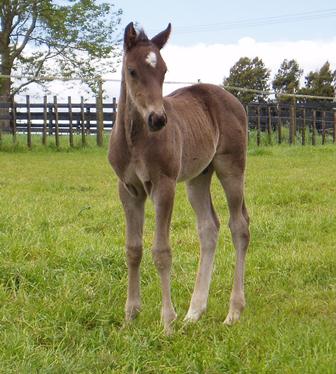
Real Desire x Zenterfold colt at 3 weeks – a half brother to the very speedy Tintin In America who is now standing at Nevele R Stud.

I’d like b4breeding blog readers to be the first, apart from myself and close friends, to see Milo.

He was born 17 October 2012 so is just a few weeks old now. Initially, all you could see was legs and a head that had plenty of character (I think Zenterfold wasn’t sure if I wanted a dish face, standard straight or roman nose so has given me a bit of everything, but time will tell).

He’s a very  light colour, and that means he will probably turn out dark brown – his dam is dark brown (looks black at a glance but not).

I’m excited about this foal. I went for Real Desire for quite clear reasons – my observations about what the sire adds in terms of precocious speed from a line (sons of Life Sign) that is not tending that way. He is forging a very good record as a sire overseas and now here (from limited crops). So it was important to examine how the mare would connect with him. I believe she does, and I am keeping up my “engine room” decisions as well (see my recent blog if you are not sure what I mean) – you need those hard working genes cranking up the revs for the sire to ignite the engine and give it the gun!

Hello Milo!

Ray Chaplin from equineexcellence.biz, an Australian breeding consultant, has produced two reports lately which may be of interest to many.

One report looks at why New Zealand bred sires seem to be making more success in terms of excellence at stud than Australian based sires – the old sports rivalry of All Blacks vs Wallabies (rugby) and Silver Ferns vs Diamonds (netball), but in this case the rugby results tend to reflect the successful sire results, with New Zealand getting an edge. Coincidentally one of New Zealand’s best sires of the modern era is Christian Cullen, named after a very quick thinking, quick stepping New Zealand All Black rugby player.

Ray’s second report looks at an Australian sire Classic Gary that he identified in his first report as being an exceptional Australian-bred sire. Why was he so successful and others not?

What I like about Ray’s reports (available free online through this web address:   is that he has put a lot of thought into developing way of assessing the attributes (genetic compatibility and a range of performance standards) of mares and sires to come up with probabilities of success.

Now, I can’t say whether I agree with his algorithm or not, because it is commercially sensitive and therefore the genetic side of things remain “the Kentucky Fried Chicken recipe” – out of our ken, but results indicate customer and investor satisfaction!

On that topic, Ray has recently published another (free) report, showing his success rate statistically. Tip o’ the hat for that, Ray!

Ray’s reports are recommended as well researched and thoughtful (which is the “think b4 breeding” part of my blogsite name)  if frustrating reading that helps provoke us breeders to be more focused in our decisions.

While you are there, ask Ray to add b4breeding.com to his list of recommended websites – I know I don’t offer a pedigree matching service, but hopefully I get people thinking for themselves.

My algorithm for breeders is more about empowering you to do it yourself:

1 + 2 + = + $ + V + U + ?

Which translated means:

1  What the mare brings to the table, plus
2  What the sire brings to the table, plus
=  How those complement each other, plus
$  Your budget and what’s good value
V  The added value of how you raise the foal
U  Your goal – what you are aiming to succeed in, plus
?  An element of luck.

I believe that learning and thinking about each part of this equation will enable breeders to improve their ability to breed successfully. If I was revising the order of this equation I would probably put the “U” right at the front, because a I’ve mentioned before, what you are breeding for is a key decision that can set parameters on several other decisions you need to make.

Now and again, I like to blog on some of the horses who are creating a lasting legacy as a broodmare sire, even if they could not create or continue a siring line themselves. Tar Heel is the classic. If you look at the usual “family tree” of the sons of Hambletonian, the Dictator siring line is virtually a stub. And yet the influence of that line via Billy Direct and his son Tar Heel is still potent in the structure of many of our best performing horses and top breeding lines today. Another Hambletonian siring line “stub” is Bert Abbe/Gene Abbe – but again, Big Towner’s influence as a broodmare sire is reaching far down in some of the best breeding lines of the modern era.

Overtrick is another example. He sits in the Hambletonian family tree under the Happy Medium siring line, a very interesting line that includes Peter The Great and Volomite, and  has kick started again for pacers via Sampson Hanover (a son of Volomite), who was the grandsire of Direct Scooter. That siring line has caught alight in recent times thanks to Matts Scooter and In The Pocket. It is a line that historically stands out for its prowess in producing top broodmare sires – in reference to my previous blog, great workers in the engine room of pedigrees.

Overtrick is a great grandson of Volomite. He was a brilliant two year old and continued to be a top race horse through his 3 and 4yo seasons, setting 8 world records along the way.  By New Zealanders he is remembered for his battles with Cardigan Bay (one race was in front of a crowd of over 35,000 people at Yonkers!)  He was an adequate sire, producing tough, sound horses rather than passing on speed. After 10 seasons at stud in the States without leaving anything really outstanding, he was bought by Australian interests.

John Bradley (“Modern pacing sire lines”) notes that Overtrick was definitely a better sire of colts than fillies, but many of his daughters have become fine broodmares.  A few of them have ensured Overtrick’s enduring contribution to great pacing bloodlines in both hemispheres – as the damsire of No Nukes and Falcon Seelster, and grandamsire of Cam’s Card Shark and Christian Cullen, to name some of the most notable ones.

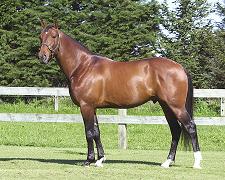
Christian Cullen, Overtrick grandam

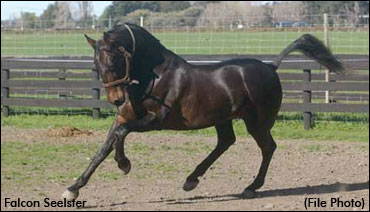
Falcon Seelster, Overtrick dam

I would be keen to hear from those blog readers in Australia who can throw some light on how Overtrick was received there, and on his Australian record (as a sire 521 foals, 239 starters, 173 winners/as a damsire 1482 foals, 708 starters, 454 winners). It’s not bad, but it is not outstanding. Has his influence in Australian maternal lines turned up at any stage? Or was there a lack of compatible sires available when his daughters were needing them? My personal guess was that Overtrick mares may well have done better with some of the well bred imported sires we were standing at the time in New Zealand.

In New Zealand the incredible contribution of Falcon Seelster and Christian Cullen to our maternal lines will keep Overtrick’s influence alive for a good while to come, and give breeders some interesting choices with sires like Real Desire, Santanna Blue and others with No Nukes in their maternal pedigree now available.

What makes Overtrick tick? John Bradley points out that Overtrick’s first five dams are 2:00 producers, and this includes mares foaled from 1927 to 1954 – quite an accomplishment in that era. His grandam is Barbara Direct, a Billy Direct mare, and Billy Direct is another excellent broodmare sire who would have added value to that strong maternal line.

One of New Zealand’s top breeders, Tony Dickinson of Alta Dream Lodge, has kindly provided his observations on Overtrick and the family of Barbara Direct:

My interest in Overtrick’s place in modern day pedigrees stems from looking to double up the Barbara Direct blood carried by Ballie Hanover, a mare I imported quite some time ago from the USA. Barbara Direct has established an influential branch of the taproot mare Minnehaha, and I recall reading an article in either Hoofbeats (probably) or Horseman and Fair World (possibly) singing her praises as a remarkable progenitress – sorry but I can’t find the article but think it was penned a dozen years or more as comment on some annual statistics. However, her blood turns up frequently, particularly via a son, Bullet Hanover and a grandson, Overtrick. Bullet Hanover,by Adios won the 1960 Little Brown Jug and while a champion pacer of his day, did not sire any horses as good as himself. His legacy flows from his fillies in the broodmare barn.
Jennas Beach Boy descends from Barbara Direct maternally. Again, he was an out and out champion who left no siring sons of note. Nevertheless ,his progeny have performed well on the racetrack.
Overtrick also won the Jug, in 1963 and history has recorded numerous head to head races with Cardigan Bay. However, he has not created his own siring dynasty. His son Mark Lobell came to NZ as an unraced stud – he was moderately successful in that department but did feature more as a broodmare sire, I think.
Western Hanover has two strains of Barbara Direct-on the paternal side through No Nukes and,more importantly in my view via Bullet Hanover who,  as the maternal grandsire,was in a position to influence (and probably did) the transfer of the X chromosome to this great sire.
Champion stallion,Christian Cullen through an Overtrick granddam has Barbara Direct well placed to influence the passing on of the X chromosome the progeny of his fillies. In my view, Cullen’s legacy will eventually include an outstanding record as a broodmare sire.
For my own part, I retain two descendants of Ballie Hanover, a daughter by Christian Cullen in Millview Ava who has just foaled a Real Desire filly (three strains of Barbara Direct). And a two year old filly by Elsu called Alta Michaela, in work with Mike Berger, who has four strains of Barbara Direct via Overtrick (twice), Bullet Hanover and Beauty Hanover.

Some theories to reflect on………….

In one of my early blogs (originally an article for Breeding Matters magazine) I outlined my approach to pedigree matching by using analogies from cooking, knitting and land use mapping to explain what I meant.

In this blog, I’m throwing a another strange analogy into the mix – the pedigree of a horse as a steam engine.

Building the power of your mare’s family.

Que?

Visualise the pedigree of a horse as the engine room of a steam train. That’s where you find the hard working genes of quality mares, sires and damsires stoking the boiler that will keep a family performing consistently on a foal to winner basis, and over many generations. These are the hot, sweaty, muscular genes that are heads-down/butts-up scooping the coal into the furnace so that the resulting foals can produce results.

These genes  (and I’m not just referring to the heart size/ “x factor’) provide the two most important elements of great performance – power, which in turn drives speed. It’s something that can be build up and maintained over time, with the right pedigree matches – keeping the fire stoked, as it were. Or the furnace can be allowed to die down, and strong families run out of steam due to poor breeding choices over a few generations and it can take one helluva effort to get those coals going again.

The other two key elements of a family’s great performance – temperament and conformation – might be visualised as the domain of the engine driver, tapping into the power from the boiler and regulating how it is used, ensuring the mechanical parts of the train are well oiled and working correctly, and steering the train from stop to stop (or foal to foal) along the track of time.

There is much debate about where a horse’s temperament and conformation mainly come from. It’s not as black and white as y chromosomes and x chromosomes, and it’s not as simple as nature or nurture. Anyone who breeds knows that some foals will have a similar temperament to their dam, others seem to take after the sire. Some sires “stamp” their foals more than others, and some dams do the same. And often you get some aspect of a foal (markings are the visually obvious one) that is a throw back to the past or seems to come out of the blue.

But there are things a breeder can do to maximise the chances of improving conformation and avoiding bad temperament traits – some by breeding choices and some by the way a mare/foal are managed. I recall wise words from Andrew Grierson and Sandy Yarndley when I did my articles about ‘stamping’ – warning about blaming or crediting too much about temperament on the sire, with Sandy noting that the temperament of a foal is often more influenced by the people who handle it,  and Andrew pointing out that the foal spends much of its formative months with the mare, and she is likely to be more of an influence on the foal’s temperament than the sire’s genes.

So in a way, the breeder’s role is to make “engine room” choices that keep the fire crew strong and happy feeding the boiler, and “engine driver” choices that maximise the chances of staying on track to your desired destination.

Toot! Toot!

Or as a favourite childhood book of mine, Margaret Wise Brown’s “The train to Timbuctoo” put it: “Slam! bang! grease the engine, pull out the throttle and give it the gun!”

It’s breeding time, and it can be a hectic, nervous time for breeders.

But here’s something to put a smile on your face, if you haven’t seen it already: