Feeds:
Posts
Comments

Archive for the ‘Standardbred breeding’ Category

Part 3 of this Feelgood mini-series looks at Mr Feelgood’s siring prospects. He is standing in New South Wales, Australia, and only available to Australian breeders this season.

I love what he offers as a sire, pedigree-wise and his own attributes.

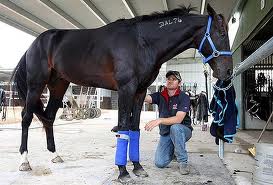
He’s not a big, striking type of horse – more medium, athletic, and quite fine boned. He has thrown to his dam’s side and to Jate Lobell (who developed a reputation as a sire of speedy earlier types) than to his sire Grinfromeartoear. Grin of course can leave them big, small and inbetween, but Mr Feelgood doesn’t have much at all of Grin in his physical appearance that I can see – definitely not that Grin head! I would expect Mr Feelgood’s progeny to be naturally earlier types than Grin’s often are.

Mr Feelgood combines the great Golden Miss family through Grin, and the great K Nora/Adora family through his own maternal line – what riches there, with many echoes in the maternal lines of damsires in Australia – Life Sign, Red River Hanover, Panorama, Safely Kept etc.

John Coffey of Alabar Australia is a man who has kept the faith re Mr Feelgood over a period of time, and has kindly shared the story. John has a lovely way with words, so I will simply quote him below – not as a marketing push, but as a tale of belief in a stallion.

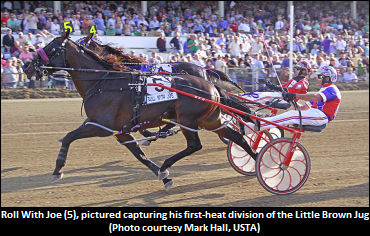
Graeme Henley [Alabar New Zealand] and myself have been been visiting North America for the past 7 or 8 years , usually around late May / early June. In 2007 we visited Brittany Farms in Kentucky where Mr Feelgood was two thirds of the way through his first season at stud. He had won the Little Brown Jug in September 2006. We were both highly impressed with the horse as a type – just a glorious athletic individual. We did even engage in conversation with Art Zubrod , the Manager of Brittany, about the prospect of Mr Feelgood being sold down under as Stallion prospect.

At that stage Mr Feelgood was predominantly owned by the group of people who had raced him the year before. However Kentucky is not really the State in USA to stand a Stallion to give him a great chance – there is only limited racing and not that many mares – there are hundreds of beautiful Farms , but not many keeping Standardbreds.

Anyway Mr Feelgood only attracted around 30 to 35 mares in that first year , resulting in 23 Foals . The owners then decided after the Breeding season had finished to put him back into training and he made a return to the Racetrack in late 2007. From memory he raced very successfully into 2008 until around May or June and somewhere around that time or shortly after , the Southern Hemisphere connection came into play. The Butt Brothers and Aussies Kevin Seymour and Peter O’Shea purchased Mr Feelgood to race down under. As you may recall he had his first Aussie start in the Bendigo Cup in January 2009 – second start won the Shepparton Cup , third start ran second in Ballarat Cup and then in 4th start won the Hunter Cup. Couple of months later he became the first horse to defeat Blackie [ Blacks A Fake ] in the Inter Dominion Final.

Although we hadn’t pursued Mr Feelgood after seeing him in June 2007 , we were delighted and so impressed with his ability to adapt to the Aussie style of racing and to win a Standing Start race over 3200 metres (the Interdominion) was a real feather in his cap.

A couple of months after the Inter Dominion Final , both Brett [son Brett Coffey] and myself met with Kevin Seymour in Brisbane to discuss a future Stud career for Mr Feelgood. At that stage Kevin was non committal , which was understandable given the horse’s remarkable return to the racetrack. For the next 3 years we have stayed in touch with Kevin Seymour always expressing an interest in having Mr Feelgood in an Alabar Stallion paddock one day. Well that day has now arrived.

Apart from Feelgood’s obvious race record , he is a superb individual and has an unbelievable temperament for a Stallion – Tim Butt and Luke and John McCarthy can give plenty of testament to that. The other massive string to his bow is his Female line. I believe many experts around the World regard the pedigree tracing back to K Nora and then further to Adora and Romola is the best of the best. Mr Feelgood’s dam is a half sister to Western Ideal and a daughter of the millionaire mare Leah Almahurst. I’m sure I don’t need to rave on for the next hour about its credits – you would be well aware.

So that in brief is how Mr Feelgood found his way from Brittany Farms in Kentucky as a foal to Alabar in Aussie. He is still owned by Kevin Seymour and Peter O’Shea.

I believe he will have the ability to Sire early 2yo’s with speed – although he won some races by leading or breezing , I felt he raced best off a helmet when he could display high speed. He did have 26 quarters in him.

John Coffey also has some interesting comments on type and observations of the experimental crop of foals he left in Australia, now just turned 2yos.

Mr Feelgood must have thrown to the dam somewhere – he is very fine boned , canon bones about the size of a small wrist and smallish feet. I remember commenting to John McCarthy not long after he had taken him over that he didn’t look anything like Grin. John said at the time he was worried about the size of his feet and whether he would stand up to racing on the hard tracks , but sure did pretty well.I think his action where he tended to glide across the ground was a big help in his soundness.

I have been visiting Kevin Seymour’s property around Toowoomba on the Darling Downs in Queensland for 3 or 4 years now – an annual pilgrimage to Queensland, and the people who run his property Peter and Leanne Bell are such a nice couple. In 2011 we were shown the Mr Feelgood weanlings that Kevin had bred with some frozen semen – was very impressed with them as types.

So this year when I visited the Farm , those same 6 yearlings now were there , having been broken in and back at the farm for a spell. They really do look very athletic types and you can imagine all of them making it to the races as types at least. On the Saturday night I was at Albion Park for the Queensland Derby and was introduced to the guy who broke the 4 Mr Feelgood fillies in, and he put a big wrap on them – great pacers , great attitudes etc. I know it is only early days , but these Yearlings do give you a good feeling about Breeding to him.

We have decided this year at least just to breed mares in Australia – he will probably breed a book of 120 to 140 this year and see how he goes, that’s assuming he gets that many Bookings – will be disappointed if he doesn’t.

Thanks to John for sharing that information. I’m outside my comfort zone when considering Australian mares, as I don’t know enough about their type and families. The Alabar website comes up with a wide range of mating hints and possibilities (as studs usually do) although I don’t personally follow the “sons of” logic.  Mr Feelgood has a pedigree that is open to a lot of mares –  and those with Abercrombie and/or Cam Fella in their genes may complement Mr Feelgood’s finer side – I like Pacific Fella in particular (Big Towner sitting there to keep the speed factor up). I’d love to see him cross with Mach Three mares! And mares with Most Happy Fella sitting behind them.
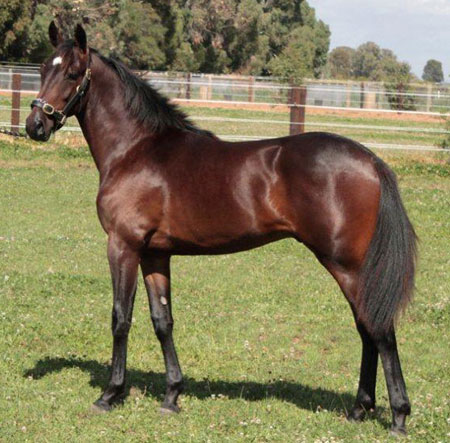
This colt by Mr Feelgood out of Heavenly Grace (D M Dillinger) sold for $9,500 at the 2012 Melbourne APG Yearling Sale.

Mr Feelgood will need ‘luck in the running’ to make a mark as a sire in such competitive and tight breeding times. His first yearlings (3 fillies, 1 colt) sold at the APG Sales earlier this year at okay prices in a fairly difficult economic climate. The photo here of the colt (from a D M Dillinger mare and bred by Benstud Standardbreds) looks a nice athletic type, not unlike his sire.

I hope Australian breeders give Mr Feelgood a chance – and that at some stage New Zealand breeders get the opportunity to breed to him as well.

Just a note to add to this blog – I think one of the challenges Mr Feelgood will face is our ‘downunder’ preference for what you might call the “Christian Cullen” type of horse (particularly yearlings), the strong, bolder and bigger looking yearlings. The finer “North American” type of yearling can still struggle to overcome ingrained preferences regardless of the sire’s credentials. Mr Feelgood looks a handsome, medium sized horse, and a very athletic type himself. I noticed a ‘racey’ type of foal in some of the Shadow Play weanlings I’ve seen to date, and of course In The Pocket was like that himself and often threw a finer, athletic type of progeny).  They are well worth a punt by breeders particularly when the sire is like that and has shown all the strength, toughness and durability a buyer could ask for, as well as the speed you might expect.  And of course athleticism and speed make a great complement to a bigger mare or mares from sirelines like Cam Fella, or with Cam Fella in their damlines or indeed Christian Cullen mares!
Read Full Post »

This is part 2, following my previous blog, and a part 3 is coming….(Yes, I intended to get it all written today, but I got completely diverted building another chook house in the rain. I wish weekends were longer!)

In my last blog I recalled Mr Feelgood’s Little Brown Jug win, and the fact he had then gone on to an exceptional career as a mature horse – he earned over $3 million from a 2yo through to a 9yo, racing in three different countries and adapting to completely different hemisphere styles of racing.

What he has earned, in addition to the money, is a huge amount of respect.

And that, in my view, is one of his strengths as he takes on all comers in the race for success as a sire.

Because standing as a sire is just as competitive and challenging as any part of Mr Feelgood’s racing career.

There are many other horses who have similar attributes – a solid maternal family, closely related to excellent horses, performance statistics that confirm both speed and toughness at the highest level…

But as far as I am aware, there are very few horses that has achieved what he has – two successful careers at the top level, one in the northern hemisphere and one in the southern hemisphere, and in races that even on their own would have earned him the respect of trainers, punters and breeders. Combine Mr Feelgood’s achievements in one curriculum vitae, and you can see why this horse is so exceptional.

Mr Feelgood

Trainer Luke McCarthy runs his eye over 2011 Len Smith Mile hopeful Mr Feelgood at his Cobbitty property yesterday.
Photo: Jonathan Ng

The only hiccup in Mr Feelgood’s racing record is that his initial sojourn in New Zealand in 2009 was not particularly successful, as he came to terms with the new environment and, under Tim Butt’s guidance, learned a new style of racing. His southern hemisphere career has been mainly based in Australia, with the McCarthys, and that is where he has built an enduring and successful second career at the very top echelon of open class racing. (He did return to New Zealand on a raid from Australia in 2011, when he came 2nd in the Auckland Cup and 4th in the Christchurch Interdominion Finals.)

Raids to another hemisphere always capture interest. The incredible journeys of Graham Pearson and Under Cover Lover, of Graham Brunton and Lyell Creek, of Mark Purdon and Pride Of  Petite, are some New Zealand examples from the past 20 years or so.

But as Auckland Reactor found, it is quite a different thing to move from one hemisphere to another and build a second career there at the very top level.

There is one great New Zealand horse that has achieved it, and that is Cardigan Bay in the 1960s. He won the very top races in 3 different countries (NZ Cup, Auckland Cup), and in Australia (Interdominions), and then moved to North America at the age of 8 and over the next 4 years he beat the likes of Bret Hanover and Overtrick, and was twice US Pacer of the Year – there’s plenty about “Cardy” on the internet, just google Cardigan Bay and refresh you memories of this truly great campaigner!

[In hindsight I would add Lyell Creek to the list of those horses that made top level careers in two hemispheres – he was in Nth America for two years and competed against the top trotters, winning or placing many times.]

Mr Feelgood has something Cardigan Bay and Lyell Creek (both geldings) could not achieve – the opportunity to become a successful sire.

Remarkably, Mr Feelgood has already had two shots at it, once when he was first retired in America and once with frozen semen while he was still racing in Australia – for some very interesting and promising results.

In the United States the entire served a book of mares 31 which produced 25 live foals. From the small crop he has left three $100,000 winners to date, two of which won the Colts and Gelding and Fillies 3YO divisions of the $250,000 Kentucky Sires Stakes Finals, namely I’m Feelin Good and Feels Good. Then when Mr Feelgood was racing in the southern hemisphere he produced 17 live foals through frozen semen, three have since died and the remaining 14 turned 2yos from 1 September this year.

Mr Feelgood is standing at Yirribee Stud in New South Wales but under Alabar’s management.

In racing “world champions”, “sensational”, and many other marketing hyperboles are all too common, Mr Feelgood has proved he much more than a Little Brown Jug 3yo winner. He is, in my view, an exceptional racehorse.

Will he be an exceptional sire? In my next blog I’ll look at that, and share some insights from Alabar’s John Coffey.

Comments always welcome – and examples of other horses you know of who have had top level careers in two hemispheres.

Read Full Post »

Only a week to go to the Little Brown Jug!

Six years ago I was on track to see Mr Feelgood win the Jug. This post and the next one tomorrow are a ‘tip o’ the hat’ to that wonderful event and to a wonderful horse – who is now tackling his next challenge, to become a successful sire.

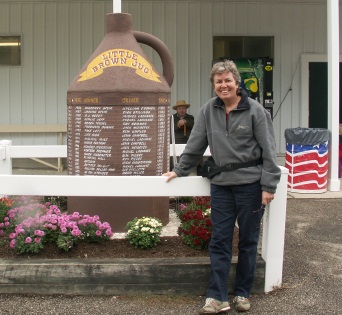
Bee Pears alongside the Little Brown Jug

Bee Pears alongside the Little Brown Jug

2006, a fine but cool late September day in Delaware, Ohio. The wind on track made me buy a souvenir polar fleece jacket to keep warm.

We found our online-purchased “seats” in the grandstand, indicated by numbers painted along the narrow benches at spacings which were optimistically close. Luckily our ‘neighbours’ were Don and his friend, great guys who,  like many at the Little Brown Jug,  booked the same seats each year, a tradition. Don was informative and friendly, and kept an eye on our gear and seats while we went exploring.

Kym Kearns with our friendly Little Brown Jug neighbour Don.

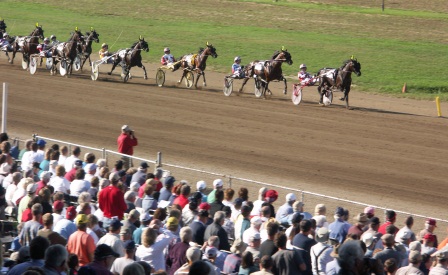
The Little Brown Jug is two days of experience I’ll never forget – and definitely recommend. It is a huge meeting – about 50,000 people descend on the small town of Delaware for the Grand Circuit Racing County Fair that features the Jugette (for 3yo fillies) on the first day and the Jug (for 3yo colts) on the second day, some other good stakes races and a lot of local fields.

The atmosphere is like a Motukarara Gold Nuggets day but 50 times bigger. It’s laid back, but electric. It’s country, not town. It’s casual, but incredibly well organised. Go to their website and you can tell that it retains an identity which avoids the sophisticated PR promotion you might expect for such a big occasion.

It is a great tradition – and a lot of fun.

You can walk all around the half mile oval – on the side opposite the grandstand, the back stretch, is an area where people have their own deck chairs – you get a great view of the horses coming out onto the track, and it is a popular social area. Hot dogs, burgers and goulash-type meals dominate the food hall area under the main grandstand and dotted around the course. Many of those attending stay in motorhomes parked in the county fair grounds – which would have been a better and cheaper option in hindsight than the Delaware hotel we booked in advance.

I wasn’t a close follower of North American racing, so many of the Jug elimination heat participants in 2006 were just names to me – but of course they are more familiar now – Jereme’s Jet, Armbro Deuce, Total Truth (all sires now),  and of course the eventual winner of the Jug, Mr Feelgood. Also racing on Jug and Jugette days – and winning – were Ponder, a very classy performance in 1.49, and the very good Bettor’s Delight 2yo filly Isabella Blue Chip (a US$40,000 yearling purchase who went on to earn just under US$800,000) and Bettor’s Delight Jugette winner Eternity’s Delight, who was owned by well known American breeders/owners Jules and Arlene Siegel – and it is worth quoting Jules Siegel on the Little Brown Jug as an event:

The Jug is a throwback to what racing was and should be today. The Delaware County Fair is the most exciting event in (harness) racing. My wife and I bring guests to Delaware each year who are not even involved in harness racing and they enjoy the racing as much as we do. Everything about Delaware is a credit to the sport.

Little Brown Jug 2006

Big crowds, big excitement at the Little Brown Jug
Photo: Bee Pears

The county fair is in Ohio, which is a backwater in terms of top level racing and breeding, apart from this event. It is, however, a state where many bread and butter horses are bred and raced, with its own yearling sales (which we went to, and noticed the quality of the Pegasus Spur yearlings), and a number of sires standing locally or nearby who are not in the top league but popular and affordable for the state breeders. So the large proportion of horses competing over the 2-day county fair meeting have breeding much less familiar to us than that of the horses in the Jug, Jugette and other $50,000 plus stakes race fields on the day. These local sires in 2006 included Nobleland Sam, Stand Forever and Precious Bunny for pacers, and Master Lavec and Ilooklikemymom for the trotters.

In New Zealand we place high value on the Little Brown Jug as a true test of qualities we like to see in a sire – toughness, speed and heart (they race twice within the same afternoon, with three elimination heats producing the nine horses for the final, all over a mile of course and the tight half mile Delaware track). Some winners we admire in Australia and New Zealand include Armbro Operative, Fake Left, Life Sign and Bettor’s Delight, while more recent Jug winners in our siring ranks include P-Forty Seven, Shadow Play, Well Said, Rock N Roll Heaven and now Mr Feelgood.

On Jug day in 2006 we watched Mr Feelgood take out his elimination and then the final in grand style. In the final he was sitting behind Armbro Deuce on a fast pace that stretched the rest of the field, then came off the back of the leader as he started to tire, and blasted to the front with only Cactus Creek looking vaguely dangerous.

I have to confess my money was on 14.2h Doonbeg from Toronto, a very small horse with incredible ability who came last in the final, but has gone on to a fascinating career in Britain (in 2010 breaking the world record for the fastest mile on a track LESS than half a mile).

Of interest, Jereme’s Jet never made it to the final, having been burned in a 25.4 first quarter speed duel with Armbro Deuce in his elimination heat (the third heat) , so that makes Armbro Deuce’s performance for second in his elim and third in the final even more remarkable given the short timespan between those two races.

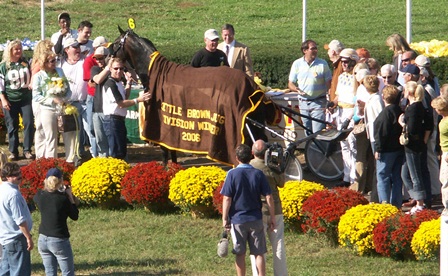
Mr Feelgood in the winners circle 2006

Mr Feelgood in the winners circle, 2006 Little Brown Jug
Photo: Bee Pears

Mr Feelgood is a class act – he was on that day, and he has continued to be so in achieving outstanding results in two different hemispheres – with two different styles of racing over different distances.

The qualities that allowed him to win the Jug are the same qualities that enabled him to win the InterDominion Final and the Hunter Cup in Australia as a 6yo, and heats of the Interdominion at 8 and 9 years old. (See summary of his racing record)

The training feat by Jim Takter (USA), Anthony Butt (NZ) and then John McCarthy (Australia) played a large part in maintaining the will to win and soundness of Mr Feelgood over such a long and varied racing career.

In the next blog, I look at Mr Feelgood’s attributes as a sire – and share some frank observations and stories from John Coffey of Alabar Australia, where Mr Feelgood is standing.

Read Full Post »

Frank Marrion’s great summary of the 2012  trotting Australasian Breeders Crown winners (in the 29 August Harness Racing Weekly)  throws up another cross-breeding success. See previous blog.

In the wake of the very good (and unusual) Googoo Gaagaa in USA, we have Blitzthemcalder in Australia!

Blitzthemcalder – from a trotting mare by a pacing sire (photo: Herald Sun)

The winner of the 2yo Australasian Breeders Crown Trot is “looking like some sort of freak,” writes Frank Marrion, “being a big and bold-going black colt by the pacing sire Metropolitan from the family of Maori’s Idol.”  Metropolitan is an fairly ordinary pacing sire by Panderosa-Tallulah Belle, by Artsplace.  Blitzthemcalder’s dam is the first foal from the unraced Like A Calder, a daughter of Balanced Image and a good trotting mare in Maori’s Dream.

You can read the full article on p13 of the New Zealand Harness Racing Weekly Vol 27, August 29, 2012 (unfortunately not available online as yet). Or if there is enough interest expressed I will see if I can arrange to reprint it here.

Read Full Post »

A few blogs ago I described two vary different racehorses (later to both become very successful sires and damsires), Spencer and Scotland. Spencer was a big, lanky horse; Scotland a sleek medium sized one.

This same pattern occurs in several famous pairs of horses who later became excellent sires and damsires –

  • Tar Heel and Adios;
  • Most Happy Fella and Albatross;

In all these cases the first of the pair was a bigger, rugged type and not the smoothest gaited horse, while the second of the pair was the smaller handsome one with the gorgeous gait.

As I said in my blog about the three very different Jamaicans in the Olympic 200m final, speed and greatness can come in very different packages.

And although I often talk about the advantage of having a great gait (what I call ‘gait speed’) it’s good to be reminded of champion horses who didn’t have that advantage but delivered brilliance anyway – on the racetrack or in the siring shed or both.

In the chapter on Tar Heel in John Bradley’s “Modern Pacing Sire Lines” he describes Tar Heel like this:

A big-headed coarsely made horse who was not especially good-gaited….One of the racing scribes of his era commented on his gait by saying “It was hard to tell what he was doing, but we called it pacing.”

Adios, on the other hand was a stunningly handsome horse, medium sized with a beautiful fine head – and very good gaited. (I found this great article about Adios’s career in Sports Illustrated May 14, 1962, when he was still alive at 25 years of age.)

Of course these two horses are present in so many pedigrees – the Golden Adios/Tar Heel Cross. See this good article in Sports Horse Breeder website that looks at some of the genetic reasons this was a good combination – but just their complementary attributes and physical types must be a key factor.

Most Happy Fella – big and rugged

Most Happy Fella was a big, rugged looking colt who was bothered through his career by a hock injury, leading to a somewhat rough-gaited style of going. In fact trainer/driver Stanley Dancer is quoted as saying:

What a nasty horse he was to drive. You never knew when Most Happy Fella was going to make a break. He went with such a tight hobble, and he still felt like he was going to put in a step. I was surprised he was such a great sire. He sired some good-gaited horses.

Many of Meadow Skipper’s racing sons were big, bold horses – and Most Happy Fella also had a big dam (Laughing Girl), surprisingly a Good Time mare because Good Time was under 15h himself and often left smaller horses.

Albatross, on the other hand, was an atypical son of Meadow Skipper – he stood only 15.1h but with a long-barrel and “an unattractive head which seemed very disproportionate to the remainder of his conformation.”  He was a very well balanced horse, however, and his gait was superb.

Albatross’ hallmark, and his greatest contribution to the breed, was his gait. Dancer believes that Albatross could have raced free-legged, such was the purity of his motion. It was free-flowing, solid and allowed Albatross to carry his speed through three demanding seasons.” (John Bradley)

These four fantastic horses illustrate just how different the qualities of top horses (and top sires/damsires) can be.

Read Full Post »

It’s finals day. Timely to remember two Kiwi horses who won 3yo Breeders Crowns and are now at stud here – Changeover and Tintin In America, both at Nevele R.

Two quite different horses and both offering a lot to New Zealand and Australian breeders.

Changeover is a big powerful fellow (16hh) who was okay as a 2yo but really blossomed at 3yo – 5yo into such a tough stayer who always gave his best, a Cups winner. In The Pocket out of a Vance Hanover mare. Standing at NZ$4000. Good fertility.

Tintin In America, smaller type (15.1), incredible speed and mentally assertive and tough. He was outstanding at 2yo and muscled up as a 3yo and 4yo to become a very consistent competitor in top races, including winning 5 Group 1 races. His win in the Messenger and 2nd to Monkey King in the Auckland Cup hinted of things to come, but he was retired due to a reoccurring injury. McArdle out of an In The Pocket mare. Standing at NZ$2250. High fertility.

Both these sires have solid proven maternal lines and are well positioned to cross with a range of mares. Of course there is a prevalence of In The Pocket and Falcon Seelster blood in our broodmare pool that rules out some mares for Tintin In America (although I wouldn’t be averse at trying a Falcon Seelster mare)  but makes him very suitable for others – I’d love to see some Armbro Operative, Badlands Hanover and Live or Die mares heading his way – and Art Major or Perfect Art mares could suit. And mares that carry Soky’s Atom/Albatross in their bottom line. His maternal family loves great old blood – Breath Of Spring, Old Maid etc.

Zenterfold, Tintin’s dam, is medium sized herself and throws foals of different sizes; small foals are not a feature of the wider family (also his sire McArdle is 16hh), so I would not expect him to necessarily leave smaller types. But I do believe he will bring speed to the party, as it is in his genetic makeup from several different sources.

These are two great horses from our recent racing past. It has never been easy for outstanding local racehorses to convert themselves into top commercial sires here – but I would love to see these two stallions get a damn good chance to do so.

Read Full Post »

There are plenty of examples of full and half brothers standing as sires, but very few where two or more brothers have made the grade as outstanding commercial sires. Will recent arrival Roll With Joe, full brother to Bettor’s Delight, be an exception?

In New Zealand and Australia, the ‘brothers at stud’ situation has usually involved an imported brother to a top sire we have not been able to access with our mares for one reason or another – an example is Chill Factor, the brother of Artsplace.  With frozen semen and shuttling much more common now, this reason is less prevalent. The other common situation is when a good (but less well performed or known) brother stands at a much cheaper price than the ‘original’ in the hope of capitalising on the glow factor and drawing breeders in a different price range – an example is Extreme Three/ Mach Three, and Julius Caesar/Christian Cullen who are standing (but not really competing) in the same market.

To be top performing racehorse is hard enough, but to be a top sire is even harder. And to get progeny from one mare that can achieve both these things more than once is exceptional.

Four sons of Rich N Elegant have tried, but not succeeded in terms of siring careers at the top end (Western Hanover full brothers Rustler Hanover, Red River Hanover, Richess Hanover and Righteous Hanover), but their Western Ideal half brother Rocknroll Hanover is certainly making a great job of his chances, and may even be starting his own siring line. I’ve covered more of that in a previous blog series collaborating with equineexcellence’s Ray Chaplin.

Probably the most famous successful example is that wonderful mare Amour Angus and her siring sons Angus Hall, Andover Hall and Conway Hall, who have all performed as credible sires in their own right and are now sires of sires.

Perfect Profile left two excellent performing sons who went successfully to stud – Art Major and Perfect Art, although the latter died before his true legacy as a sire could unfold. Although perhaps not “gold” ranked (on Ray Chaplin’s equineexcellence.biz criteria) Perfect Art was definitely “silver”. Of course he wasn’t directly competing as a sire with Art Major in the same market.

Marketing Joe
The interesting thing about Roll With Joe is that he is being placed in the market at $6000, which means his owners and Pepper Tree Farm are taking a punt on him in his own right. He may well be a less expensive siring option for breeders than Bettor’s Delight, but he is certainly not cheap. In New Zealand, he’s probably competing in a similar market (for type of sire) as newcomers Well Said (at Nevele R, $8000, frozen) and even more so with Big Jim (Alabar, $4,500) as a well proven top end racehorse who could be attractive commercially and may deliver speed.

His mid zone price category is a tricky one, with most of our NZ studs lowering their prices from this level, so his key competition at the same price may well turn out to be his colleague at Pepper Tree Farm, Sportswriter.

Roll With JoeSo is this “Bettor’s Delight but bigger”? Well, he is a bigger horse than Bettor’s Delight, although 15.2 is really only medium sized and both his sire Cam’s Card Shark and his dam Classic Wish were smaller, quick type of horses, so I would not place too much emphasis on Roll With Joe’s bigger size considering his parents. Genes may well dictate that more often than not he will leave medium or smaller horses, and for that reason I would look to bigger mares for him in much the same way that you might add that into consideration for Bettor’s Delight.

At $6000, the idea of “two Roll With Joes for the price of one Bettor’s Delight” would be a risky strategy – breeders with $6000 to spend on their mare will probably be at the commercial end of the market and may be willing to pay more for the proven brother, or breeders that prefer to shop in the mid-range (currently $4000 to $5500) of sires but may be willing to stretch a little bit to get something special – and is Roll With Joe that special as a sire?

His brother or his mother?
I think he could be.  He was a very good racehorse, but what interests me from a siring perspective much more is the recent blossoming of his maternal line thanks to some great breeding choices over the past couple of generations.

Roll With Joe doesn’t have exactly the same genes as Bettor’s Delight – we know from our own human experience that although they share the same parents, siblings can be very different physically and in talents.

What you are getting with Roll With Joe is not a clone of Bettor’s Delight but rather a proven performing racehorse from the same genetic foundation but with his own unique combination of “nature and nurture” factors.

Take the x factor/heart size gene as an example. As a colt he must take his x chromosone from his dam – but she has two x chromosomes on offer, and which one Bettor’s Delight got and Roll With Joe got may not be the same. That’s where the quality of their dam really comes into play.

And what a mother she’s turned out to be. She is the dam not only of top sire Bettor’s Delight (by Cam’s Card Shark), but of excellent racehorse and proven sire No Pan Intended (by Pacific Fella) – and it is her ability to produce horses from different sires who can then succeed as racehorses and as sires that is really exceptional – and a marker of great genes.

 (Quote from article Classic Wish: A Maryland Mare of Distinction by Ted Black.) “I think I got lucky when I purchased her,” says Thompson (Classic Wish’s owner Joe Thompson of Winbak Farm). It was one of those things where I thought she would boost our breeding product because of her speed. Some people may not have taken a chance on her, but in business you have to go away from the norm sometimes and do things that others might not try. It’s worked out for me so far. She’s a great broodmare … and I hope she keeps producing quality racehorses.  What I liked about her was her breeding and her speed,” Thomson said. “She was by [Canadian Hall of Famer] Armbro Emerson and out of an Albatross mare, and she had a mark of 1:52, which for mares back then was very fast. It’s still a good time. She’s one of those mares that has been good right from the start.” Though not a big mare – she stands just 15.1 hands – Classic Wish possesses a long body. During his years in the breeding business, Thomson has discovered that mares built this way often develop into top broodmare prospects. “I think the lengthy mares cross better with many of the sires,” he noted. “[And] the big mares don’t often pan out as productive broodmares.” Thomson also called Classic Wish a “nice” mare. “She’s got a great disposition,” he said. “A lot of mares that raced for years can be nasty, but she’s actually quite pleasant.”

Classic Wish’s sire Armbro Emerson was a very good millionaire son of Abercrombie who won a Breeders Crown at 4yo and took a time of 1.52.3. He become a sucessful sire based in Canada. He’s bred 4×3 to Tar Heel and 4×4 to Adios. His maternal line includes the wonderful racemare of the 1950s Dottie’s Pick and of course Most Happy Fella. Dottie’s Pick traces back to the great Extasy/Ethelwyn family.

So in conclusion, the greatest attribute for Roll With Joe as a potential siring success story will be the strong proven genetic foundation from his maternal side, rather than the more obvious marketing association with Bettor’s Delight. Like Bettor’s Delight, it is a pedigree that should suit a wide range of our New Zealand mares, particularly (once again) the amount of Tar Heel that lurks relatively close up in many of our pedigrees.

When breeders consider going to either of these sons of Classic Wish, what they will get is always partly the roll of the genetic dice. However thanks to the classy foundation of Classic Wish, the dice may be a little more ‘fixed’ in their favour!

In a coming blog, I’ll look at the potential impact of large numbers of Bettor’s Delight mares (and possibly Roll With Joe mares!) in our future gene pool – can you get too much of a good thing?

Read Full Post »

This blog is “Part 3” of an article written by Ray Chaplin and myself for the latest edition of Breeding Matters, the magazine of the New Zealand Standardbred Breeders Assn.  You can read Part 1 and Part 2 in the latest issue of the magazine at the association’s excellent website http://www.harnessracing.co.nz/

The article looks at the sire sons of Life Sign in Australasia  (Island Fantasy, I Am A Fool, Day In A Life, Peruvian Hanover and Real Desire) , and asks the question: Why have they failed to become commercially successful sires, whereas Real Desire appears to be making his mark?

Part 3: Real Desire – speed sire has a rollercoaster start

Real Desire’s first few years at stud here (with Alabar) have been a bit of a rollercoaster ride.
Firstly, he didn’t settle here in his first shuttle season as Alabar’s New Zealand manager Graeme Henley explains:

“Real Desire didn’t handle the shuttling that well in his first season (2007/8) and he was a bit below par after he returned to the US. The owners decided to not send him back for the next season – they wanted to give him a season off to recover and make sure there was nothing seriously wrong with him. Anyway, with the break he was back to his usual health and condition and he has been back shuttling without any problems since.”

He got 202 mares in his first season here. However a year out of the limelight meant he struggled a bit for numbers when he returned to shuttling, dropping to just 68 in 2009 and 52 in 2010. The quality of his mares dropped as well, which meant Real Desire was hovering on a well-known slippery path that many sires have trod before him.

Then his first yearlings didn’t sell that well – “He is a plain type himself and leaves very plain types as a rule and I don’t think the buyers got their heads around this. Even now buyers go for the big, showy Christian Cullens and under value the little plain Bettor’s Delights for example,” Henley says.

However some of the Real Desire’s started showing up as 2yos – and they displayed that rare and highly valued ingredient: natural speed. With Let’s Elope and Cowgirls N Indians getting Group wins and others showing ability, there was a growing sense of a “speed sire” in the making.

Then Cowgirls N Indians went amiss and Let’s Elope went through a flat patch, plus Real Desire had no yearlings coming through the 2011 sales, and therefore no 2yos and only 3yos to fly his flag in the 2011/12 racing season.

But in the later part of the season, several Real Desires were catching the eye as they developed more physical and mental maturity to go with their speed, and Let’s Elope regained his mojo. At the end of the 2011/12 season, Real Desire has had 55 starters for 28 winners which is a good enough record for his only crop here of racing age. The next couple of years will still be awkward for Real Desire as his missing crop is followed by the two smaller crops, so it will be some time before larger numbers of Real Desires hit the tracks again. However his progeny should get better with age, and that will help keep his profile up.

Although yearling sales buyers have been cautious, breeders have seen enough evidence of speed in Real Desire progeny both in his North American crops and his New Zealand foals to take a punt, and (I am sure to Alabar’s relief) he served 212 mares in the 2011/12 breeding season, including my own mare Zenterfold, the dam of Tintin In America.

If you take any direction from his North American “crosses of gold”, Beach Towel, Albatross and Direct Scooter mares do stand out, but he has performed well with a number of others including Artiscape and The Panderosa. Of more interest to Kiwi breeders, his results in America with Falcon Seelster mares (from only a few foals) is poor to date, from Artiscape mares (from 19 foals) is good, and Presidential Ball mares (from 8 foals) is average. These statistics are updating all the time of course, and worth keeping an eye on.

In New Zealand remember Real Desire’s oldest crop is 3yo (at time of researching in late July, so now have just officially turned 4yo on 1 August) with no 2yo crop here at all, but some statistics of interest include:

  • 23 foals from In The Pocket mares, 13 are 3yo, 9 starters and 7 winners.
  • 32 foals from Holmes Hanover mares, 21 are 3yo, 7 starters and 4 winners.
  • 16 foals from Christian Cullen mares, 11 are 3yo, 7 starters and 2 winners.
  • 9 foals from Falcon Seelster mares, 6 are 3yo, none qualified.
  • 8 foals from Presidential Ball mares, 6 are 3yo, 3 starters, 2 winners.
  • 11 foals from Sands A Flyin mares, 3 are 3yo, none qualified.
  • 7 foals from Beach Towel mares, 4 are 3yo, 1 qualified.
  • 4 foals from Artiscape mares, 1 is 3yo, qualified and exported to Australia.

In most cases, the mares we can offer Real Desire have quite a different look from what he is accessing in North America in terms of their maternal lines and damsires, and the results to date look particularly promising for our In The Pocket mares, and I have heard some good reports on his yearlings from Christian Cullen mares too.

Real Desire has two foals as a damsire in New Zealand (by Bettor’s Delight and Sands A Flyin) from one imported mare.

Real Desire’s ability to be a quality sire that can leave speed sets him apart from the other sons of Life Sign who have been offered here. The answer to a large extent lies in his maternal genes. As pedigree analyst Ken McKay points out: “His maternal pedigree, Golden Miss “The Queen Of Gait” and her daughters are a running line and also one that leaves significant siring prospects amongst it’s male members. If you have great gait then the speed will follow.”

Of course that line has also produced sires with too much fizz (Red River Hanover) and more grit than sheer speed (Grinfromeartoear).  However I think the presence close up in his other maternal line of the fast Troublemaker, bringing with him Most Happy Fella and Bret Hanover, helps keep speed in the frame. It’s good to see New Zealand breeders are doing their bit to keep adding that speed element, rather than relying on a sire to do all the work for them!

Read Full Post »

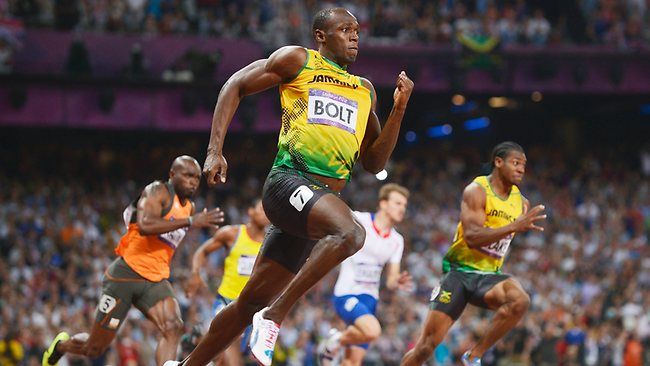
Men’s 200 metres final – what a race! What athletes, and what a beautiful ‘freak’ Bolt is. Jamaicans 1-2-3.

And that’s where my interest lies – what makes them so good at running so fast over short distances? It’s easy to point to the things about Bolt which make him stand out – his height and hence the length of his stride being the obvious ones. I heard him quoted as saying that if he is in front with 10 metres to go no-one can catch him because he covers that 10 metres in 3 strides. It is awesome to see. He reminds me of those beautiful big racehorses with extended loping strides that seem to effortlessly cover the ground. They (like Bolt himself) are often not the quickest out of the gate, but once they get into their rhythm they are glorious and fast.

Yes, all things being equal, size and length of stride are winning assets. But not enough on their own. If the horse (or the person) doesn’t have the physical strength and balance or the mental maturity to match, size can be a handicap. Often those qualities come with age, if we are patient enough to wait. Sometimes precocious talent can be spotted in a big, lanky young horse (or person) and they can even perform well as a youngster, but time is their friend. Bolt is 30 (sorry, incorrect) 25 years old and at his peak, but he was showing huge talent as a much younger man, winning junior world titles. In a much closer to home comparison, you can see some amazing precocious talent in some big young trotters and pacers, and will hear their trainers, owners or commentators referring to them with affection (“big, dumb thing with heaps of raw ability”) knowing that time and experience will add the physical and mental strength they need.

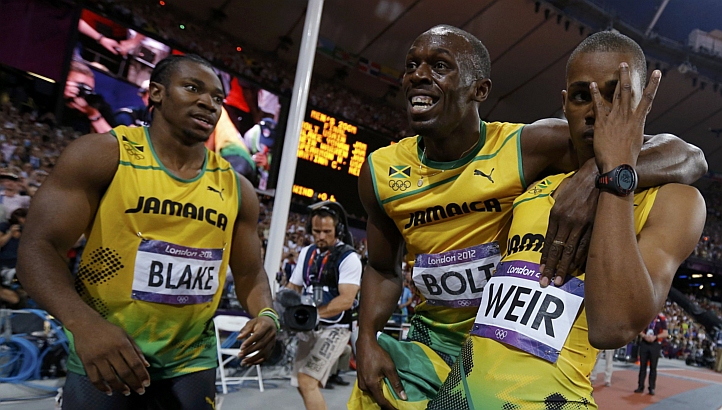
Blake, Bolt and Weir – Photo Reuters

What really interested me and surprised me most was the physical difference among those 3 wonderful medal winning Jamaicans:

Bolt, tall, long limbed, running with a fluency and natural balance that takes your breath away.

Yohan Blake, broad, very muscular upper body as well as powerful legs.

And then Warren Weir, the surprise package – small and wiry, flying into 3rd.

Three Jamaicans, yes, but three completely different body types. All very fast.

Usain Bolt – in the harness racing world we know of many 16 plus hand horses who perform superbly as racehorses and as sires – Western Ideal was 16.1, Artsplace and Rocknroll Hanover, Art Major all 16h, Panspacificflight 16.2h and what a stride! I think he is the one that reminds me most of Bolt. We have had some great examples in New Zealand too – very big horses with massive strides, although several of them have battled soundness problems.

Yohan Blake is more the Christian Cullen style of champion horse – broad chest, big muscular shoulders, strength in his heart to pump very strong (but not exceptionally long) legs.

And then Warren Weir, a Tintin In America type – lean, speed machine. We are not short (if you excuse the pun) of smaller horses who did the job themselves and can rise above the perceptions of their size to become top raceshorses and sires – currently Courage Under Fire (not even 15h) and Bettor’s Delight (15.1h), and in pacing’s history we find ones like Good Time who were so small and so good.

Speed and greatness comes in many shapes and sizes.

I’ve talked before about what I call “gait speed” – the advantage of having a very good gait. This includes a very efficient and clean action, good balance, the strength to reach out in front and to push from the back, and just the sheer length of stride. Great gait delivers speed and soundness – and it is a precious thing to find in a horse. It too comes with all sizes. But as with Usain Bolt, all things being equal the length of stride does give a tremendous advantage.

Right at the start of this blog, I mentioned genetics. I’ve listened to a few discussions on whether the success of the Kenyans in distance running and the Jamaicans in sprinting has a genetic factor. One view I heard on the Jamaicans is the those more recently coming from Africa can tap into a much broader and deeper gene pool with potential for more mutations that can lead to standout variations on the main theme, while those of us who migrated away from that original gene pool a long, long time ago took with us a certain limited range of genetics and thus have been playing in a much smaller pool ever since. I can’t say what truth lies in that – but there are interesting similar discussions to be had on the genetic history of the horse and particularly for us, the standardbred, such as  the mutation theory for the development of the X factor/big heart gene, and the issue of whether we are breeding ourselves into a genetic cul de sac (see the recent blog about cross-breeding, and one I will do over the next month or so on dominant pedigrees in a small breeding population).

The same academic/commentator who talked about the African gene pool viz Jamaican runners, also made the remark that many other factors must play a part in the Jamaican excellence at sprinting, including the “glow” effect of success breeding success, and the sporting culture in Jamaica that makes this and cricket “theirs” in much the same way we might see rugby and rowing, and therefore there are greater numbers of children involved in those sports to start with and talent is spotted at an earlier age, cherished and developed.

My hope is that our increasing emphasis on 2yo racing and on speed is done in that context too – identifying, cherishing and developing talent. Rather than a ruthless way of testing which horses are going to meet the grade or which can show up early for quick gain regardless of the long term cost to the horse.

Getting onto the podium makes all the time and effort worth its weight in gold.

Read Full Post »

Oh yeah, baby. It’s business time. And what many breeders are hoping over the next few months is that their mare will get “in conchord” with the stallion of choice.

Thanks to artificial insemination, chilled and frozen semen and different breeding seasons in north and south hemispheres, our mares and breeders have more options and less stress (and often less costs) than the thoroughbreds. But even so, we know that decisions made now can play a major part in future prospects for us (return on investment, meeting our aims whatever they are) and our mares (increasing their value and the family’s reputation, the risks of breeding). 

So I imagine right now there are many breeders who (after putting out the recycling and cleaning their teeth) are settling down in bed to study the register of standardbred stallions, or the latest newsletter from one of the studs, or perhaps something they found of interest on the web…or like me might take John Bradley to bed for a little flick through the pages. Yes, it’s business time! (For those who wonder what the hell I’m talking about, a little google on Flight of the Conchords, lyrics It’s business time will give you the reference.)

My biggest tip to those who are looking to breed, is to work out what your aims are, what you want to achieve. Without this focus you are sailing without a compass. If you really want to get a stunning price at the yearling sales, or if your goal is to breed a NZ Cup winner, or to breed an affordable bread-and-butter- racehorse for you and your friends to enjoy, then you need to be clear about that BEFORE you make your breeding choices.

That’s the b4 part of b4breeding (as well as being my name Bee) because I’ve learned from even my limited experience how important it is to have clear goals and work towards them. My goal for the mare Zenterfold, for example, is to keep enhancing and building the reputation of the family for delivering very high quality performing progeny. That means my focus is on breeding the best possible racehorses (male or female) that I can, not just the quickest commercial return for myself at the yearling sales. Hence, why my choice of sires so far for this wonderful mare may have some people scratching their heads. Unproven McArdle when he first arrived? Grinfromeartoear twice? Why not Bettor’s Delight and Art Major? (Both of which have credentials for this mare).

While it is lovely to have the choice of so many good sires, choice can be confusing unless you have goals.

The next thing you need to think about (after your own goals) is your mare. Because she, more than anyone else, has the information you need to make a good decision on a sire. Listen to her, look at her, read her record, know her strengths and weaknesses, and be honest about her credentials. And be good to her. If she is worth breeding from, she is worth looking after – before and after “business time”.

The Blue Lotus just born

The Blue Lotus a few days after being born – not pretty but real

I’m lucky (or is that unlucky) this year because I have no choices to make. My mare Zenterfold is already in foal and her next turn lies with Geoff and Aria Small, so I don’t even have to think about suitable sires. Her Grinfromeartoear daughter The Blue Lotus has a first foal deal with the small group of owners who leased her for her racing career. They’ve made the decision to go to Bettor’s Delight and then she returns to me after her first live foal. It’s been a good arrangement that takes the pressure of me financially for the racing period, which I could not afford to do on my own,  but gives those who front up with the money (the leasees) for racing seasons a ‘sweetner” in getting the first foal to sell (or not) from the horse when she retires. It’s all built into the written agreement.

The Blue Lotus qualified as a 2yo, same as all Zenterfold’s progeny to date, and raced very well as a 3yo for a couple of wins and her main claim to fame is a third in the Sires Stakes Fillies Final, chasing home those fantastic fillies Carabella and Under Cover Lover, which makes third place, running on but lengths behind, a lot sweeter! However after a tear in a tendon, she was retired as a broodmare. What she showed in her racing career was grit, toughness, competitive streak… and that’s worth it’s weight in gold. In conformation and size, she took after Grin, and in temperament and speed (1:56.6) I can see Zenterfold.

The next foal from Zenterfold I bred was also from Grinfromeartoear, but a completely different type – quick, early type (Destination Moon now with Gareth Dixon). Which reminds me of Jack Glengarry’s advice: if a mating makes a big appeal employ it at least twice in case the union didn’t fire in the first instance. Given the nature of genetics, it is sound advice, so long as the mix is well founded to start with. I’ve been lucky enough to get a big, strong mare and a quick looking young colt because the sire (Grin) had attributes that click with the mare regardless of particular individual type and the sex of the foal.

It’s a fascinating business – and at “business time” as breeders we are challenged to do more than just tick the boxes. The best steer we can get is to be clear about WHY we are breeding, and WHAT our mare needs.

To be honest, we are spoilt for options for globally known sires once we have have sorted out our own end of “the business”.

For a really interesting, readable account of “business time” with stallions and mares (mainly thoroughbred but includes a chapter or two with really up-close-and-personal observations on Western Hanover, Sierra Kosmos, The Panderosa, Big Towner and others), I recommend “Stud – adventures in breeding”, by Kevin Foley published by Bloomsbury 2002, a “strange and seductive” (and detailed) account of breeding stallions.

You may need to explain to your spouse/partner/occasional friend why you can’t put it down at bedtime!!

Read Full Post »

« Newer Posts - Older Posts »