Feeds:
Posts
Comments

Dia Mia Amore is proving to be a bit of an eye-catcher, with the third win for the filly coming at Bunbury, Australia on Saturday, in 1.56 for the mile race.

The video is up on the Australian Harness Racing results page, and she did it nicely, leading all the way. She is a good sized attractive looking filly with probably quite a bit more development to come, and apparently has quite a strong personality and has tested the patience of her connections! But all that is forgiven when they show potential like she is doing.

Her main aim is the $150,000 Group 1 WA Oaks at Gloucester Park on 6 May. Date for my diary!  Photo of her at second win a week prior, and article on Nevele R website

Back home in New Zealand we had a nice debut for 2nd from Tintin In America colt Junkyard Mase who is from a lightly bred Son Of A Fella mare. He went out hot favourite, showed a lot of gate speed to get to the lead and fought hard to stay in contention on the line. There have been lesser performers of the sire as well, I am not completely blind lol. But it was an ok debut for the 2yo filly Manahiki Pearl for a 5th today at Manawatu raceway. On the replay she looks to be a decent sized filly with a good reach, just lacking a bit of strength but that will come. She is from the good Presidential Ball mare The Black Pearl. Down in the South Island What A Curtainraiser, a 3yo Tintin filly from a Live Or Die mare, is really struggling to find any form at all and the penny just hasn’t dropped after 7 starts for nothing of note, and trainer Kevin James will be disappointed. Earlier she had a tendency to over-race but he has been patient with her because she did show some speed. She was in the same race as Junkyard Mase on Sunday, and came 12th but was only 5 or so lengths from the winner and was trying hard. It was probably her best performance for a while.

And also down south, this time in Christchurch, the Tintin filly I co-own has had a good long break and is now starting a serious prep with Chris McDowell so she will only be getting to races as a very late 3yo or 4yo, but needed that time to strengthen. I’m really excited to find out what she will be like as a race horse!

Romola Hal, like Golden Miss, Spinster, Arpege, and other great foundation mares of the modern era, act like a massive waterfall at a point when a river needs extra energy to carry its quality and volume further downstream. These mares and the sires they clicked with create the deep pool at the base of the waterfall, from which a freshly renewed river and many tributaries flow.
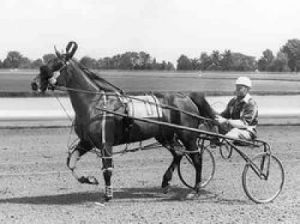
Romola Hal

Romola Hanover with John Simpson snr at Du Quoin in the late 1950s

In most modern pedigrees, Romola Hal will sit 6 to 9 generations removed, but her legacy is so strong that many branches of her line are able to kick up not just good performers but outstanding performers at regular intervals. Some branches do this more often, and at different times. Some have eventually become streams that dry up for long periods of time, as you see the sire choice become more affordable but less able to contribute new energy.

The Romola Hanover branch has been the strongest in recent years, particularly through the outstanding Rodine Hanover. But there is a wealth of other Romola Hal influences worth tracking in maternal lines, and this blog looks at her lesser known daughters.

Apart from Romola Hanover (1957), Romola Hal had 4 daughters of significance – all by Tar Heel. Ritzy Hanover (1959), Romantic Hanover (1960), Rochelle Hanover (1961), and Rotate (1962).

Ritzy Hanover

Ritzy Hanover

Newspaper article about Ritzy Hanover seeking her 8th win

Ritzy Hanover (photo here, originally in Harness Horse) was the only one to really shine on the track as a 2 and 3yo. Here’s a newspaper article about her chasing her 8th win in the Lady Maud (The Evening News, 7 May 1962) and she ended up retiring with a very tidy $127,550 in stakes. Ritzy Hanover had 14 foals for 10 winners (2 in 1.57). Her descendant line is extensive but her sons appear to have been more stamina types than speed horses and they accumulated wins over time (the best being Albatross colt Rhulen Hanover who got 16 wins, $227,802 and a 1.56.2 mark). Her daughters included Ricki Hanover (by Best Of All) who was a good broodmare and dam of Rampage Hanover (by Albatross, $367,531). A daughter of Ricki Hanover, Ripreza Hanover, is the dam of the very good mare Feeling You (by Cambest, $1,028,496) and the good mare Biggest Big Bertha (by Little Steven, $284,794). Yet another daughter of Ricki Hanover is Rapunzel Hanover who was also a consistent broodmare without yet producing a standout.

Ritzy Hanover had another branch worth noting – from her daughter Rio Rita Hanover. She did nothing on the track but has produced her own successful branch through her daughter Rilda Hanover (by Best Of All). That success traces through Rilda Hanover’s Meadow Skipper daughter Rashina, whose line has turned up some very good performers including the classy 1986 mare Windy Answer (by Storm Damage, $531,645)  – you can trace her line down on Classic Families here.

But to date Feeling You is the standout from the Ritzy Hanover branch of the Romola Hal line, and it will be interesting to see how she does as a broodmare herself. 

I spotted a female descendant of Rilda Hanover called Ciggs CA who was imported to Australia around 2007 and bred from by Cold Mountain Stud for two Camelot Hall  foals, but little result in terms of racing sucess. The filly foal, named Cammys Reign,  has since been bred by a MR Cuthbert in NSW for a 2014 colt by Always A Virgin, yet to be registered.  I can find no sign of any other descendants from Ritzy Hanover in the Australian and New Zealand harness racing databases. But let me know if I’ve missed one!

Romantic Hanover

Five daughters show up in the Classic Families page for Romantic Hanover – there may have been others but these are the only ones that have performed or left performers at the “classic” level – two by Overtrick (Rachel Lobell and Rebecca Lobell), two by Adios Vic (Roberta Lobell and Truck Stop Rosie), and one by Most Happy Fella (Romaine Dancer).

If you are judging the line on performance, Classic Families is a great way to get a snapshot of what branches are throwing a very good performer to two in each generation.

The longest continuing branches of quality from Romantic Hanover are Rachel Lobell (specifically through her Adios Butler daughter Romantic Butler), and, even more so, Romaine Dancer.

There is also a branch descending from Truck Stop Rosie who had a well-performed daughter Colour And Light (by Nero, $303,637). Colour And Light’s daughter Cheryl Hanover (by Big Towner, $243,943) is continuing that form with modern sires – she had a good Western Terror son Lord Terror (1:51.2US $363,095) and an Art Major grandson Whiskey Pete (1:48.4US $410,866) both born in 2007, and an Artsplace daughter Cheryl’s Place produced the tough raceway multiple winning mare Gabrielles Girl.

She Has Passion's yearling colt 2016

She Has Passion yearling colt sold for $20,000 in 2016. Photo: Jodie Hallows

A half sister to Cheryl Hanover called Purple Passion did okay as a 3yo and her one and only foal, a daughter called She Has Passion (by Laag, 16 wins, $38,347) was imported to Australia. A grey colt yearling by Betterthancheddar from She Has Passion was sold by KTC Bloodstock at the Perth yearling sales in February 2016 for $20,000. A Sportswriter 3yo gelding called Backpage Screamer from the mare has had 1 win and 3 places to date – current breeders are listed as K T Charles, K J F Charles, A G Charles, WA, i.e. KTC Bloodstock. Interestingly the Australian Harness online pedigree page for this family doesn’t take the maternal line further back than Truck Stop Rosie, so the connection to Romola Hal is not obvious, but it is Romola Hal>Romantic Hanover>Truck Stop Rosie>Colour And Light>Purple Passion>She Has Passion.

Romaine Dancer’s daughters have not been consistent, but there are high earners and classy horses scattered through daughters, grand-daughters and great-grand-daughters. The “Keystone” moniker is prominent, and to be honest I am not sure how that started, presumably with horse racing and breeding around the Keystone township, which once thrived as a racing centre, but there may well be a more modern story. Let me mention a few names from Romaine Dancer’s branch – her son, the 1985 colt Keystone Raider (by Big Towner,  1:51.1US $946,914) who went on to have a great siring career based in Michigan, including two millionaire sons. The following tribute was posted by USTA in October 2005:
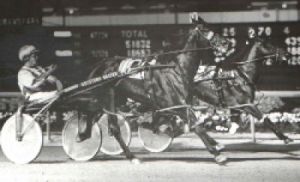
Keystone Raider

Keystone Raider

Keystone Raider, 20, died earlier this month of complications from injuries suffered in an August paddock fall.The son of Big Towner raced for five seasons, amassing earnings of $946,914, and taking a 1:51.1 mark as a 4-year-old. He retired to a stallion career that made him one of Michigan’s greatest sires. His 774 starts earned in excess of $34.7 million, led by millionaire Rair Earth p,1:49.3s, and fellow sub-1:50 pacers Midnight Jewel p,1:49.1 ($666,723) and Fearless Raider p,1:49 ($663,120). In all, he sired 101 $100,000 winners, six in sub-1:50 and 135 in 1:55 or better.

There is also Keystone Rodeo (by Western Hanover, 1:51.0US $725,180) from her daughter Keystone Romance, and some very good performers from the line of another daughter called Leap Year Romance (by Keystone Ore).  She has two top performing sons: Keystone Luther (by Abatross, 1:52.1US $614,717) and Keystone Romeo (also by Albatross, 1:51.2US $704,412), as well as a grandson called Next Flight (by Shotgun Scott, 1:50.0US $895,406).  But there appears to be no current top performers from this line – yet. 

I want to come back now to the Rachel Lobell/Romantic Butler branch of Romantic Hanover’s family, as this is where we have many New Zealand connections and several that have spilled over to Australia.

It all comes down to a daughter of Romantic Butler mare called Romantic by No Nukes. As I mentioned earlier, Classic Families includes two separate filly foals from Romantic Butler – Romantic (b1988) and Romantic II (b1987). But these are one and the same mare, and I understand that the “II” was added when she was imported and registered in New Zealand as there was already another horse called Romantic here.

Romantic II was brought from America to New Zealand by Sir Roy McKenzie with Roymark at foot and in foal to Precious Bunny. She went on to breed another 11 foals here. Roymark (by Tyler’s Mark, $122,461) and Precious Romance (by Precious Bunny, $62,013) were the best performers by far, and the sprawling family has left less of a footprint here than might have been expected. Only two of her several fillies have done anything in the breeding barn – Rachel Romance and Dreamy Romance.

Rachel Romance (by Camtastic, unraced) is the dam of the tough Courage Under Fire campaigner Beyond The Silence (9 wins, Lt $116,846 to date). Two daughters of Rachel Romance went to Australia and now have foals – Sly Romance and Xplosive Romance. Sly Romance is a Sands A Flyin mare bred by Burbeck Harness Bl’Stk Ltd., and of course that sire traces back to Romola Hal in his pedigree via her daughter Rochelle Hanover (see below). Sly Romance has just one foal to date, a 4yo filly bred by N Van Der Snoek in Western Australia that raced once as a 2yo and not sighted since. Xplosive Romance also has just one filly born in 2009 after missing twice, but that foal never made it to the races. Another daughter of Rachel Romance is the Christian Cullen mare Romanticully, who has a 3yo Art Official colt and a 2yo Art Major colt bred by Malcolm Shinn (both linking back to Romola Hal via Art Major’s maternal line), and a yearling Big Jim colt bred by Lynda Hebberd who now owns the mare. She’s back in foal to Betterthancheddar which will bring a 3×3 to Camtastic. I’d love to find out more about these.

The only other filly from Romantic II that has kicked on in the breeding barn is Dreamy Romance. She was an unraced mare taken in by
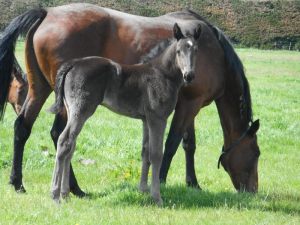
Dreamy Romance and her Big Jim filly foal at Macca Lodge

Dreamy Romance and her Big Jim filly foal at Macca Lodge

Bill Keeler when Sir Roy McKenzie had a dispersal sale. After breeding 5 foals, Bill Keeler put the mare back in a mixed and broodmare sale, and that’s when I bought her. She’s left big types so far but as they strengthen (with trainer Kirsten Barclay) they are producing some nice wins Rainbow Romance (by Knight Rainbow (4 wins, $24,882, now sold to North America), and My Rona Gold (by Klondike Kid, 2 wins, Lt $10,665 to date), and a 3yo filly by American Ideal which Kirsten likes but is not hurrying. I’ve bred a lovely looking Big Jim filly, and the mare is back in foal to Mr Feelgood. Read more about Dreamy Romance in the blog I wrote back in October 2014 and I will say a bit more about the Mr Feelgood decision in a later part of this series, when I cover some of the current breeders.

Rochelle Hanover

At first glance on Classic Families, Rochelle Hanover’s line appears ordinary. Her daughters didn’t stand out as racers and the best of her foals was the Albatross colt Rockwell Hanover ($197,520). But as you click through the descendants there are some top class horses poking up every generation or so, and the strongest and widest branch descends from her Torpid daughter Ribbon Hanover, and her daughter Richelle Hanover.

It is way too extensive to cover in text here, when you can unfold it on Classic Families as the tree.

Richelle Hanover was by Dancer Hanover, a son of The Old Maid and Adios – what a potent mix. Her daughter Misty Raquel (by Meadow Skipper) won $484,463 and was a top class, tough type adding the Jugette as a 3yo and the Lady Maud to her credentials of eventually 48 wins.

One of Misty Raquel’s 14 foals was Misty Bretta. In New Zealand we know her best as the dam of Sands A Flyin ($481,436) who was a significant sire in New Zealand for many years, but she also produced David’s Day ($383,092), Ringaleevio ($265,567), and Beach Bretta ($251,960). 

Of particular interest are Misty Bretta’s two daughters Celerity (by No Nukes) and Myriad (by Niatross) – they are half sisters to Sands A Flyin, and both have had descendants downunder. An Artsplace daughter of Celerity, Lil Sweet Art, was imported to New Zealand and bred from by the late Dave Carvill and bred from with B T Mackie and M W Hamilton. Her first foal was a Falcon Seelster filly called All My Art who achieved 2 wins and 6 places from 23 starts. She’s gone on to be a great if difficult producer with several of her foals ending up racing

Ohoka Nevada winning Barastoc Cup

8yo Ohoka Nevada winning Barastoc Cup in 2011

with success in Australia – Ohoka Du Nord (by Bella’s Boy, 1:52.7 $200,760) and Ohoka Nevada (by Sands A Flyin, 1:51.0 $505,757) were her first two foals, and her third was Ohoka Squire (by Christian Cullen) who is still racing around Pinjarra and Gloucester Park this season with 30 wins and 34 places and $140,550 to date. Her fourth foal was Millwood Liberty, again racing in Australia with a lot of success (1:51.7, $199,459, 18 wins to date).

While there have been others bred from daughters of Lil Sweet Art, it is only the All My Art line that has fired to date. All My Art is now being bred by Katie Carville and B T Mackie, and after not getting in foal to American Ideal twice, now has a Christian Cullen filly at foot and was served this season by Art Major.

If you view the Romola Hal family in its deepest context, as a branch of the Miss Duvall (U7) family, you can see some possible “Romola Hal” or “Miss Duvall” angles on some past and present sire choices, but equally ones that are not. I hope Katie Carville might be able to throw some light on this in future blogs.

Myriad’s connection here is much more limited – a Jate Lobell son called Raleigh Road was imported and raced here by Sir Roy McKenzie for 40 starts, 4 wins and 4 places.

Although the Misty Raquel branch is probably the most well known here, there are some other stunning performers dotted through through Richelle Hanover’s line and through the generations of other descendants of Rochelle Hanover. Just to mention a few: See You At Peelers (by Bettor’s Delight, 1:49.2US, $1,573,260), Robust Hanover (by Warm Breeze, 1:52.2, $1,613,667), Chairmanoftheboard (by Meadow Skipper,  $1,341,823), Elusive Prey (by Western Hanover, 1:51.2, $802,706), Speed Again (by Dragon Again, 1:48.1, $882,296), Capital Request (by Life Sign, 1:49.2, $753,204), Mystic Desire (by Real Desire,1:50.0, $786,009), Fridaynightflight (by Panspacificflight, 1:51.3, $617,495), the mare Bunny Lake (by Precious Bunny, 1:49.0, $2,843,476) and her two sons Bestofbest Hanover (1:48.4, $586,041) and Tobago Cays (1:50.0, $818,272), plus a more recent one – the current 3yo Angel or Terror (by Western Terror, 1:53.1,$103,001), the winner of the USA Arden Downs Stakes for 2yo fillies in the previous season.

Chairmanoftheboard, a very well performed grandson of Richelle Hanover, was available in New Zealand as a sire for just two seasons, for 79 live foals but his legacy is minor. Read NY Times article about Chairmanoftheboard beating Falcon Seelster in the $600,000 Cane Pace in 1985. Update: 6 April 2016 trials – almost as I was writing this blog, a 2yo filly called Toppatherock from Sharn’s Delight (daughter of Sharn, possibly Chairmanoftheboard’s best filly in NZ) qualified – results.

Again you can find a few double ups in that lot I’ve listed above, not just Panspacificflight (who shares a very similar maternal line with Art Major), and Precious Bunny who brings in Romola Hal’s son Romeo Hanover as a sire on the bottom maternal line, but also Life Sign whose maternal line goes to K Nora and right back to Miss Duvall.

Rotate

Romola Hal’s 1962 daughter Rotate is a bit of a revelation. She sneaks under the radar, I think, because it takes a few generations to see which branch of a line is going to keep up the momentum, which river is going to keep flowing on even if sometimes it eddies and braids along the way.

In Rotate’s case, it is her Overtrick daughter Revolve who has ensured this branch has flourished overall, and is still tossing up some excellent performers from a wide range of its offshoots into the current day. Remarkably she has 18 foals and 14 of those were winners. Seven of her 18 foals meet the criteria themselves or through their own descendants to be included in the Classic Families database.

Just looking at some of the best of her descendants that were born from year 2000 onwards – Fancy Filly (by Western Hanover, 1:49.4, $1,080,806), Serious Comfort (by Serious Bunny, $622,468), Top Gear (by Real Desire, 1:50.0, $549,771), Adventure Bound (by Camluck, 1:49.2, $519,434), Native Bride (by Allamerican Native, 1:50.0, $707,493), Big Deal (by McArdle, 1:49.1, $818,544) and her half sister Galimony (by Artiscape, 1:52.4, $485,913), Coffee Addict (by Dragon Again, 1:51.1, $424,303) and her brother Mudslide (1:50.0US $242,399), as well as their dam’s half brother Something for Doc (by Western Hanover, 1:50.0,$619,972), St Lads Kingpin (by Million Dollar Cam, 1:50.0, $443,671), Itrustyou (by Third Straight, 1:48.2, $747,033), Rafferty Hanover (by Western Ideal, 1:51.3, $379,728) and Restive Hanover (by The Panderosa, 1:51.4, $941,971).

And that’s just most of the top ones racing during that period – there are many more with stakes $100,000+.

I can find nothing that descends from Rotate breeding on in Australia or New Zealand – with the exception of  Rotate’s 1965 Dancer Hanover son Rite Retort who was imported to Australia as a sire and had 163 foals from 1977 to 1983 for 31 starters and 24 winners. The database credits one of them as winning over $70,000 which got me quite excited – but checking the horse’s performances I think it’s a data entry error and should be corrected to just over $7000. Very little worth noting seems to have come from this sire in spite of his lovely breeding.

If I have missed a descendant of significance here, please let me know – and also if I have got something wrong. It is easy to lose yourself in the tributaries of this mighty river!

Next time: a quick recap on Romola Hanover’s legacy – and then we will start to talk with some of the breeders of the family in this part of the world.

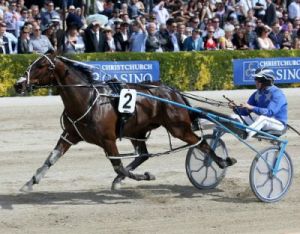
Let’s bring to life the remarkable story of Romola Hal. She was a good racehorse herself, but her legacy has been so much more. She is one of standardbred’s breeding gems.

Article on Romola Hal win in Chicago Daily Tribune 4 Oct 1949

Article on Romola Hal win in Chicago Daily Tribune 4 Oct 1949

The focus of the Romola Hal line revival in the past two decades has been on the flowering of the line from her daughter Romola Hanover, particular with branches such as Rodine Hanover and now her daughters like World Order and Perfect Profile.

I’ve done  a few blogs that touched on the excellence of this maternal line in modern breeding and also reported back comments from New Zealand breeders, and my own interest as a breeder from Dreamy Romance.

In this blog I want to revisit the topic in detail, and put out a call for other breeders who are working with Romola Hal descendants in this part of the world – and indeed in North America – to get in touch with me.

Does the connection play any part in your breeding? And if so, what have you tried/want to try? Or are you focused more on the present when it comes to choices of sires? How do you rate the branch you are working with? And have you got any learnings to share?

I’m using the online database Classic Families as a guide (although a word of caution: their database has Dexter Hanover wrongly listed as a son of Romola Hal when in fact he is a 1968 born Dancer Hanover son of Romola Hanover, her daughter. Plus the split of Romantic and Romantic II is also wrong, these are the same mare. I’ll take these issues up with the Classic Families contacts).

I am travelling online and real time to find out the answers – how is this family tracking now, and especially downunder?

Romola Hal’s most famous daughter Romola Hanover had heaps of ability but issues as a racehorse, as Frank Marrion covers in his very good 2008 article on Harnesslink, quoting Murray Brown of Hanover Farms as saying

She could go incredibly fast, but was neither good gaited nor the most sound of fillies.

Of course Romola Hanover’s success as a broodmare is well known and her incredible line of “classic” descendants, males and females, can be tracked on Classic Families. The modern day branches show up in maternal lines of Art Major and his late brother Perfect Art, Real Artist, Captain Treacherous, Panspacificflight, Nuke Of Earl, and the females like Worldly Beauty, Michelle’s Revenge, Artriverderci ….and so many young ones like Rock N Roll World, Wake Up Peter, Cooperstown, Shadowbriand, and Sir Richard Z Tam.

There are several maternal descendants in Australia and New Zealand, and I will catch up on some them as we go through. and would love breeders to contribute their stories.

So let’s get going on this series.

Coming soon – The “other” daughters of Romola Hal.

Dior Mia Amore, the Australian-bred Tintin In America filly I featured almost exactly 3 years ago in a blog, hit the track at Pinjarra on Monday and won easily in a near track record time. Replay here,  Nevele R news story here

I don’t want to bore you with Tintin progeny stories, but I am damn proud of him! Especially when, as I’ve covered often, it is so hard for new sires to get some traction – whatever the price they are set at.

I Am Special, the dam of Dior Mia Amore, was a good Live Or Die mare. Live Or Die is one of the damsires I have suggested would suit Tintin, having  Shadow Wave twice in his sire’s pedigree, and Spinster twice in his dam’s pedigree. And I Am Special has a nicely constructed maternal line herself. Since going to Tintin In America she has gone “up in the world” with her next foals being by Art Major and Bettor’s Delight. Still, Tintin’s filly foal is holding her own right from the start, with one start for one win – and obviously a real turn of speed.

Tip o’ the hat to Brett Coffey, the breeder.

Rumour has it

In a recent blog following the yearling sales, I made this comment about the mixed/cool reception Rock N Roll Heaven received this year as a sire:

Rock N Roll Heaven was in favour at first, but now there is word around that some of his foals can be hard to gait. He was dropped in a big way at these NZ sales.

A couple of trainers mentioned that Mark Purdon had some that didn’t gait well, and so he wasn’t buying them/didn’t like them. That may be true, and it is his prerogative. I haven’t spoken to him yet. And there may well have been other trainers experiencing a similar thing.

What intrigues me is that a possibly off-hand remark by one person or a few people can become so influential in a sire’s early career, whereas it may be valid personal experience of a small number of his progeny, and in a context that is quickly lost in the retelling. It’s been the same for many a sire – Sundons are mad, Art Majors don’t want to be there, Mach Threes don’t have heart, Somebeachsomewheres are highly strung and hard to gait, Rocknroll Hanovers bash their knees, and so on. With luck and time, the “pudding” is eaten and a reputation is made based on more solid ground and more foals and racehorses and winners. Sometimes there is an element of truth – that sires can leave certain traits in a percentage of their foals. You want the good traits like conformation and speed to be in a higher percentage of foals, i.e. that a sire “stamps” his progeny with some traits that are consistent and favourable, and these make up for other traits that are perhaps less endearing in some of his foals!

All wasn’t doom and gloom for the “Heaven” yearlings at the New Zealand yearling sales – a total of 9 were offered, 7 were sold and 2 passed in for the same reserve of $20,000. So the average of ones sold by auction was $17,500. The highest price was $25,000 for my own filly from Zenterfold, bought by Merv and Meg Butterworth (strictly speaking this one was bought by Merv Butterworth when his wife wasn’t looking!). The Butterworths also bought a “Heaven” filly in the Christchurch sale for $17,000.

I can only speak for my one, but she’s been left in the care of Tony Herlihy, who reports she broke in well, gaits well and is bowling around nicely.

Benecio, the Australian bred Rock N Roll Heaven x Miss Brazillian, trained by Purdon/Rasmussen in New Zealand.

Benecio, the Australian bred Rock N Roll Heaven x Miss Brazillian, trained by Purdon/Rasmussen in New Zealand.

And at the race meeting on Easter Saturday at Addington, I noted the Purdon/Rasmussen team had two starters in race 2 by Rock N Roll Heaven – the winner Mackenzie, a 3yo filly, (formline now 8 starts, 3 wins, 3 places) and the third placegetter 3yo gelding Benicio (formline now 7 starts, 3 wins, 3 places). A couple of races later,  they got another win with Rock N Roll Heaven 3yo gelding Heaven Rocks, which gives him a 2 starts, 2 wins record. Today at Motukarara on the grass track, Cran Dalgety lined up his very talented Rock N Roll Heaven gelding Alpha Rock for another win (so far 6 starts, 5 wins, 1 place) off a very awkward draw, but what a talented young horse from a lovely family (dam Sparks A Flyin).

And here’s a comment from trainer Greg Hope about talented filly Emily Blunt (breeder Pat Laboyrie):

She is a lovely gaited filly but is also one of those fillies that lifts bigtime off the place on raceday. The other thing that has really pleased me all the way through with her is she has never stopped improving the whole time.

In New Zealand, “Heaven” has 60 registered foals of racing age showing on the HRNZ database, for 28 qualifiers (fractionally under 50%), 22 starters and 14 winners (23%), and 7 of those winners have had 3 or more wins. For small numbers and an oldest crop of just 3yos, Rock N Roll Heaven is tracking well.

His Australian stats seem to be proportionately about the same so far, with 88 starters and 44 winners. He was rated 2015 Australian leading first crop sire & 2nd Aust. 2yo sire. But although he can leave precocious types, those startlingly natural 2yos that show up in the top babies’ races, it is as 3yos and older that his foals will shine – as is the case with almost every sire.

In America he is a star sire.

So the “disappointment gap” and perhaps the rumours and perception about him currently, are probably more due to high expectations rather than to his actual performance as a sire.

The expectations were that

  • a really fast sire
  • of smaller size
  • and with a renown great gait

(all of which he had himself) would bring those things to his progeny in spades i.e. fast early types that were easy to gait. If only breeding was that simple!

Look at his own record – he was an outstanding 2yo, but the improvement in him from 2 to 3 years old was astounding! He developed into not just a fast horse, but a really tough one as proven by his Little Brown Jug heat wins. At 2 he won 4 of his 9 starts and a record of 1:50.4. But at 3 he won 16 of 21 starts and a record of 1:47.6. He retired to stud before racing as a 4yo but his gelding half-brother Clear Vision is showing just that sort of top level consistency as he ages. His dam Artistic Vision raced from 2 through to 7, and got her record of 1:50.2 as a 4yo.

North American top filly Sassa Hanover

North American top filly Sassa Hanover

It is a family that can run at 2 but gets better. And in the end, isn’t that what you want in a horse? Their gait early on is less important in the context of their potential to improve.

It’s timely to remember, as a couple of people have told me lately, Christian Cullen was really hard to gait and took about 3 months to get it right.

People want a sire that leaves fast, early types, and yet I’ve heard that in Australia some are viewing Sportswriter as a sire whose progeny “show speed early but don’t go on with it”. Boy it is hard to please some people!

Early reports can be skewed by the natural traits so many yearlings or 2yos show before they mature mentally and physically. And if they are pushed to be early 2yos, then some of those traits (like being overly keen/headstrong, or difficult to gait, or even hitting itself) may show up more strongly, or may take the will to race out of the horse. That’s why good trainers read their horses and know how to adapt their training to get the best out of a horse.

Several things will help Rock N Roll Heaven – his fillies appear as good as his colts, and as his current 2yos move into their 3yo season his reputation will right itself. Also his own pedigree is rock solid and is matchable with many mares.

The ideal thing would be to bring his service fee down from around $9000 to say $7500 with the same sort of discounts already offered. This would bring him closer to more proven sires like American Ideal and new kids with big support like A Rocknroll Dance and He’s Watching, both of whom will now be strong competition for him over the next couple of years. He needs a fee that still holds him as a top sire, but gives breeders an incentive to stick with him. Perhaps the new partnership between Pepper Tree Farm and Alabar will see some movement there. I hope he will remain available to New Zealand breeders, but I doubt we have earned it!

I went to Rock N Roll Heaven when he was $11,000 (but got a standard payment date discount to $9,500). I like him a lot, but until the rumours change, I could not contemplate going back to him for a foal bound for the sales at his current price of $9000 ($8,300), when I could pay two thousand dollars more and get Art Major – and possibly get twice the sales price for a yearling, certainly much less risk in terms of reputation.

Having said that, “Heaven” still strikes me as one of the classiest sires we have. The 2018 yearling sales are a long way off, and so much will happen on the racetrack and at the rumour mill by then!

Milk and horses

No, I am not promoting a milk-based formula for horses, although I do know that milk proteins are a key part of some popular supplement feeds.

This blog is looking at our industry as a whole and trying to find where breeders sit in terms of the industry’s returns.

To get some comparison, I have looked to the giant in NZ that is the benchmark of how to make things rural turn into things that deliver global success, and also how it handles bad times and its relationship with its suppliers, the dairy farmers.

innercowheroFonterra, one of the world’s biggest dairy product companies.
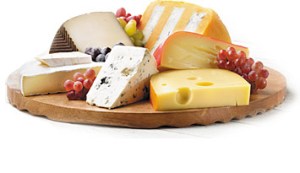
Now, I don’t agree with everything that Fonterra does. This is not about acting like them – but there might be some things that our own small and vulnerable (but resiliant) industry can learn from. I am very aware that analogies fall flat on their faces when taken to extremes, so this is more a look at “how does their industry manage this issue?” rather than a detailed comparison.

Recently I heard that Fonterra had made a record breaking profit. At the same time its Milk Price for farmers (i.e. the price it will pay for the milk that dairy farmers produce) has dropped to a level which is simply not profitable for most farmers, and is forecast to stay there for a couple of years more. Ironically, the two things are interlinked – stay with me, it does relate to horse racing – because the overall profit for Fonterra was driven by lower raw milk prices, which in turn allowed much better profit margins on items that use milk but are not “just milk” – e.g. cheese and yogurt – and which have a high “value added” factor and a growing market.

So that is how Fonterra can be having a record profit year while many dairy farmers in New Zealand have their backs to the wall.

The basic product - milk

The basic product – milk

The driver for this situation is not Fonterra’s greed as a monopoly, but worldwide trends. In a nutshell, there is an over supply of milk globally based on previous encouraging good signs (“get into dairy, it is white gold”) and a slower demand in large key markets like China and Russian based on their own economic situations. However while the global demand for basic milk products has gone down, there is still good demand for cheeses and yogurts and other dairy-based products.

It is also important to know that Fonterra is a farmers’ cooperative, so some of the profit made can be distributed back to farmers via a less direct route than the basic “farm gate” milk price. And that is the situation at the moment where Fonterra is releasing a good dividend at a time that will bring some help to cash flows over the difficult winter period when many cows basically go off production.

The longer term implications for most NZ dairy farmers depends on how resilient they are. And that is a mix of factors like debt burden, size, flexibility (ability to move partially to dry stock farming in the short term,  for example), and market niche. The farmers most likely to suffer are those that have highly capitalised their production to intensify outputs and reap the rewards of the very high “farm gate” milk prices we have had for a number of years. So newly set up farmers in Southland, for example, are probably mortgaged to their eyeballs and also reliant on expensive irrigation to maintain the intensive farming methods they have set up. Many of these farms may well go broke if bank support flags. Whereas in the Waikato, which is a more traditional dairy farming area, experienced farmers with larger farms, lower debt ratio and less pressure to farm intensively or with some dry stock alternatives, are likely to get through the hard times.

Now I am no dairy farming expert, only a listener of analysis thanks to our excellent national and rural farming media coverage which I catch online or listening on my radio on the way to and from work – tip o’ the hat to Radio NZ National.

This is a “helicopter view” actually more like a Boeing 747 view as the Auckland to Christchurch plan flies over the Waikato where I live in New Zealand.

But it puts a different perspective on our industry which sometimes we lack when we are literally at the grass roots level.

What can we learn from this?

First thing that strikes me is that the producers – those producing milking cows/milk – are recognised absolutely as key stakeholders (financially and structurally) in the industry. Their role in producing and managing a dairy herd (from which basic and value-added products come) is recognised in a range of ways, not just the “farm gate” price for milk. As shareholders of Fonterra, they get dividends and that is what is helping them now. They are not just stakeholders, they are shareholders.

In the harness racing industry, breeders are not recognised as key stakeholders in the same way. When profits from the racing industry are ploughed back to stakeholders it is usually in the form of payouts to clubs and into stakes. While this is a welcome move for the industry overall, it is not shared by breeders unless they are also successful owners or trainers. Many are, many are not. There is nothing going back directly as a “dividend” to breeders.

Value-added products

Value-added products

If mares and foals are the equivalent of dairy cows and milk, then the equivalent of cheese and yogurt is our own “value added products” – race horses. So many would say it is only fair that those who add the value (owners, trainers and drivers) get the rewards of higher stakes. However this doesn’t recognise that what breeders produce takes a while to mature – or as our Mainland cheese advert says, “Good things take time.” In one sense a foal is raw material, but what has been put into it and the mare, plus the experience of pedigree matching, and then the added resource of the weaning, handling, good feeding while growing and sometimes preparation for the sales is not just cosmetic. These things, if done well, optimise a foal’s potential to be the best it can be.

When we raise the concept of “breeders bonuses” or a performance-based percentage of stakes paid to breeders, the response is usually about the cost – “Where will the money come from?”

The Fonterra factory at Hautapu, just down a road or two from where I live.

The Fonterra factory at Hautapu, just down a road or two from where I live. specialises in high-value products including cheese, casein, whey protein concentrate, hydrolysate, lactoferrin, milk protein concentrate and lactose – bound for the domestic market, as well as international markets in Asia, Europe and the USA.

The Fonterra example shows that when you look at an industry in a more integrated way (particularly vertically integrated), the producers of your basic product will be better looked after and/or given better signals that help them predict the future and make choices which align with the industry’s direction and their own “business”. Fonterra gives clear signals via its forecast Milk Price – and estimate that is regularly adjusted of where the Milk Price is heading. The Milk Price is a price calculated on all the product as if sold as the basic product to the world commodity market i.e. basic market value. The sale of value-added products then make up the rest of the income. Profit is used for capital investment, maintenance, R&D and other costs  – but also allows a dividend to be paid back to shareholders (farmers). In some cases, including now, an early or additional dividend can be paid to help farmers through difficult cash flows. This is not a subsidy or a guaranteed safety net. They are still vulnerable to global ebbs and flows, changing interest rates and the consequences of their own decisions. Or indeed a stuff up by Fonterra.

So for our harness racing industry, there is a strong case to be made for a model that at the very least returns a dividend (as bonuses, credits or percentage of stakes) to breeders. And at the far extreme, a model that totally restructures and integrates our industry to provide contracted (but forecastable and adjustable) prices for foals, plus additional returns as a dividend potentially based on performance of a foal as a racehorse (i.e. when value is added to the product).

The devil would be in the detail, but it is a scenario I will have a look at in more detail in a future blog.

OLYMPUS DIGITAL CAMERAI believe there is a lot of confusion about the harness racing industry’s consumers versus the industry’s stakeholders. For the dairy industry, it’s those who drink milk or eat cheese, versus farmers with dairy cattle. In our case it’s punters versus breeders /owners /trainers. We need to structure our services to meet consumers’ needs because our success depends on their interest in our product. But we also need to structure our industry to meet stakeholder needs because our success depends on their ability to produce a good product. It’s a balance companies big and small struggle with, but I think there is a lot we can learn from those who do it well.
In future I will do a similar comparison with the wine industry, which we can also learn from.

Appropriately it is the Geoffrey Small/David Butcher combination that got Kiwi Tintin home first in his first raceday start.

Kiwi Tintin first win 18 March 2016

Kiwi Tintin first win 18 March 2016

The win came at the Manawatu meeting yesterday, and from the inside draw he had to do a little bit of work to hold the lead, then increased his margin to win comfortably at the end in a 28.7 last quarter, without David Butcher having to push him.

Kiwi Tintin is owned by the Kiwi Tintin Syndicate and was bred by Hambletonian Ltd (David Phillips) from the now retired Road Machine mare Tall Blonde.

He’s a chestnut, same as American Flyebye, the Tintin In America filly who also won her first start and has since won 4 from 9.

The two other winning credits for NZ bred Tintin In America so far are Dame Puissant and the late Zee Dana, but there are a number of Australian bred Tintins of course. He has 17 NZ qualifiers, including a few 2yos in the last couple of months – His Royal Harness, Manihiki Pearl, Tintin Naturally, plus 3yo Claus who looks a nice one for trainer Stan Moore in Rangiora. He’s had a week off after qualifying and is back in work now, so keep an eye out for him.

Beautiful sunny Cambridge morning, and I’m at the modest workouts (looked up the fields last night and only a few are turning up). Amongst those having a run is Souvenir Glory, Kym’s 6yo Elsu mare (1 win, 3 placings) – we know her as Georgie, the filly bought as a weanling from Alabar and who has accompanied Kym as she learns more about training. The older she gets, the better she gets – the horse and the trainer lol. So it was with some anticipation I am at Cambridge to see how the long hours Kym has put in to bring Georgie to race fitness have resulted. Kyle Marshall is driving her. A few other C1 horses and a much higher graded horse Risk are in the workout heat with Georgie. That’s ok. We can get a line on where she’s at.

Then I hear the workout announcer call the horses to the track, and the names that leap out for me are Lazarus and Chase The Dream.

What?? First thought – hah, nice joke. Next thought – oh my god, that’s the All Stars colours out on the track! Third thought – Bugger!

However, I’ve got to report that all went well. The heat included those two stars, plus Risk (C5 star in the making), Dave Iremonger’s Waipipi Falcon and Souvenir Glory (both C1). Others had defected or got shuffled into the next heat.

Off the arm we go, and Souvenir Glory heads to the front. Leads them around in a tactically sedate pace (great drive Kyle) for most of the race and when – as we know it will – the last half rush happens, she fights on like a tiger. I’d love to say, “and wins” but we save that for dreams.

Fact is, she “whacked on very well” as the course announcer said, and was a very respectable 4th behind Lazarus, Risk and Chase The Dream in that order.

Proud? You bet we are. It’s not often your C1 pacer gets a chance to strut her stuff on the racetrack with the top guns of harness racing. Talking to their drivers afterwards, they were only looking for a fast last half workout as part of their preparation for the big races coming up. A salute to them for making it a race where everyone got their wishes and no horse got crushed. Only regret? One of the few times I didn’t take my camera.

Georgie blew up a little across her back, so there is still improvement there…Kym says she was full of herself tonight and ate up well.

Lovely.

Update 8 March 2016

Tragic news, Zee Dana died today – announced on his Twitter account. That is not what I wanted you to follow and read. So with vets in attendance, and possibly twisted bowel or snake bite, something intestinal, we farewell a horse with so much potential and so much a flagship for Tintin. I really feel for all the connections – that’s a great word for them because they really were connected with Zee Dana, loved him, proud of him, the individual character and talent that he was.

__________________________________________

I was so excited on Sunday night to watch Zee Dana (Tintin In America x Zwish; breeder Dave Kennedy) flying off the front from the widest draw and heading straight to the front.

Zee Dana

Zee Dana with Nathan Jack before the NSW Derby. From his Twitter account.

That he could do that, then still have gas in the tank – just – to run a close third in the NSW Derby….well, what a lovely horse he is turning into. With a bit more room in the passing lane it could have been 2nd place.

Rapt for Dave Kennedy, too, who was over there for the Derby and who reminded me that Menangle doesn’t have a passing lane (damn it!). Dave is a Kiwi breeder who has really supported Tintin In America.

Zee Dana is off for a spell now before aiming at the Breeders Crown. Well deserved break.

Tintin’s first crop is, like Zee Dana, just 3yos at the moment – he had 32 live NZ bred foals that season. Bettor’s Delight had 220, and Mach Three 94, Art Major only 49 in NZ and American Ideal a low of 96 before before those latter three picked up for bigger crops in the next couple of years.

So those statistics sort of paint a picture of the dominance of one pacing sire for what is now a 3yo season.

No complaints – you have to do the best with what you get. And Zee Dana is an example of a breeding that has clicked, a horse that wants to run, and trainers that have developed and channelled his ability.

I am encouraged by what I see from Tintin foals – not all will be successes, but let’s follow the story. Share yours with me – the good and the not so good. I’m interested to know.

You can follow Zee Dana’s story on his own Twitter account here which is very cool. And for a back story on this blog, just search on “Zee Dana” in my blog search field.

Here’s a quick analysis of some of the New Zealand yearling sales results this year.

As usual, I am looking to get a more realistic pictures overall than an average price will give you, and at the results for breeders/vendors as a group rather than for individuals who may have had a great sale or have the numbers to even out their return.

These statistics look at the results of the auction on the day, so I have not considered those who got no bid, withdrawn or passed in. (Many or were passed in may have subsequently sold privately, but I will assume the range of prices will reflect those from the auctions so will not dramatically alter the analysis.)

At this stage I have not differentiated between pacing and trotting yearlings. My overall comment on the trotters is that both sales were flatter than I had anticipated for trotters given the rising number of races for trotters now part of our racing landscape.

Lot 114 Karaka 2016

Lot 114 Mach Three filly x Silence Is Golden (sold for $17,500)

Australasian Classic at Karaka

  •  128 yearlings in total were sold/bought at auction.
  • The median was $40,000. That means that roughly 50% of horses sold for $40k or more, and 50% sold for $40k or less.
  • 24 yearlings (19%) sold for $15,000 or less.
  • 47 yearlings (37%) sold for $50,000 or more.

Premier Day at Christchurch

  • 373 yearlings in total were sold/bought at auction.
  • The median was $20,000. That means that roughly 50% of horses sold for $20k or more, and 50% sold for $20k or less.
  • 109 yearlings (39%) sold for $15,000 or less.
  • 47 yearlings (17%) sold for $50,000 or more.

The statistics paint a picture of sales that are worlds apart. That has always been the case, but becoming even more so. Take into account that the costs or raising and preparing a yearling in the South Island are significantly cheaper than in the upper North Island, although of course that will differ quite a bit depending on whether a breeder/vendor has the ability to agist on their own land and even grow some of their own feed, hay or haylage, whether they are preparing themselves or paying someone else, and what sort of deal they have managed to get for the service fee. Larger scale breeders have an edge here for sure, in both islands.

Lot 371 Christchurch 2016

Lot 371 Betterthancheddar x Saccha Maguire (sold for $11,000)

So given the statistics, there are some real challenges for South Island breeders and some creative thinking about how to make yearling sales part of a wider picture that allows vendors some structured options. I like the idea of somehow combining an entry fee into the sales with a large discount on (or free) entry to a ready to run or mixed sale later in the year (or even timed for a late 2yo aged sale to give yearlings more time to develop), for those who don’t manage to sell. But this still puts the onus on breeders/vendors to carry more costs and perhaps for no greater return – or for a greater loss. For many breeders, the option of retaining yearlings to race or sell later is an added expense rather than a valid option, particularly for fillies. They may well have others in the paddock at home who are tagged for that.

What about some sort of bonus for buyers who pin-hook yearlings for over $15,000 and put them in a ready to run sale? That gives an immediate return to the vendor and an incentive for the buyer and may bring back the smaller trainer-buyer who seemed to be missing from this year’s sales.

Lot 432 Christchurch 2016

Lot 432 Lucky Chucky x Sunny Moment (sold for $8000)

The $20,000 to $35,000 bracket is where costs are at least covered and the buyer has a bit of scope to make something as well if the horse turns out okay. The affordability to buyers, who are also taking a risk, is very important factor to keep in mind. At the higher end of that $20-35,000 price range, there is something to plough back into improvements and even to breed an additional foal next season. In the South Island sale only 18% of yearlings fetch a price in that $20-35,000 bracket.

For the North Island, I think the trend to higher prices merely reflects how breeders up here have taken up the message to go to proven sires, particularly for pacers. Luckily Alabar in particular have stood some of the newer sires at realistic prices (in the $4-6000 service fee range), so breeders who are willing to take a risk on newer sires (like myself) can still cover costs and make a wee bit at around $20,000. But there is nothing left to put into expansion of breeding.

Fashion is also so hard to follow – hindsight makes us wise. Somebeachsomewhere has been out of fashion in New Zealand for several years – but now is the best thing since sliced bread. Rock N Roll Heaven was in favour at first, but now there is word around that some of his foals can be hard to gait. He was dropped in a big way at these NZ sales. Interestingly, that comment about gait was also the same comment I recall about Somebeachsomewhere foals originally. Ah, fashion is fickle and time will tell.

And if the proof of the pudding is in the eating, or on the racetrack, I still believe that some sort of performance bonus paid to the breeder as and if the horse performs makes the most sense. It rewards the product that performs and the person that bred it.