Feeds:
Posts
Comments

Posts Tagged ‘Yearling sales’

When Peter O’Rourke (of Spreydon Lodge and Nevele R) put his mare Let’s Scoot Franco to Bettor’s Delight the stallion was a new young sire with great credentials as a racehorse. There are many stallions that start that way, and few achieve the heights of siring that Bettor’s Delight has done so quickly in both hemispheres.

But all that was in the future. When Peter made his decision Bettor’s Delight was unproven. “I wanted to take a chance with a champion racehorse and a proven family,” he says.
The result was a filly called Lena Franco, who is now the dam of Lot 283 named Lexus Franco on the second day at the Premier Sales, a filly that Spreydon preparer Zane Gregg describes as a nice size from a good family.

It is a solid family, with 4th dam Lancia being a 10 win mare who got 3rd in the Messenger amongst many group placings. The 3rd dam Looks OK was unraced but produced the tough filly OK Rock (1998/99 3yo pacing filly of the year). The 2nd dam by Live or Die took a fast time trial and retired with 3 wins under her belt, and has gone on to be the dam of 14 win Franco’s Lancelot and the very nice Falcon Seelster pacer Franco Ledger.
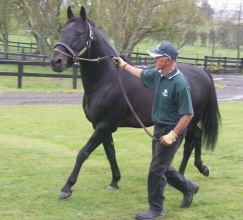
Bettor's Delight

Sire and now damsire, Bettor's Delight with Kevin Foley at Woodlands Stud open day 2012 (photo Bee Pears)

I’m laying out the family credentials so that Bettor’s Delight doesn’t get all the credit!

Peter O’Rourke says the filly Lena Franco, foaled 2005, is a good sized mare and would probably have won a race but was more valuable as a broodmare – by then the signs were starting to look good for Bettor’s Delight so Peter says he was “very happy to have a Bettor’s Delight filly.”

Lot 283 is her second foal.

Peter says the choice of Falcon Seelster for this Bettor’s Delight mare was a combination of looking at compatible US stallion bloodlines and confidence in Falcon Seelster as a proven sire leaving good colts and fillies of value. The fact that the talented Franco Ledger (by Falcon Seelster) is close in the family didn’t enter into the equation, as the timing meant he was yet to show up at the races.

The first foal from Lena Franco was a filly by Lis Mara so there was a bit of doubling up in that combination on the male lines with Cam Fella and on the female lines with Albatross, and a mix of both lines with Abercrombie.

The second foal, this filly at the 2012 yearling sales, is more of an outcross.

It’s interesting to note that as a sire Bettor’s Delight has forged good percentages of starters to foals (44%) and winners to foals (37%) with Falcon Seelster mares. So not unlike the Bettor’s Delight colt in the previous blog, Peter O’Rourke has a reverse cross to a successful “click”.
Read Full Post »

In my latest article in Breeding Matters I wrote about some of the relatively new sires that are making an early appearance as damsires at the 2012 NZ yearling sales:

Mach Three (Lots 112, 129, 131, 291 at Christchurch)
Bettor’s Delight (Lots 132 and 283 at Christchurch
Courage Under Fire (Lots 14 and 101 at Karaka) 
McArdle (Lot 140 at Christchurch)
Washington VC (Lots 24, 49, 169 and 323 at Christchurch) 
Elsu (Lot 17 at Christchurch)
Western Terror (Lot 68 Karaka)

I’d like to have a look at some of these in a bit more detail over the next few blogs, because it’s interesting when breeders move into new territory.

None of the Mach Three, McArdle, Courage Under Fire, Bettor’s Delight, and Elsu mares are successful racehorses retired with a significant reputations or wins to their name. Only two (by Courage Under Fire and McArdle) won a race. That’s no surprise. Untried or lightly raced dams are common in the catalogue, and it just means the yearling is relying more on other factors than their mum’s success – factors such as the family reputation, individual type, and of course the popularity of his damsire and the selected sire with trainers and buyers.

Besides, the top performing fillies and mares from these sires are still doing the business on the track or were only recently retired to stud, and they will start appearing at future sales.

Featuring : Lot 17 Christchurch, Jack Black

 – a Mach Three yearling from Elsu mare “Black And Royal” (2006).

This is Elsu’s first appearance in the yearling sales catalogue as a damsire. (Correct me if I’m wrong!)

This yearling comes from the Spirit Of Venus family which produces really good horses now and then. The black type on the page is impressive, but the odds are intriguing. Spirit Of Venus had 15 foals for 4 winners (Nketia and Ciccio Star being the standouts, with Whata Spirit getting 4 wins and the only other winner was her second foal Pitman, a colt by Midshipman who managed only 1 win.)

While the Yarndleys bred most of Spirit Of Venus’ foals, Michelle Carson bought the mare when she was older and proving harder to get in foal, and chose Elsu (who was standing in his first season) because he was “supremely fertile”. She recalls being on the spot early in the morning, watching him being collected, then took the fresh semen and “drove like a maniac back home” where the vet was on standby.

The result was a gorgeous black filly with white markings, which she named Black And Royal. Mainly due to timing and resources, the mare is genuinely untried as a racehorse. There were delays and “in the end I thought I might as well start breeding from her,” Michelle Carson says.

The Elsu-Spirit of Venus cross means Black And Royal has a heap of excellent old New Zealand bloodlines with no double ups until well back in its pedigree, when the maternal family of Elsu brings in U.Scott and Spinster (and those are two excellent double ups to have on board in combination), so it’s an old fashioned but quality foundation for a modern broodmare.

Matching the mare with Mach Three was less for pedigree reasons, Michelle says, and more because she loves the Mach Threes – “They are beautifully gaited, and have a long, reaching stride,” she says. She was involved with Mach Of A Man, a very promising juvenile whose career was curtailed by bad luck and injury.

Michelle sold Jack Black as a weanling, because of having too many to raise and prepare on her own. Allan Clark for Highview Standardbred Ltd in Riverton was the buyer. He says Mach Threes can sometimes be plain types of yearlings, but Elsu has added type. He describes the yearling as a lovely colt, almost black, not a big type but a strong barrel and “quarters like an Angus bull”. A real two year old type.

Black And Royal’s next foal is by Christian Cullen.

Read Full Post »

As I said in my last blog, going to stallion parades and yearling parades can be a great way for breeders to see types ‘in the flesh’.

It can challenge the prejudices or misconceptions that inevitably creep in when we base our views on promotional material or a bad experience with one individual horse or what we’ve heard on the grapevine.

I like observing the yearling parade day in a state of mind that says: “Just look at each yearling coming into the parade ring – ignore the lot number, ignore any practice commentary from the PGG team and just respond to the type of yearling in front of you before your vision is clouded by too much information.” If one grabs you then check out what it is – and the results might surprise.

American Ideal

American Ideal at Woodlands Stud parade 2011, photo Bee Pears

Last year I did this at the 2011 Australasian Classic Sale at Karaka, and rediscovered American Ideal. Four of the five yearlings by American Ideal were ones that appealed strongly to me on type, enough to make me jot down comments and note their lot number – and discover their common sire.

A couple of years before that, I had been the Woodlands Stud stallion parade and saw Bettor’s Delight, Pegasus Spur and American Ideal paraded up close. Perhaps I was distracted by the strong energy of Bettor’s Delight, a sire who is not big in size but has a big personality and is built like a brick shithouse! And perhaps I was too busy admiring Pegasus Spur, who has a heap of character, stands tall and looks a bit like a Friesian horse! Anyway, I came away with the impression that American Ideal was a smaller stallion and quite plain. He hardly registered with me.

But lo and behold, a couple of years later here were three yearlings for sale that, on type, I really liked – all by American Ideal. They weren’t big, bold horses but they seemed evenly developed and strong, and what you might call go-early types. I really liked them.

Lot 41 was sold for $80,000, Lot 92 for $10,000 and Lot 93 for $60,000. The only filly sold for $7500, and I hadn’t seen her parade. I’d be interested to find out how they are getting on (note to self).

So when I went to the Woodlands Stud stallion parade again later that year, I was keen to have another fresh look at American Ideal.  Again, all three sires were paraded – Bettor’s Delight still strutting like he owns the place (he’s certainly helping to pay for it!), Pegusus Spur checking out the crowd, chewing on the grass, happy to run up and show us what a lovely mover he is. And then American Ideal – oh not as small as I remembered (15.2h), very relaxed, very professional, a lovely walker, not showy but strongly built right through the body.

He’s doing a top job so far on the track in America as well as starting to show up here – Ideal Scott, Besotted, etc.  American Ideal himself performed well at 2 years and superbly at 3 years old.

And in North America he has crossed successfully with mares we can offer here from sires like Artsplace, Falcon Seelster, Life Sign (almost inbreeding, interesting).

So although he doesn’t have the glamour profile of a Bettor’s Delight or an Art Major, American Ideal yearlings certainly opened my eyes to a very nice type of stallion who seems to be stamping his foals.

Read Full Post »

Yearling sales are only three months away – the catalogue is already out. Why not use the sales as a way to test your skills and breeding theories? Can you be as clever as Cran Dalgety, as good as Geoffrey Small or as magic as Mark Purdon in finding the nuggets of gold amongst the hundreds of hopefuls?

This is a great time to test your ability to pick future winners based on their pedigree, family performance and individual type.

By yourself, or with a group of friends, select your own ‘virtual stable’ of yearlings and follow their careers.

There’s no need to waste sellers’ time with inspections – just use what is publicly available such as the catalogue, further pedigree databases if you want, the videos and photos, and the yearlings themselves on Parade Day and as they go through the ring.

You can make up the rules to suit yourselves, but the key is to keep it simple and avoid long lists that get altered as the reality of racing starts to kick in. The best option is  about 6 yearlings each. You can use a budget limit, or just pick without regard for the yearling’s price on the day. It works best if the decision deadline is on Sales Day or soon after. 

Follow your sales picks over the next few seasons, and see what happens. At the end of each season, there might be a “shout” by the loser or a TAB voucher for the winner, or whatever suits your pocket and the number of people involved.  You might judge success on number of “virtual stable” wins, or the horse with the highest earnings – or for their 2yo season just qualifying is worth celebrating.

Because this is a lot harder than it seems!

I first tried this with a friend at the Sale of the Stars 2009. We each picked three yearlings from the North Island (Australasian Classic) Sale, and three yearlings from the South Island (Premier) Sale. Our six selections had to be split between colts and fillies. 

Of the total 12 yearlings we picked between us, only one has (halfway through their 4yo season) earned more than its purchase price. Three of our fillies never qualified but are at stud already.

I was fortunate to pick Charge Forward for my stable, the lovely Grinfromeartoear-Pure Envy colt who cost $30,000 and has so far earned $82,082 with 7 wins. My next best was (by coincidence) another colt bought by the ATC Syndicate – McArmbro, cost $36,000 and ended up with 17 starts for no wins and 8 places and only $5276, before going to Australia and adding 7 wins for a lifetime earning total of $28,301 to date.

My friend’s best pick was Return of the King (Christian Cullen-Hot Blooded Woman) who cost $41,000 and was exported immediately to Australia where he’s managed 6 wins and 20 places for a total of $31,446 to date. Another of her selections was Meet Me In Seattle which looked very promising but then his form tapered off with only $9,674 in the bank so far. 

I have a huge respect for those who buy astutely and successfully at yearling sales! I certainly found selecting from the catalogue (on pedigree and family performance alone) was a disadvantage for the South Island sale, as I could neither get there in person or watch it on TV. I can understand why buyers/trainers place a premium on type.

This year we limited selections to four yearlings (either sex) from the 2011 Australasian Classic at Karaka.  I watched the Parade without my catalogue, picking out what I liked purely on type before checking its breeding. (In my next blog I’ll talk more about that, because it is a great way to test your biases when it comes to preferred sires!)

My “virtual yearling stable” picks are
Lot 79 Outlaw (Bettors Delight – Gift of Grace),
Lot 154  Alta Christiano (Christian Cullen – Right This Time),
Lot 92 Eye for a Deal  (American Ideal – Illmakemyname
and Lot 179 Sugar Ray Brogden (Grinfromeartoear-Swift Mirage).

A friend has picked
Lot 69 Los Amante  (Grinfromeartoear – Erinyes),
Lot 146 Mexicano  (Christian Cullen – Precious Maiden)
Lot 177 Isa Smiling (Pegasus Spur – Sun Isa)
Lot 27 Assasin – (Art Major – Almost an Angel).

So far we have two qualifiers (Mexicano and Sugar Ray Brogden) and Mexicano has tasted success at the races.

Developing a good eye for a nice horse, good families and potentially successful pedigree matches takes time. The yearling sales are a wonderful opportunity for any of us to observe some of the better bred horses in the flesh and to compare types.

So come on, start your homework now, and I’ll come back to this topic closer to the 2012 yearling sales and compare notes.  

Can you pick a champion?

Read Full Post »

« Newer Posts