Feeds:
Posts
Comments

Archive for the ‘Harness racing’ Category

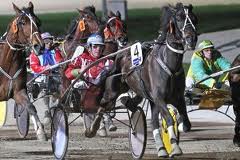
If ever there was a horse that epitomises the Anzac spirit in the modern era, it is Courage Under Fire.

Courage Under Fire in action

Courage Under Fire in action

Aptly named, Courage Under Fire was a racehorse loved and respected in both New Zealand and Australia for his heart, gait and sheer willpower which overcame his pint-sized (14.3h at a push) frame.

He was born (1995) and developed in New Zealand, owned by Australian Greg Brodie, and raced at the top level in both countries.

He was simply a superb racehorse as a 2, 3 and 4yo, winning 24 out of 24 starts in a run that reminds us currently of Black Caviar – and “The Pocket Rocket” was just as much a crowd pleaser.

A really lovely summary of his racing career by Adam Hamilton can be found here on the excellent Addington Raceway Timeline webpages, written when Courage Under Fire retired.

The admiration he had earned “under fire” on the racetrack continued on both sides of the Tasman Sea when he went to stud.

He’s left 10 crops of foals so far (2002-2012) – it’s a milestone worth celebrating. His NZ bred foals have just topped the 1000 mark, and in Australia now exceed 500 and many more to come I hope! His oldest progeny are now 9yos. He’s got the ability to leave really good horses, and to inject a needed element of speed and toughness. And he hasn’t stamped his small size.

His popularity in Australia as a sire is undiminished, and he is still getting full books there, with good supplementary bookings for his chilled semen coming from New Zealand.  He first stood at Nevele R in New Zealand for several years, then after a stint under the Stallion Station he has found a home more recently at Alabar Australia. He is currently standing at a $6000 service fee which indicates how well he is regarded at this stage of his career.

His siring career could be headed in the same direction as his damsire the great Vance Hanover, carving out a great reputation over a long period, not leaving a major siring dynasty in his own right, but likely to provide some very good broodmares in the future.  Many of his best sons are geldings – Pembrook Benny, Sleepy Tripp, Smolda.

Thoughts on Anzac Day

Completely on a different tack, I’d like to give a tip o’ the hat to the horses who have literally performed under fire through many different wars. Forget the awful Spielberg movie and search out some of the real stories to be found about these horses and their handlers.  I hate war for what it does to people, to animals, to the environment. It’s a soul-destroying aspect of life, and its only good side is the other part of the human condition it reveals – courage, resiliance, and humanity shown by individuals against all odds. That’s what I think about on Anzac Day.

Read Full Post »

Number 3 of my 4 solutions for the New Zealand standardbred breeding industry is to place a limit of 100 on all NZ available stallions for the next 3 years (i.e. number of NZ mares served regardless of where the sire stands).

Many people will say there is no point in even raising this issue, because it was done and dusted many years ago when there was a legal ruling based, presumably (because I cannot find any easy reference to it) on the “restraint of trade” argument. That was the end of the matter.

But I believe a short sharp period of limited books will, in conjunction with the other 3 solutions I’m putting forward, provide a bridge to the future for our Kiwi standardbred breeding industry.

The restraint of trade argument is a strong one that carries much weight in Western economies. To be valid, any restraint must be agreed to by both parties (for example in an employment contract), the extent of the restraint needs to be reasonable, and generally there needs to be some benefit in it for both parties.

Restraint of trade is balanced by other commercial laws directing competitive behaviour and preventing cartels, anti-competitive practices, mergers that over-dominate competitive markets, plus consumer protection laws.

These things are presumably intended to set some parameters within which” the market” will usually sort itself out.

And many in the breeding industry will say that is what will happen again here, with a fertile sire like Bettor’s Delight eventually over-supplying the market and breeders moving on to other sires once the average market price takes a downward turn. It’s happened before with Vance Hanover, Sundon, In The Pocket and Christian Cullen. Maybe but given the long cycles of breeding and the current dire straits of the breeding industry, are we willing to wait and see? There are some features of the current situation – the huge dominance of one super sire for several years now; the reduced pool of broodmares; the financial situation of harness racing in general – which means we have to turn the history channel off and get out of our armchair.

So let’s start from the assumption that my proposal is not about a law change, but a change of mindset.

A change from laissez faire reliance on “market forces”, hoping they will trigger changes in time to prevent some very negative flow-on affects.

A change in attitude from “she’ll be right, we’ve seen this all before”. And letting another 3 years slide by to see if it turns out that way.

The aim is to slice the cake more equitably without over-influencing breeders’ choices, during a period where the industry is in danger of contracting to insignificance. Tweaking the market rather than totally controlling it.

What we need is a proactive willingness from stallion owners, breeders and studs. Because in hard times, it is collaboration rather than competition that pulls us through.

Limiting sires’ books over a short period will result in:

  • A wider distribution of the service fees paid by breeders across studs and sire owners, which enables a healthy diversity of industry players to survive – and that protects the competitive environment of the future.
  • A wider range of quality sires who will have a chance to prove themselves at stud, because history tells us that we cannot really predict who will become a top sire.
  • A more diverse future broodmare pool, racing stock and even potential sires.
  • A stronger representation of different types and new sires at yearling sales, giving more representation to breeders who are willing to look “outside the square”. A sire needs 20 yearlings across the sales to really break into the perception of buyers as a commercial stallion.
  • And more active, adventurous thinking (hopefully) on the part of breeders when they choose a sire for their mare, instead of just following the crowd and singing the mantra “best to the best”!

So how could a book limit work in practice?

The number of sires affected is very small – probably Bettor’s Delight the most,  Mach Three and perhaps American Ideal significantly, a little bit for those sires who sit around 100 mares anyway, such as Gotta Go Cullect and Changeover, Washington VC and maybe a couple of others whose stocks are on the rise.

So initially the impact of any agreement would fall on the owners of Bettor’s Delight. And if agreement needs a sweetner,  it could be that a transition which recognises the reduction from a higher income, so it may reduce to a maximum of 175 in Year 1, 150 in Year 2 and 100 in Year 3.  Mach Three is owned by the Muscara family, but it may be that the loss of services to him results in a shift of more services to other sires they also own.

Fact is, in each year a book limit may provide a relatively small number of additional services split around other current or new sires – perhaps around 250.  The shift would initially favour other popular sires until they also reach the 100 book limit, and then breeders would need to look further afield.

Who would benefit then? There are several quality stallions who hover around the 50/60 mare mark, and are currently at a make or break point but need more time (i.e. more progeny at 3+ years) to gauge yet how good they are as sires; and there are top sires available by frozen semen or shuttling who are at risk of being withdrawn from the market because they can’t get the numbers here to justify their costs.

Book limits by agreement for a short period might not be a game changer, but it could put a “salary cap” type requirement on the “players” in our industry. It’s not a new concept in sport, or industries that look to the wider interests and not just the immediate return.

They’ve done it in America, the bastion of the free market place, so it must be possible!

Just out of interest:

Some of the general principles and pros and cons of limiting numbers of mares that a stallion can serve are canvassed in numerous articles and forums about live service vs artificial insemination, especially comparing the thoroughbred industry (which of course doesn’t allow AI foals to be registered in The Stud Book) and our standardbred industry which embraced AI many years ago. This blog on The Breed blogsite in 2009 provides quite a neat review of the pros and cons and differences between the thoroughbred and standardbred approaches – and is worth going to just to read the fantastic quote at the end of the blog from North American harness racing figure Stan Bergstein.

Read Full Post »

I’ve never been keen on embryo transfers except when the mare is unable (for whatever reason) to carry naturally.  I worried about us getting into a ‘factory farming’ situation where the complex mix of nature (genes) and nuture (early upbringing) was lost in the hurry to make money above all.

I’ve changed my mind. Not my principles, just my mind.

I believe the ability to breed two foals per season from one individual mare creates opportunities for the breeder and the industry overall which just cannot be discounted. And I believe two foals should be the limit.

Of course, the idea will be discounted. I am sure there is a piece of obscure government legislation, some racing industry committee or board, or just a clause in HRNZ rules that requires everyone to unanimously agree on changing from the status quo…well, I’m not interested at this stage about why we CAN’T do this. I am only interested in discussing whether it will help our breeding and overall harness racing industry, given the decreasing number of foals and breeders we have.

It’s not exactly going to open the floodgates – but it may help the flow.

So let’s tick off what the benefits could be:

For breeders

  1. It allows a potentially greater and more frequent return on investment (the broodmare) over her limited productive years. Therefore it makes a good broodmare a sounder financial investment (even allowing for the cost of embryonic transfer and an additional carrier mare), and gives the breeder more opportunity in a shorter period of time to discover the ability of the mare as a producer.
  2. It gives breeders the chance to spread their risk among a wider range of sires. For example, a breeder may go to a “tried and true” top commercial sire with one foal and a risky but exciting new sire with the other. Or perhaps a compatible but less commercial sire, and keep the foal to race. So newer or well priced sires may benefit from this proposal, and get access to better quality mares.
  3. It allows breeders more chance to get one healthy foal, and perhaps a foal of the sex they prefer. The high risk nature of breeding means that any significant conformation problem or injury, or even getting a filly rather than a colt, can prove a real disappointment to the breeder and impact hugely on the likely sales result or racing outcome. Double the chance does not double the risk – it may not half it, but it can reduce it significantly.
  4. More breeders using embryo transfer will bring down the costs of the process, and therefore cost will be less of a barrier.
  5. It creates a new ‘career option’ for mares who are not commercially bred but have the qualities to make really good carriers and ‘surrogate mums’ to their foals. Some mares may have a top record and carry great genes but are not the best at delivering and raising foals. And some mares may not have top (or desired) breeding, but have the good nature, physique and quality colostrum to add value to a foal. Rather than creating the ‘factory farming’ scenario I was worried about, embryo transfer can create a market (lease or sale) for mares who may otherwise be lost to us – and they could still be available to breed in their own right if required. Some breeders will already have mares more suitable to be surrogate mums than to continue as commercial broodmares.
  6. The limit of two foals per mare per season (and from different sires) means that the market will not be inundated with “doubles”. This is not a cloning exercise. It is likely that numbers will be a very small proportion of total foals initially. So breeders will not be ‘competing against themselves’ and the overall genetic pool will not be unduly affected. Much less affected, indeed, than it is by the tsunami of sperm coming from highly popular sires!

It is easy enough to note ET at registration of foals – an administrative hassle no doubt, but what isn’t. And in any subsequent notation a simple (E) after the name could provide the flag required for those who want to know and for the record the surrogate mare’s name should be recorded.

Who would take up an option like this? Not heaps of breeders, initially. But more as the merits sink in. Probably it would appeal to the biggest breeders, and also the smallest. The latter being people like me, who have a really good mare but rely on her results for any re-investment in breeding, which makes expanding a slow and fragile venture.

Of course some breeders may want to breed a mare twice every second year.  The mare is not exhausted from breeding and there are many who believe resting a mare can produce a quality foal.

So for the industry:

  1. It creates a way of increasing foal numbers without necessarily increasing the number of mares bred – it helps stop the downward spiral of breeding numbers.
  2. It creates opportunities for less proven “higher risk” sires to get progeny on the ground, and perhaps from a better class of mares. It may well be a requirement to breed a mare to two DIFFERENT sires in any one season, if embryo transfer is being used, to encourage this to happen.
  3. It creates more services/service fees for the studs and sire owners, both of whom are important for our industry’s success.
  4. It has the potential to raise the quality and (ironically) the diversity of our breed.
  5. It does not impact negatively on the product (race horses) as perceived by the investing punter.

What do you think?

And before you say: “it’ll never fly” just remember that pigs don’t, but bumble bees do!

Read Full Post »

I’m not interested in harness racing surviving the current downward trends in stakes, horse numbers, attendances, and betting figures.

I’m interested in it reinventing itself to become an exciting industry to be involved in for the future.

Merely surviving becomes a goal in its own right. And that is when the bell starts tolling.

We can’t afford to hunker down and wait for “things to change” or more money to miraculously appear. We need to be actively pursuing ideas that will position us well for that moment, or indeed help make that moment happen and then capitalise on it.

We hear it said loud and clear: There is no money.

But when ideas start to flow in a positive way, when we really get brainstorming with an open mind, we can create opportunities and energy. That’s what can attract any money that is around.

So here are 4 radical solutions to re-energise the NZ breeding pool (I will look at each one in more detail over the next month of blogging, including how they might be funded.)

  1. Allow breeders to breed 2 foals from an individual mare (no more than 2) per breeding season.
  2. Create meaningful breeders bonuses related to first win or all wins of all NZ-bred horse.
  3. Place a limit of 100 on all NZ available stallions for the next 3 years.
  4. Attach winners’ credits to breeders of fillies (transferable only to current owners)

First up I’ll look at why I have changed my mind about embryonic transfers – and how this idea could grow our pool of broodmares as well as our number of foals.

And if you haven’t read it previously, check out my ideas for making our racing product more interesting and attractive. I rated heat racing and rewards for times as two possibilities – and look what happens, HRV gives the new Great Southern Star series a format that culminates in two heats and a final on the same night, plus rewards fastest placed heat times with additional berths in the final. Yes, it can be done. Many of our current race meetings (even at the highest level) lack the structure of an exciting event, and this is one way to attract punters and attendances. We were all shocked at the demise of the Interdom Trotting Series. The nay-sayers were out in full force as the alternative format came to light. BUT the new format has really added value – congratulations Harness Racing Victoria!


Read Full Post »

The main difficulty for newer sires is to get enough representation at this level to make an impact. Elsewhere I’ve said a new sire (i.e. unproven one starting a career) really needs to have 10+ progeny across the sales, preferably 20+. See my blog of 13 January on this topic.

So which sires made that mark, and how did they fare?

I’ll look at Changeover (37), Justa Tiger (12), Stonebridge Regal (11),  Art Official (10) and Santanna Blue Chip (10).

Changeover’s yearlings

Changeover had 37 yearlings offered and overall a very pleasing result.  Talking to Peter O’Rourke (it so happened to be on his last day in his role at Nevele R Stud), he remarked that Changeover has had good books of mares and positive sales results, but now will need to prove himself on the track. Of  his sales yearlings, Peter said: “They looked good and breeders were not prepared to give them away.”  He said he knew of several passed in lots (there were 7) that had converted to sales soon afterwards.

To my mind, his pricing at $4,000 service fee, his solid pedigree and perhaps most of all the respect trainers had for him as a racehorse makes him attractive. Will the Changeovers be 2yo types? The yearlings I saw were attractive but quite rangey, with good height and a longish bodies. Perhaps more 3yo types, but look how well some of the Mach Threes have done as younger horses. Changeover himself won 2 races as a 2yo and $140,000 and simply got stronger and better with age. So there’s plenty of potential there – fingers crossed for the great horse to make it.

Changeover’s Results:
Australasian (Karaka) Sale – 4 lots offered, all sold. Range $10,000 – $35,000. Average $21,750
Premier (Christchurch) Day 1 – 13 lots offered, 8 sold. Range $13,000 – $23,000. Average $17,250. (Note: One of lots on Day 1 was passed in at $40,000 with a reserve of $49,000, a filly from Sly Shard).
Premier Day 2 – 20 lots offered, 18 sold. Range $2,500 – $23,000. Average $8,422.

Justa Tiger

I blogged about Highview’s Dave and Allan Clarke’s decision to back their sire and put his yearlings into the Premier sale. I still believe it is a courageous move – but it didn’t pay off financially. To be honest, they had a sale from hell. 6 of the 11 lots offered (including the sole lot that made it into Day 1) were passed in, 3 of them without a bid. And of the 5 that sold, 3 of them were for less than $3000. The best sale on the day was Lot 301 called Tiger Minx from a very solid family, second dam having left 7 winners. That colt sold for $10,000.

I spoke to Allan Clarke recently and he said there just wasn’t a middle market at the sales, and those yearlings that didn’t get the attention of the buyers were sold very, very cheaply. However Highview have managed to place most of the ones that didn’t sell to local trainers, and it will be fingers crossed that Justa Tiger has something eyecatching at the races soon.  My pick will be the colt Rosewood Tiger, a half brother to the talented Johnny Fox. Allan Clarke says he will be taking a break and looking for a new direction – his own yearling from the very good mare Baptism Of Fire sold at the other extreme, the full brother to Highview Tommy going for $122,000.

Do I think the Justa Tigers were poor types of yearlings? No, but I do think Justa Tiger has an uphill battle because he was one of several tough, honest, talented racehorses getting results in very good races and yet just lacking that ‘wow’ factor to translate into commerical appeal. Also trainers are short of “try it and see” money – because as Allan rightly said, in the current climate there is less funding for trainers to make speculative purchases and then find owners afterwards. It’s about risk. Trainers were buying fewer horses, and by sires that potential owners will know and feel are proven. In that climate, a poorer type by Bettor’s Delight will be preferred over a nice type by Justa Tiger.

Stonebridge Regal

This is a sire that has, for me, flown under the radar as his yearling lots were exclusively in the Premier Sales in Christchurch. 8 of his 11 lots offered were on Day 2 and all but 1 sold, with the top price being $14,000. On Day 1 he had just 3 lots and they all sold, with the top price of $28,000 being paid by Tony Herlihy for a colt out of a Christian Cullen mare.

His foals born in 2011 are really his only significant crop here in New Zealand – 100 served and 82 live foals, with Wai Eyre standing him at around $4000; he had a smaller number of mares his next season and then was shipped to Victoria I believe mid 2012. He’s a sire that would not have been a “name” downunder, as he didn’t really win any of the top races in North American but accumulated “legs” and divisions of them. However his progeny are doing alright over there and some going early. But he may not be available again here regardless. He looked a handsome horse himself, and perhaps his yearlings have sold more on type? Didn’t see them, so cannot really comment.

Stonebridge Regal’s results
Premier Day 1 – 3 lots offered, all sold – $15,000, $18,000, $28,000
Day 2 – 8 lots offered, 7 sold. Range $2,750 – $14,000
Overall average across 3 days – $10,840

Art Official

Art Official had 10 lots offered, from his first crop of just 39 live foals.  He had a considerably bigger book of mares in his second season so a decent result from these sales was important in terms of marking him as a truly commercial sire and giving confidence to those breeders who have supported him, because his number slid a bit in his third season last year.

Overall, I think Alabar would have been pleased; it was a strong showing from small numbers.

Art Official’s results:
Australasian sale – 4 lots offered, 2 sold – $22,000 and $11,000.
Premier Day 1 – 2 lots offered, 1 sold – a filly for $23,000, and the passed in lot had a reserve of $20,000.
Day 2 – 4 offered, 3 sold – $12,000, $15,000 and $38,000 (which was the top lot of the day)
Average across the three days = $20,333.

Santanna Blue Chip

The Santanna Blue Chip foals and yearlings that I’ve seen are very athletic, strong and attractive types. It is his second yearling sale here in NZ, but he only 2 lots at the Australasian , 5 in Premier Day 1, and 3 in the Day 2 sale. Mind you, only 2 were passed in, and there were 2 that sold for $20,000 plus. However his average overall was $13,625. This was only the second time his yearlings had been offered at the sale, and it is interesting to see that he served over 114 in his latest season, considerably up on his previous 3 seasons. The two SBC yearlings I saw ‘in the flesh’ at Karaka were eyecatchers,  the filly (Lot 153 and a half to Cyamach) made a good $22,000. The colt at that sale was passed in for $9,000 but is being advertised post sale for $10,000 I believe, and I recall it was a nice long barrelled type.

What he needs at this stage is a couple of very nice 2 or 3yos to pop up on the track so that breeders who have kept the faith will feel like his reputation will be tracking up by the time their foals are born. He stood at $4000 for these 2013 yearlings.

Santanna Blue Chip’s results:
Australasian sale – 2 lots offered, 1 sold for $22,000.
Premier Day 1 – 5 lots offered, 4 sold – $8,000, $10,000, $11,000, $25,000
Day 2 – 3 lots offered, all sold – $8,000, $10,000, $15,000

Average across 3 days = $13,625

Other sires? Just too few yearlings to make fair assessment.

(As always, stats are not underpinned by ruthless technically enhanced accuracy, and more likely to be supported by a glass of light wine. Cheers!)

Read Full Post »
How are the results shaping up?

The Australasian sale at Karaka was very mixed – highs and lows in prices, a smaller bench of NZ buyers and some good support from Australian buyers. As noted in other publications, a high “passed in” rate which may be vendors adjusting to the new Reserve system or just not willing to let well bred fillies (in particular) be devalued because of the current market. Many of those passed in will translate into private sales of course, but it was very noticeable during the auction itself.

The Bettor’s Delights held up well although there were still 11 out of the 42 sold going for under $20,000 – although often you could see why. I don’t mean to sound critical saying that, but buyers in this economic climate will always be picky about families and type, and the smaller Bettor’s Delights found little interest if they were a finer type or from families that had little black type or current eye-catching performers. Lesson? You can try to upgrade families by going to excellent sires, but any positive results may appear later on the racetrack rather than earlier in the auction ring. So you have to be ready for a patient and expensive process.

Art Major had a flat sale, with many not meeting their Reserve price. Enough NZ buyers and trainers are still holding back from all-out endorsement of this sire to pose questions for breeders – is the market going to change for next time? Will Art Major’s results on the track next two seasons convert everyone into fans? And are the rumours about “leg issues” based on anything or just a few isolated horses and a lot of gossip? And the talk about” “some just don’t want to be there” – well, isn’t that horses? Even 50% (approx) of Christian Cullen’s progeny were not winners.

Mach Three had a great sale, and congratulations to breeders who have stuck with him. His 2yo stock started to show up again at just the right time. He’s got some older showy runners performing well right now. Overall, the Mach Three yearlings looked decent sized, athletic types with longer barrels and a real presence about many of them.

The trotters were up and down – with only very few representatives it is best to wait for the results from Christchurch before doing the stats on them and the newer pacing sires.

Personally?
Isa Lodge had a very pleasing result with Kym’s Angus Hall colt (lot 69) selling to Lincoln Farms for $42,000.

All the results of the Australasian sales are now posted on PGG Wrightson’s Sale of the Stars website
Christchurch results are being posted as they happen.

Keep in mind a general idea of breeding costs. Of course that depends on how much you can carry yourself and how much you have to pay commercial rates for various breeding expenses or carry overheads on a property etc. However let’s take a figure of $10-15,000 for foal to yearling sales costs, to which the sire’s service fee (which might be discounted or not) needs to be added. So in very general terms, a vendor really needs $20-25,000+ to cover costs/fees and get a return on such a risky investment. Those able to do much of the foaling, raising and preparing work themselves on their own property will have a lower point of breaking even and starting to get a profit, and those selling larger numbers can spread the risk across their draft. But $20,000 is a “ballpark figure” for those paying commercial costs and going to ‘sales type’ sires.

Just a few observations and some quickly calculated stats. Remember that averages hide a wide range – delighted vendors doubling their money, many just covering costs, and some gutted and selling at a significant loss.

Overall NZ trends will only become apparent after today and tomorrow’s Premier Sale days in Christchurch.

Bettor’s Delight

51 lots offered.

42 sold (82%)
Buyers total spend on the day: $1,690,000
Price range $3,000-$210,00
Average price: $40,238
Average price without top lot: $36,794
Average price without top 3 lots ($100,000+): $31,794
Number of lots <$20,000 = 11 (26% of lots sold by auction)

Art Major

22 lots offered.

13 sold (59%)
Buyers total spend on the day: $312,500
Price range $11,000-$50,000
Average price: $24,000
Number of lots <$20,000 = 7 (53% of lots sold by auction)

American Ideal

13 lots offered.

8 sold (61%)
Buyers total spend on the day: $177,000
Price range: $5,500-$82,500
Average price: $22,000
Average price without top lot: $13,500
Number of lots <$20,000 = 6 (75% of lots sold by auction)

Mach Three

15 lots offered

13 sold (86%)
Buyers total spend on the day: $475,000
Price range: $8,500-$120,000
Average price: $36,576
Average price without top lot: $29,583
Number of lots <$20,000 = 3 (23%)

Christian Cullen

16 lots offered

11 sold (68%)
Buyers total spend on the day: $242,000
Price range: $7,000-$65,000 (but one passed in for $97,500 with reserve of $100,000)
Average price: $22,000
Number of lots <$20,000 = 7 (63%)

Read Full Post »

Looking through the 2013 New Zealand yearling sales catalogue, there is a real mix of outcross, close bred and in-between pedigrees on show, which is great. It’s hard to tell if they reflect what breeders are deliberately trying, or more a match based on other preferences (commercial status of the sire, type, previous siblings etc)  that just happened to end up like that.

There are three yearlings, all fillies, from the wonderful USA Lismore family in the Woodlands draft (on behalf of Charlie Roberts). One of which has a very unusually close double up (in this case to the sire Western Ideal). Inbreeding is not something we often see now in New Zealand, so I was interested to find out what was behind it.

In this blog I’ll look at those three lots, and in the following blog I’ll check out an example of the other extreme, Lot 48 at the Australasian yearling sale, an outcross with a strong “colonial” flavour bred by Bryan and Marilyn Macey.

Line breeding US style

Charlie Roberts of Woodlands Stud fame had the opportunity to buy two affordable fillies from the wonderful Lismore family some years ago – Lismurray with a broken shoulder and Lisgarden with a slightly crooked leg – and bring them to New Zealand.

Lot 37 is a daughter of Lismurray called Lisconnie who is a Western Ideal mare. Charlie Roberts has bred her to Woodlands’ American Ideal, who of course is a son of Western Ideal. So that makes Lot 37 2×2 to the sire, and double ups so close on the siring line are unusual these days. Lisconnie’s previous foals were by Artsplace (I’m) Lisart now racing in Australia, and then by Bettor’s Delight for Red Sky Night who has just qualified at Cambridge this month.

Charlie Roberts’ reasoning behind selecting American Ideal as the next sire for Lisconnie is simple – if you are line breeding, breed to the best stallions in the pedigree and to the best stallions available. Not surprisingly, he rates American Ideal and Bettor’s Delight as the best.  He believes there is no problem about breeding so close (what would generally be regarded as inbreeding) so long as the horses are the best quality.

It is an interesting thought, and one that has thrown up some exceptionally good results in history – but also some disappointments. My own concern would be more about type.  In Lot 37 the pedigree is packed with horses that can leave types that we don’t recognise as sheer speed influences – Abercrombie, Cam Fella, Western Ideal himself can tend to leave bigger strong, tough types. However both the female lines have Albatross, and American Ideal does throw Matt’s Scooter into the mix.

It’s a risky breeding that Charlie Roberts is very relaxed about, and I guess he’s in a better position than many of us to experiment if he so chooses.  As they say,  the proof of the pudding is in the eating. And some of us may end up eating our words, while Charlie is eating the pudding!

There was a forum thread about this particular foal and similar close breeding later last year (although I don’t agree with this foal’s cross being described as 2×3 rather than 2×2 – if Tesio says 2×2 that’s good enough for my small brain!)

Lot 45 is Lisdargan’s filly also by American Ideal. Lisgarden is by The Panderosa, which makes this foal 3×3 to Western Hanover, again on the siring lines. And again, you get the double up of Albatross on the female lines.

And then finally Lot 53, a filly by Bettor’s Delight from Lismurray, who is a Presidential Ball mare, so that brings a 3×3 to Cam Fella, again on the siring lines. The filly will be a full sister to Lisharry who is now pushing the $70,000 mark in combined earnings here and Australia.

These lots all have a very strong American influence, of course.  As I said before, Charlie Roberts has followed his belief in going to “the best” and went to the best NZ bred sire of the time, Christian Cullen, with two of these mares but the results have been a bit disappointing to date, he says.

While the Lismore family is a fine one, we only know it here  from Lislea and Lis Mara as sires, who have not yet set our mares on fire although Lis Mara needs to be given a bit more time. The NZ families Charlie is creating from the two fillies he bought are the other connection to that family. There is plenty of room for the family reputation to improve in this corner of the world, and I think Charlie Roberts is enjoying that challenge.

Read Full Post »

Princess Della is a miracle in today’s breeding world. Her pedigree includes one of the the last flickers of the Globe Derby colonial siring line in New Zealand. But she has turned that flicker into a bright light of success.

And that is thanks to the confidence that Don McRae and his sister Mrs Wendy Blackie have had in the mare.

The mare hasn’t made it easy – she was a “bit of a bitch” at times, says Don, but a big jet black bitch at 16.3 hands who has gone on to re-start a family from a maternal line with some very nice sires – Princess Della’s grandamsire was Armbro Del and her great-grandamsire was Bachelor Hanover – but overall a maternal line which hadn’t shown much for a few generations.

Princess Della has changed all that. The result in 2013 is some decent black type on the top part of the page of Lot 74 at the Premier Day 1 yearling sales, a filly called The Enforcer by new trotting sire Skyvalley (Muscles Yankee-Chiola Lass) who was a double Breeders Crown winner as a 3yo and 4yo.

Princess Della is a trotting mare by Last Lord (by Lordship), a little known stallion who sired only 30 live foals  from 1987 to 1995, for just 2 winners.

Much of the breeding interest lies in the fact that Last Lord is the tail end of the colonial siring line known here mainly as the Globe Derby line, which originated from a son of Hambletonian called Strathmore. More of that at the end of this blog.

Don McRae’s father owned Last Lord and so Don knows him well. He was a big jet black horse (where Princess Della got her looks from) who was given a fairly scanty serving of mares to make his mark as a sire and breeders who perhaps lacked attention to the subsequent foals, says Don.  So his statistics need to be taken in that context.

However one of Last Lord’s progeny was Princess Della, bred by C M Hanna and then bought by Wendy Blakie who wanted a Last Lord foal and was advised by brother Don to chose the one from an Armbro Del mare.

Princess Della had only 2 wins and 7 places but she was a better racehorse than that indicates and would have gone further except for soreness. Don McRae she also “had a bit of dirt, was a bit toey”. She got a 2nd in the NZ Trotting Stakes and that was enough to be awarded as 1992-3 Trotting Filly of the Year.

There were some big offers made for Princess Della, but Wendy Blackie wanted to keep her as a broodmare.

What a great decision.

And what an opportunity taken, as Don and his sister Wendy have made very astute and modern breeding choices for such a ‘colonial’ bred mare. It has paid off, as the catalogue page shows.

Kyvalley Mac, son of Princess Della

Kyvalley Mac, very good son of Princess Della

Princess Della is now a 23yo (note that, Don, you think she is only 21 because you look after her so well and she looks younger!)  As a broodmare she has had 9 foals and 5 winners, and three of them – Rare Opportunity, Dealornodeal and Millions To Spare are currently racing in New Zealand. She seems to leave tough, consistent types with a bit of speed – and the best of them was really good, Kyvalley Mac, who got placed in many group races in Australia and ended up with 12 wins and over $160,00. Three of her other sons have now won over $90,000 (Just A Cracker, Just Incredible and Dealornodeal).  Her most recent foal to the track is Millions To Spare (by Majestic Son) who has just got his first win with only two starts on 4 January this year.

Don and Wendy have chosen sires for Princess Della which include very good proven sires and new imported sires, some at fairly high stud fees when they were first available here. Her consorts have been Sundon (Just A Cracker and Just Incredible), Earl (Kyvalley Mac), Dr Donerail (Off The Rails who showed a lot of talent but injured himself badly before racing), Dream Vacation (Dealornodeal who had an outstanding 4 and 5yo season, particularly in Australia),  Pegasus Spur (Rare Opportunity), and Skyvalley (Lot 74 The Enforcer), and the old mare is back in foal to Muscle Mass.

When a mare leaves consistently talented horses from such a range of sires, I take notice. That is a sure sign of a mare who brings a lot to the breeding table, and takes charge of the negotiations when she gets there.

Lot 74 is described by Don as being a beautiful big filly (Skyvalley was not a big sire, but one who impressed Don and Wendy with his times and his level of success).

“The mare leaves lovely long foals,” he says. And those in trotting understand the advantage of a long (as well as square) body for good gait.

Don is hoping to take a photo of The Enforcer and send it to me probably by ‘snail mail’, and I will post it up when it arrives – but those of you who are going to the sales with a thought of getting a nice trotting filly from an exceptionally good broodmare should definitely take a look at the real thing.

Quick summary of the Globe Derby siring line

Strathmore was a son of Hambletonian whose siring line is almost gone into history. It continued in Australia and New Zealand, through Globe Derby and then his son Logan Derby, and then in New Zealand Logan Derby’s outstanding son Johnny Globe who raced here in the 1950s and early 1960s and stood successfully as a sire in the 1960s and early 1970s.  Johnny Globe’s son Lordship  raced at the top level in the 1960s and stood successfully as a sire from the mid 1970s into the 1980s, but although he left good racehorses, including Lord Module and Starship, but they did not carry on the siring line. There have been recent attempts to find a stallion to carry on this “colonial” siring line in New Zealand before it becomes totally extinct – the elderly Magic Rule has been set to work a few years ago in Australia and then NZ with a handful of mares, but these are unlikely to make an appearance at any yearling sales. Just an aside –  Last Lord has two lines to Globe Derby, one through his sire and the other through his grandam (Complaint) who was a daughter of Logan Derby. You can dig into Princess Della’s pedigree further on the HRNZ website in the incredibly useful Info Horse section. Two other sources of information on the Globe Derby line are the Globederby.com website (although I am not sure how up to date that is) and the chapter 13 on Australasian sirelines in the e-book available on Pepper Tree Farm website: The American Standardbred by Ron Groves).

Read Full Post »

Warning – this blog is LONG – but an important topic. So hope you will hang in there!

I want to go back to the topic of sire representation at this year’s New Zealand yearling sales.

Three things to make clear:

  1. This is not a criticism of Bettor’s Delight, who is a fantastic sire.
  2. I realise many progeny never pass through the sales. But as I’ve said before, yearling sales represent the most commercial end of the breeding spectrum, often the most successful families providing a significant percentage of top racehorses, and therefore sales trends are important.
  3. There are a number of factors creating this situation, not just one. Other important factors are the siring competition in the relevant year, and the growing perception of Bettor’s Delight’s mega-sire status (in part a self-fulfilling prophecy).

I’ve been doing a bit more number crunching to see if my ‘gut feeling’ about dominance is significant or not.

I’ve made more comparisons with other years – using the 2012 year when I did detail analysis of damsires at the sales as my baseline. Hence I have picked 2007 (5 years prior) and 2002 (10 years prior) as sales to look at in more detail, as well as the current year (2013) of course.

There will always be some dominant sires, and a smattering of sires that have very few representatives, either because they were so expensive or unusual, or because they are not commercial.

My main concern is the bit in the middle where a trend becomes so dominant that sires represented by 10+ yearlings or 20+ yearlings are virtually squeezed out by one or two very dominant top sires. This can have impacts on the careers of some very good sires, and make it extremely hard for new sires to get a slice of the action (particularly because New Zealand breeders are often very cautious about new sires, unlike the North American situation where hot-of-the-track sires are usually popular and given some of the best mares).

Why have I made the mark of 10+ yearlings? Generally, a sire will need to have 10+ yearlings across the 3 days of sales to provide a display of his types from a range of families as well as staking his claim in the minds of buyers and optimising his chances of having progeny appear in the higher profile stakes series. At 20+ yearling, the sire is established or has is a new sire that has been welcomed with open arms (or should I say open mares!) and that is a healthy level of sales yearlings to be offering – a buffer against sudden death in the arena of fickle fashion trends.

More recently, the South Island sales were split into Day 1 and Day 2, and the perception of sires and yearlings can be different depending on whether they were selected for the more prestigious Day 1 or the more ‘good value for less money’ Day 2 sale.

The analysis is summarised below. But first I want to discuss why we’ve got here.

I believe the 2013 statistics, and the potential continuing dominance of Bettor’s Delight yearlings at the sales over the next few years, should give us incentive to consider what measures might mitigate the negative impacts on our breeding industry. In a recent thought-provoking article in NZ Harness Weekly, David Phillips raised the issue and mentioned voluntary or set limit on stallions’ books. In a small and shrinking breeding pool such as New Zealand’s, I believe this is a sensible option. It is done overseas – recognising that “the market” does not necessarily respond in time or get the right (pricing) signals to self-correct over-dominance.

I hope NZ Standardbred Breeders Association will be looking hard at this issue and discussing it with industry players, particularly the studs. While it is natural for commercial owners and operators to “make hay while the sunshines”, it is up to breeders and their representatives to assess what the wider results might be.

However let’s take a quick look at some of the other factors leading to Bettor’s Delight’s dominance in 2013 – which Woodlands Stud had no immediate influence over.

First, the foals born in 2011 (the yearlings of 2013) are one of  Bettor’s Delight’s biggest crop, but not the biggest or only big crop he has had. In 2007 (271) and 2009 (243) were actually bigger crops than 2011 (232). But what has happened in the meantime? Two things: His main rival Christian Cullen’s live foal numbers have been decreasing – 2007 (154), 2009 (124) and 2011 (73).  And Bettor’s Delight’s reputation has been growing hugely. It is almost a self-fulfilling prophecy because: sheer weight of numbers by a good sire = a higher percentage of races won = trainers and owners liking them more = commercial yearling sales breeders opting for what will be popular.

Second, some sires struggled to challenge Bettor’s Delight, due to breeder perception, caution about new sires, disappointing siring results,  or the cheaper “non-yearling sales” market that the sire has been aimed at. Examples of sires who could have stepped up again but are struggling to for a range of reasons  (with live foals born 2011): McArdle (61), Elsu (92), Grinfromeartoear (34), Lis Mara (38). Examples of newer sires needing to get a foothold in the market are Gotta Go Cullect (94), Gotta Go Cullen (38), Santanna Blue Chip (52), Jereme’s Jet (43) and Art Offical (49). Real Desire is exciting enough to have a real chance to shine, but his 2011 crop was only 37. Even Art Major’s crop was just 87, even though he was getting the big thumbs up in Australia.

So Bettor’s Delight has hit his straps at the exact time that other sires are struggling to break the 50 or 100 foals barrier given such a low number of New Zealand breeding mares to compete for and such strong preference by commercial breeders for one or two top sires.

Third, the economy stagnated and that hits breeders and buyers in the pocket. The attractiveness of harness racing is also struggling against other entertainment and investment options. It’s a high risk industry, and in that situation breeders often choose (if they breed at all) the proven and safe over the new and exciting. As I’ve said before, I think this is a strategy that may well end up “biting a few bums” at the sale, but time will tell, and I will certainly not be laughing if it does.

Notes on the stats below:

  • I haven’t had time to further break this down to pacing and trotting sires/lots. So it is a general scan, not a micro analysis.
  • I am taking numbers on basis of lots entered in the catalogue (regardless of withdrawals).
  • And there will be other yearling sales in the inbetween or previous years that may well show quite differing results. I’m just trying to get a feel for where this year sits and what trend there might be.

The figures for each year go like this:

  1. Total number of lots
  2. Total number of individual sires represented
  3. Number of sires represented by 10+ yearlings.
  4. Number of sires represented by 20+ yearlings.
  5. Number of sires represented by 50+ yearlings.
  6. Top sire, number of yearlings and as percentage of all lots.
  7. Breakdown of number of sires represented on each day.

2013  

  • 515
  • 56
  • 14
  • 6
  • 1
  • Bettor’s Delight, 107, 20.7%
  • Australasian Classic (Karaka)  30
  • Premier Day 1 (Christchurch)  32
  • Premier Day 2 (Christchurch)  44

2012

  • 592
  • 43
  • 18
  • 9
  • 4
  • Mach Three, 70, 11.9%
  • Australasian Classic (Karaka)  32
  • Premier Day 1 (Christchurch)  27
  • Premier Day 2 (Christchurch)  37 

2007

  • 574
  • 40
  • 17
  • 11
  • 1
  • Christian Cullen, 55, 9.5%
  • Australasian Classic (Karaka)  30
  • Premier  (Christchurch)  39

2002

  • 515
  • 48
  • 15
  • 5
  • 2
  • In The Pocket, 89, 17.3%
  • Australasian Classic (Karaka)  32
  • Premier  (Christchurch)  40

So the most similar situation out of these is in 2002 when In The Pocket and Holmes Hanover were dominating the numbers (Falcon Seelster had been temporarily unavailable as a sire). However interesting to note that in 2002 there were another 4 sires hovering at 18 or 19 yearlings, just outside that significant 20+ category but still real players as sires – they were Christian Cullen, Sands A Flyin, Life Sign and the trotting sire Sundon.

In comparison, this year (2013) there is only one sire (McArdle, at 17) who is even close to reaching the 20+ category.

It’s interesting to note that the number of catalogued lots for 2013 and 2002 are exactly the same, but Bettor’s Delight’s dominance at 20.7% is greater than In The Pocket’s at 17.3%.

Another point – the number of individual sires represented this year is the largest by far (56) – but many of these sires may have only 1 or 2 yearlings in the sale. Take the 2013 Australasian Classic: there are 30 individual sires listed but 19 of those have only 1 or 2 yearlings to represent them on that day.

My real concern is the lack of the ‘middle’ commercial sires in enough numbers to really help sustain their careers – and ensure good variety in our future pool of racehorses and broodmares.


Read Full Post »

These are just two of the 12 yearlings by Justa Tiger that Highview Standardbred’s Dave and Allan Clark have put in Day 2 of the Premier Yearling Sale in Christchurch.

They represent an approach and attitude that I find refreshing and courageous.

I’ve blogged previously about the yearling sales concentration of Bettor’s Delight and Art Major yearlings and low numbers from many sires particularly newer sires. There’s also a lack of newer damsires coming through.

The cautious, safe approach by breeders and by PGG Wrightson meant my eyes were starting to glaze over as I turned the catalogue pages for the Australasian Classic and Premier Day 1. Ditto, ditto, ditto. Is this where that irritating axiom ‘breed the best to the best” leads us? Into a boring box?

It was only when I got to the Premier Day 2 catalogue pages, that my interest really sparked.

Why?  Because hidden down in the green pages is a much more refreshing array of sires and damsires. A total of 44 sires are represented on Premier Day 2 compared with 32 on Day 1 and 30 at Karaka.  And they are from a wider range of mares (in terms of damsires).

Thank goodness breeders like Highview Standardbreds are thinking outside the square box!

Take these two lots from Highview as an example.

Lot 217 is a colt by Justa Tiger out of an Island Fantasy mare – and before that puts you off, the mare happens to be the dam of the very promising Johnny Fox, and a half sister to Highview Badlands (9 wins) and Oreti Beach (5 wins here plus 20 in America). The yearling’s grandam is the 8 win mare Highview Rose,  an OK Bye mare.  And the great-grandam has 6 winners from her 9 foals.  So that’s a very solid foundation.

The result is a  nice colt with a pedigree that looks very different from almost anything else in the book.

Justa Tiger filly from Highview Mystery

Lot 206 filly out of Highview Mystery as a foal

Lot 206 is a chestnut filly by a Road Machine mare, and Allan Clark describes her as “one of the nicest yearlings we’ve had out of any sire”. Again, the family is strong enough to support a more commercial choice of sire – if these mares had gone to Art Major or Bettor’s Delight they probably would be joining the many from those sires in the Day 1 pages.

But Allan Clark sees things differently. He’s backing the stallion that Highview has committed to, Justa Tiger, by putting many of Highview’s best mares to him – and then entering them in the yearling sales.

Most of these mares are from solid, consistent families with a good amount of black type dotted through. What I find refreshing is the range of damsires. The damsires for those 12 Justa Tiger yearlings are: Falcon Seelster, Badlands Hanover (2), Bettor’s Delight (2), Road Machine, Island Fantasy, Union Guy, What’s Next, Vance Hanover, Courage Under Fire, and Presidential Ball.

The only lot by Justa Tiger that made Day 1 is in fact the same family as Lot 217 – it’s a colt from a Presidential Ball mare who is a half sister to Lot 217’s Island Fantasy mare – and Allan describes him as an ‘outstanding’ type.

Highview is aiming at a very realistic end of the market – “If we average $10,000 at the end of the sales I will be happy and will have covered our costs,” he says. The more important aim for Allan is to get Justa Tiger’s yearlings spread far and wide, into the hands of trainers where they can prove their real worth.

For Allan, this new approach to the yearling sales is a welcome relief from the pressure to commit to expensive sires and still make a profit. “I feel like I am off the treadmill.” He believes some breeders are ‘committing suicide’ going to Bettor’s Delight and others, as buyers will have so many of them to choose from.

Allan knows the Day 2 buyers will be looking mainly for type and value for money.  Justa Tiger can tick those boxes – and of course he is a son of the great Christian Cullen.

“Justa Tiger carried himself like Christian Cullen in his races, and his conformation is great. He was bought and raced by Lincoln Farms, and they are very particular about correct conformation.

“That’s coming through in his yearlings, they are lovely through the hocks, big nostrils, good shoulder,  correct feet, athletic and some of them are almost thoroughbred in their head,” Allan says.

“If someone saw them in a paddock and didn’t know, they’d easily think they were Christian Cullens. They are that nice.”

We agree that ‘the eye of the beholder’ is often influenced by preconceived ideas!

In terms of temperament, Justa Tiger was a real professional. Trainer Ray Green described him as having “the best attitude and work ethic of any horse I’ve been involved with”. He may have changed careers from racehorse to sire, but the attitude is the same – Allan Clark calls him a ‘real gentleman’ to manage as a stallion.

Justa Tiger was a racehorse who hit his peak as a 3yo before bonechips in his knee really curtailed his career. His dam was the great Tigerish, winner of many group races, a speedy 2yo who developed into a tough mare – she won almost half a million dollars, and founded a very successful family for breeders Pam and Lindsay Turner.  Her bottom maternal line family is well described in the formal advert/pedigree page, but the sire Tiger Wave won’t be well known to many. He’s a son of Shadow Wave (whose heritage is as a damsire, notl sire of sires) out of the mare Diana Streak. That makes Tiger Wave a brother to Dottie Shadow, the dam of Oil Burner (sire of No Nukes). Diana Streak was no slouch, taking a record of 1:58.4 as a 4yo in the early 1950s.  Oil Burner was exported to Australia in the late 1980s and concluded his career as a sire with 1,077 foals and 279 winners in 2:00 and 29 in 1:55. He died at age 30 in 2003 in Victoria, Australia. But while there may be mares in Australia with Oil Burner in their maternal lines, that’s a long stretch in breeding terms and a long way from Justa Tiger who stands in Southland New Zealand.

As Allan Clark knows, it will be a major challenge just to get mares from outside of the Southland region!

For future breeding, Allan suggests Holmes Hanover mares could be a good cross, which was the match with Tigerish that produced Justa Tiger’s outstanding half sister Tiger Turner.

Read Full Post »

« Newer Posts - Older Posts »