Feeds:
Posts
Comments

Archive for the ‘Harness racing’ Category

This blog is “Part 3” of an article written by Ray Chaplin and myself for the latest edition of Breeding Matters, the magazine of the New Zealand Standardbred Breeders Assn.  You can read Part 1 and Part 2 in the latest issue of the magazine at the association’s excellent website http://www.harnessracing.co.nz/

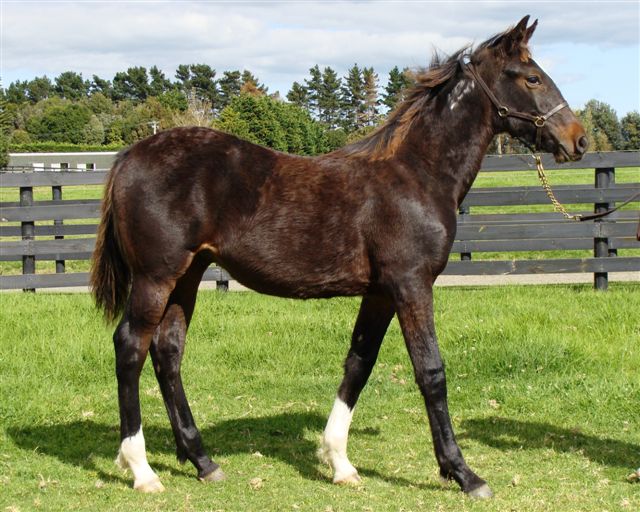
The article looks at the sire sons of Life Sign in Australasia  (Island Fantasy, I Am A Fool, Day In A Life, Peruvian Hanover and Real Desire) , and asks the question: Why have they failed to become commercially successful sires, whereas Real Desire appears to be making his mark?

Part 3: Real Desire – speed sire has a rollercoaster start

Real Desire’s first few years at stud here (with Alabar) have been a bit of a rollercoaster ride.
Firstly, he didn’t settle here in his first shuttle season as Alabar’s New Zealand manager Graeme Henley explains:

“Real Desire didn’t handle the shuttling that well in his first season (2007/8) and he was a bit below par after he returned to the US. The owners decided to not send him back for the next season – they wanted to give him a season off to recover and make sure there was nothing seriously wrong with him. Anyway, with the break he was back to his usual health and condition and he has been back shuttling without any problems since.”

He got 202 mares in his first season here. However a year out of the limelight meant he struggled a bit for numbers when he returned to shuttling, dropping to just 68 in 2009 and 52 in 2010. The quality of his mares dropped as well, which meant Real Desire was hovering on a well-known slippery path that many sires have trod before him.

Then his first yearlings didn’t sell that well – “He is a plain type himself and leaves very plain types as a rule and I don’t think the buyers got their heads around this. Even now buyers go for the big, showy Christian Cullens and under value the little plain Bettor’s Delights for example,” Henley says.

However some of the Real Desire’s started showing up as 2yos – and they displayed that rare and highly valued ingredient: natural speed. With Let’s Elope and Cowgirls N Indians getting Group wins and others showing ability, there was a growing sense of a “speed sire” in the making.

Then Cowgirls N Indians went amiss and Let’s Elope went through a flat patch, plus Real Desire had no yearlings coming through the 2011 sales, and therefore no 2yos and only 3yos to fly his flag in the 2011/12 racing season.

But in the later part of the season, several Real Desires were catching the eye as they developed more physical and mental maturity to go with their speed, and Let’s Elope regained his mojo. At the end of the 2011/12 season, Real Desire has had 55 starters for 28 winners which is a good enough record for his only crop here of racing age. The next couple of years will still be awkward for Real Desire as his missing crop is followed by the two smaller crops, so it will be some time before larger numbers of Real Desires hit the tracks again. However his progeny should get better with age, and that will help keep his profile up.

Although yearling sales buyers have been cautious, breeders have seen enough evidence of speed in Real Desire progeny both in his North American crops and his New Zealand foals to take a punt, and (I am sure to Alabar’s relief) he served 212 mares in the 2011/12 breeding season, including my own mare Zenterfold, the dam of Tintin In America.

If you take any direction from his North American “crosses of gold”, Beach Towel, Albatross and Direct Scooter mares do stand out, but he has performed well with a number of others including Artiscape and The Panderosa. Of more interest to Kiwi breeders, his results in America with Falcon Seelster mares (from only a few foals) is poor to date, from Artiscape mares (from 19 foals) is good, and Presidential Ball mares (from 8 foals) is average. These statistics are updating all the time of course, and worth keeping an eye on.

In New Zealand remember Real Desire’s oldest crop is 3yo (at time of researching in late July, so now have just officially turned 4yo on 1 August) with no 2yo crop here at all, but some statistics of interest include:

  • 23 foals from In The Pocket mares, 13 are 3yo, 9 starters and 7 winners.
  • 32 foals from Holmes Hanover mares, 21 are 3yo, 7 starters and 4 winners.
  • 16 foals from Christian Cullen mares, 11 are 3yo, 7 starters and 2 winners.
  • 9 foals from Falcon Seelster mares, 6 are 3yo, none qualified.
  • 8 foals from Presidential Ball mares, 6 are 3yo, 3 starters, 2 winners.
  • 11 foals from Sands A Flyin mares, 3 are 3yo, none qualified.
  • 7 foals from Beach Towel mares, 4 are 3yo, 1 qualified.
  • 4 foals from Artiscape mares, 1 is 3yo, qualified and exported to Australia.

In most cases, the mares we can offer Real Desire have quite a different look from what he is accessing in North America in terms of their maternal lines and damsires, and the results to date look particularly promising for our In The Pocket mares, and I have heard some good reports on his yearlings from Christian Cullen mares too.

Real Desire has two foals as a damsire in New Zealand (by Bettor’s Delight and Sands A Flyin) from one imported mare.

Real Desire’s ability to be a quality sire that can leave speed sets him apart from the other sons of Life Sign who have been offered here. The answer to a large extent lies in his maternal genes. As pedigree analyst Ken McKay points out: “His maternal pedigree, Golden Miss “The Queen Of Gait” and her daughters are a running line and also one that leaves significant siring prospects amongst it’s male members. If you have great gait then the speed will follow.”

Of course that line has also produced sires with too much fizz (Red River Hanover) and more grit than sheer speed (Grinfromeartoear).  However I think the presence close up in his other maternal line of the fast Troublemaker, bringing with him Most Happy Fella and Bret Hanover, helps keep speed in the frame. It’s good to see New Zealand breeders are doing their bit to keep adding that speed element, rather than relying on a sire to do all the work for them!
Read Full Post »

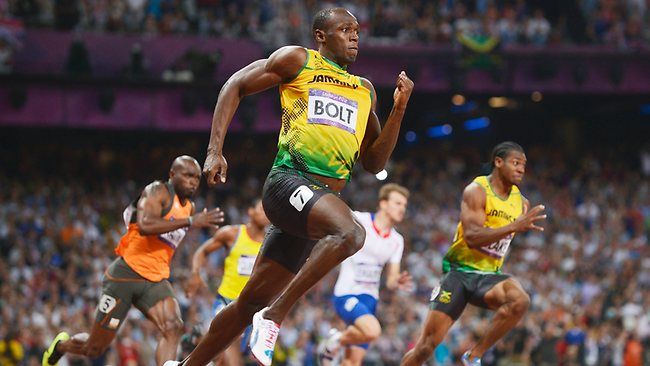
Men’s 200 metres final – what a race! What athletes, and what a beautiful ‘freak’ Bolt is. Jamaicans 1-2-3.

And that’s where my interest lies – what makes them so good at running so fast over short distances? It’s easy to point to the things about Bolt which make him stand out – his height and hence the length of his stride being the obvious ones. I heard him quoted as saying that if he is in front with 10 metres to go no-one can catch him because he covers that 10 metres in 3 strides. It is awesome to see. He reminds me of those beautiful big racehorses with extended loping strides that seem to effortlessly cover the ground. They (like Bolt himself) are often not the quickest out of the gate, but once they get into their rhythm they are glorious and fast.

Yes, all things being equal, size and length of stride are winning assets. But not enough on their own. If the horse (or the person) doesn’t have the physical strength and balance or the mental maturity to match, size can be a handicap. Often those qualities come with age, if we are patient enough to wait. Sometimes precocious talent can be spotted in a big, lanky young horse (or person) and they can even perform well as a youngster, but time is their friend. Bolt is 30 (sorry, incorrect) 25 years old and at his peak, but he was showing huge talent as a much younger man, winning junior world titles. In a much closer to home comparison, you can see some amazing precocious talent in some big young trotters and pacers, and will hear their trainers, owners or commentators referring to them with affection (“big, dumb thing with heaps of raw ability”) knowing that time and experience will add the physical and mental strength they need.

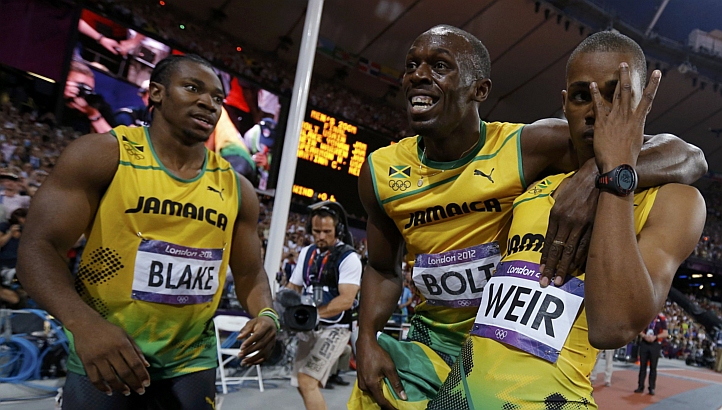
Blake, Bolt and Weir – Photo Reuters

What really interested me and surprised me most was the physical difference among those 3 wonderful medal winning Jamaicans:

Bolt, tall, long limbed, running with a fluency and natural balance that takes your breath away.

Yohan Blake, broad, very muscular upper body as well as powerful legs.

And then Warren Weir, the surprise package – small and wiry, flying into 3rd.

Three Jamaicans, yes, but three completely different body types. All very fast.

Usain Bolt – in the harness racing world we know of many 16 plus hand horses who perform superbly as racehorses and as sires – Western Ideal was 16.1, Artsplace and Rocknroll Hanover, Art Major all 16h, Panspacificflight 16.2h and what a stride! I think he is the one that reminds me most of Bolt. We have had some great examples in New Zealand too – very big horses with massive strides, although several of them have battled soundness problems.

Yohan Blake is more the Christian Cullen style of champion horse – broad chest, big muscular shoulders, strength in his heart to pump very strong (but not exceptionally long) legs.

And then Warren Weir, a Tintin In America type – lean, speed machine. We are not short (if you excuse the pun) of smaller horses who did the job themselves and can rise above the perceptions of their size to become top raceshorses and sires – currently Courage Under Fire (not even 15h) and Bettor’s Delight (15.1h), and in pacing’s history we find ones like Good Time who were so small and so good.

Speed and greatness comes in many shapes and sizes.

I’ve talked before about what I call “gait speed” – the advantage of having a very good gait. This includes a very efficient and clean action, good balance, the strength to reach out in front and to push from the back, and just the sheer length of stride. Great gait delivers speed and soundness – and it is a precious thing to find in a horse. It too comes with all sizes. But as with Usain Bolt, all things being equal the length of stride does give a tremendous advantage.

Right at the start of this blog, I mentioned genetics. I’ve listened to a few discussions on whether the success of the Kenyans in distance running and the Jamaicans in sprinting has a genetic factor. One view I heard on the Jamaicans is the those more recently coming from Africa can tap into a much broader and deeper gene pool with potential for more mutations that can lead to standout variations on the main theme, while those of us who migrated away from that original gene pool a long, long time ago took with us a certain limited range of genetics and thus have been playing in a much smaller pool ever since. I can’t say what truth lies in that – but there are interesting similar discussions to be had on the genetic history of the horse and particularly for us, the standardbred, such as  the mutation theory for the development of the X factor/big heart gene, and the issue of whether we are breeding ourselves into a genetic cul de sac (see the recent blog about cross-breeding, and one I will do over the next month or so on dominant pedigrees in a small breeding population).

The same academic/commentator who talked about the African gene pool viz Jamaican runners, also made the remark that many other factors must play a part in the Jamaican excellence at sprinting, including the “glow” effect of success breeding success, and the sporting culture in Jamaica that makes this and cricket “theirs” in much the same way we might see rugby and rowing, and therefore there are greater numbers of children involved in those sports to start with and talent is spotted at an earlier age, cherished and developed.

My hope is that our increasing emphasis on 2yo racing and on speed is done in that context too – identifying, cherishing and developing talent. Rather than a ruthless way of testing which horses are going to meet the grade or which can show up early for quick gain regardless of the long term cost to the horse.

Getting onto the podium makes all the time and effort worth its weight in gold.

Read Full Post »

There are many horses in modern day pedigrees that have become familiar names to us, and yet we’ve lost a connection with them as real racehorses who were stars in their day and who you could see perform live at your local racetrack.

In past blogs I’ve dug up newspaper reports from the 1920s and 1930s on the amazing mother and daughter trotters Nedda and Nedda Guy, who appear in the maternal line of many great sires.

I’d like to do the same with two great racetrack colts who were rivals in that the same era – Scotland and Spencer, who both went on to be very good sires and superb broodmare sires – a pivotal part of many maternal lines of top horses and sires of the modern era.

Scotland over Spencer mares became a popular cross, so these two horses turn up in many of the best trotting and pacing pedigrees including Direct Scooter, Albatross and Cambest (see footnote to this blog).

But hang on, I’m making them into “names in the pedigree” again!

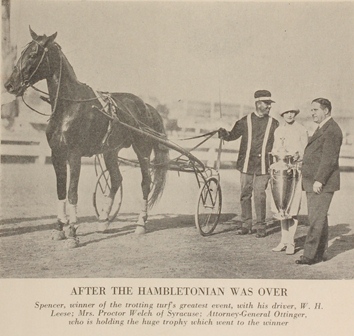
Let’s find them as “heroes on the racetrack”. And to do that I want to take you back to the Hambletonian trot of 1928 as reported by Tom Gahagan in The Trotter and Pacer magazine 6 September 1928. Remember that this is time in pacing and trotting where horses raced in heats on the same day – usually two but often three and sometimes even four to find an overall winner.

In the first heat of the Hambletonian for 3yo trotters (described below), Spencer wins, Scotland is second. In the second heat, Spencer wins again, and Scotland seventh, tiring after a slow start and an amazing recovery. This was only the third Hambletonian raced, and it endures today as one of the highest staked prestigious races for 3yo trotters in America. (I strongly recommend the website of the Hambletonian Society, particularly the wonderful collection of photos in their gallery: http://www.hambletonian.org/gallery.php).

“Another Hambletonian stake, the third to be raced, has passed into history and the honors go to Spencer, owned and bred at Castleton by David M. Look and driven by the eastern reinsman William H. Leese. In a spectacular battle, the son of Lee Tide and Petrex vanquished a field of nine of the very best three year olds in the classic event at the New York State Fairgrounds track today (27 August) where nearly 30,000 people had assembled to witness the battle for a fortune and the racing honors of the season…..

“They fussed a lot in the scoring for the first heat…When the word was finally given Billy Leese shot Spencer across and took the pole in the turn, right in front of Scotland, while Otzinachson placed alongside the black, Gaylworthy and Guy Abbe next, Coburn with them while Red Aubrey had been shuffled well back. The clip was terrific, the quarter in 291/2 seconds, Scotland right in behind the leader for the first time in his race career, the black having heretofore refused to stand the flying dirt. The order was maintained up the back stretch, the half passed in 1:001/2 with Spencer leading, Scotland trailing him and Otzinachson pounding along on the outside. Around the upper turn they went and at the three-quarters the timers flashed 1:313/4. Otzinachson was by this time flying distress signals while Gaylworthy and Guy Abbe were moving up. Leese gave Spencer his head and he moved away, followed by Scotland. Midway of the homestretch it was seen that Spencer was trotting strong with a two-length lead and the question was only who would finish second. Spencer came breezing to the wire in 2:021/2 with Scotland under a drive beating Gaylworthy for the place, Coburn fourth, while Guy Abbe, breaking at the distance stand when trotting very fast, was fifth.”

Spencer after winning Hambletonian in 1928

Spencer after winning Hambletonian in 1928

For his efforts over the two heats, Spencer’s share of the stake was $40,549.71. Not a bad pay day.

Tom Gahagan describes Spencer as “..at least one of the greatest three-year-olds of which the turf has ever boasted.”

Although Scotland didn’t win the Hambletonian, in future five of his progeny would achieve that prize – including the wonderful Rosalind.

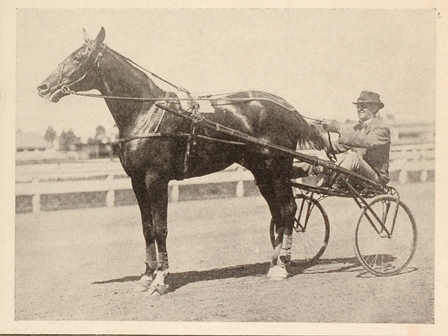
Two years later (1930) the same writer in the same magazine reported on Scotland’s attempt on the Syracause track record when he went under 2 minutes for the first time in his career, going on his own against the clock. It was a perfect day weather-wise and the course in record-breaking condition.

“Scotland, driven by Ben White, and paced by a runner with Gibson White as the pilot, trotted a beautiful mile. He was away from the wire fast, the quarter in 291/2 seconds, the half in :59, both quarters alike, then trotted the third in :293/4, making the three quarters in 1:283/4. The Pittsburgh stallion then had steam enough to come home in 301/2 seconds. The mile in 1:591/4 and he had joined his brother and sister, Highland Scott 1:591/4 and Rose Scott 1:593/4, in the two-minute list.”

The dam of all three was Roya McKinney (one of three wonderful sisters, but more on them another time). On the pedigree side, because I can’t resist, it’s also of interest to see Spencer’s dam is Petrex, who was a grand-daughter of Ethelwyn and so traces back to the x factor heart gene of Eclipse. See my blog on Nedda, who also traced back to this great Ethelwyn/Kathleen family).

Scotland as a 2yo

Scotland as a 2 year old in Tom Murphy’s stable. He took his 1:591/4 mark in Septemeber 1930 as a 5 year old, driven by Ben White. He was bred and owned by Henry Oliver.

Three of the runners in that 1928 Hambletonian (Spencer, Scotland and Guy Abbey) became highly regarded sires, and they can often be found combined as sires and damsires and grandsires in the pedigrees of  many top pedigrees. Hoot Mon, for example, has Scotland as his sire, and is from a Guy Abbey mare who has Spencer as her grandsire! Which goes to show the extended and successful siring careers these talented three year olds went on to achieve.

Footnote:  Just to jog your memory, Spencer was the sire of Spinster and therefore the damsire of half-sisters Lady Scotland (by Scotland) and The Old Maid (by Guy Abbey).  Lady Scotland was the dam of Harold J (damsire of Cambest) and Breath Of Spring (dam of Race Time and many subsequent credits). And Old Maid was the dam of Dancer Hanover, Thorpe Hanover and Bachelor Hanover (who stars in so many New Zealand pedigrees) – and what wonderful broodmare sires they all turned out to be!  Another excellent Scotland over a Spencer mare cross produced Emily Scott (dam of the very good trotting mare Emily’s Pride and grandam of the great trotting sire Noble Victory) and her full brother Spencer Scott (sire of Hoot Mon and Rodney) .
In New Zealand of course we had U Scott (with Scotland as his sire) and Light Brigade (with Spencer as his damsire) and what a contribution they made.
 

Photos in this blog are from the front covers of The Trotter and Pacer magazine of September 1928 and September 1930.


Read Full Post »

In my previous post I listed 3 ways to help decide whether a sire carries the “X factor”. I should have included a 4th bullet point:

  • From his pedigree. The presence of commonly agreed ‘X factor’ damsires in his maternal lines, and the production record of his dam, grandam and great-grandam will also indicate whether a sire has increased chance of carrying the X factor himself. It is more certain if his maternal line production statistics show a higher proportion of foals to starters/winners (and good winners), but also if the mare did this with a range of sires rather than just one, and if the successful horses are colts as well as fillies. This indicates that the X chromosone she contributes may be a dominant one and carrying quality genes. A sire that is a “one off” superb horse but  not supported by some strong production statistics in his previous 2 or 3 maternal generations is much more of a gamble. Flashing Red would be an extreme example of this – a fantastic horse himself, but walking a fairly thin pedigree line.

However even with all the indicators flicking brightly, a sire can still be a disappointment at stud. This may be a result of getting mares with the wrong gene pool to complement his, or because of some other attribute he often passes on (fizzy temperament, conformation fault, lack of mental toughness, or just leaving bigger types that will take a lot of time to strength and mature).

So the X factor is just one of the things that go into the mix.

Refer to the articles that Ray Chaplin and I put together on Rich N Elegant and her siring sons for an example of this puzzle.

I’m not an expert in this at all, and I would love to hear from others who have more experience than I do – do you think the X factor is over-rated? What is the importance of heart size in today’s harness racing?

Read Full Post »

Question came in recently from Kevin:  “I am looking for a list of Sires that carry the X Factor..Is there one, and where would i find it.”

I’d be interested in what others think or lists that people have found useful, but here is my views on the topic:

I don’t know of any list of standardbred sires that claims to identify current sires that carry the X factor. I am aware that Marianna Haun has published a list of galloping sires in her book “Understanding the Power of the X factor”, but she carefully defines what the list is – basically some current thoroughbred sires that possibly carry specific important heartlines and trace back to Eclipse (who was born in 1764) (See page 80 of her book).

It would be possible to do something similar for trotting and pacing, and there may be some pedigree/breeding consultancy services that will have databases that allow them to factor this into their evaluations of sires, damsires and mares. Such a list would be possible by either by tracing pedigrees back to Eclipse’s standardbred descendants or by listing current sires who are underpinned by proven producing mares and damsires – the great trotting and pacing families of the modern era.

There are pedigrees like that which maximise the chances of a sire inheriting a large heart. However even those lines can over time become diluted if mares are not matched with compatible sires that ‘bring out the best’ the mare has to offer and keep carryng those quality genes forward. Families “go off the boil” for a time, and often branches of them simply peter out. Even when matches are well considered, there is an element of ‘russian roulette’ about which X chromosome a foal will inherit.

In my view it is not as simple as labelling sires as ‘big hearted’ or not. The X factor usually refers to abnormally larger hearts, exceptional hearts. I’m not sure that an abnormally large heart is the ‘pot of gold’ some people think it is. In terms of heart scores, is a horse with an exceptional 150 score necessarily going to be that much better as a racehorse than one with a very good score of 120?  As in motor-racing, the car with the biggest engine has an advantage, but many other factors make a winner.

How can you tell if a sire potentially carries a large-heart gene?

  • From their performance on the track. All other things being equal, big hearted horses have had a real advantage on the racetrack, and thus are more likely to achieve the consistent top level “stand out” racing performances that are required to become a commercial sires these days.
  • From their performance in the breeding barn, those sires will soon start to build a reputation as a sire of good fillies, not just of colts.
  • And in the longer run, from their performance as damsires, leaving females that go on to be good broodmares of both male and female offspring.

By their deeds you will know them – although it is much harder to gauge new boys hot off the track, as the more reliable signs will only be apparent later.

Some horses (male and female) will never get the chance to pass on their big heart genes because for some other reason they did not show enough potential as a racehorse or their family is not commercial enough.

A list of sires only tells half the story. If you agree that the big heart gene is carried on the X chromosome, then the mares served by a sire play a huge role in carrying and passing on good heart lines.

Firstly, if the larger heart gene is sex-specific (i.e. carried on the X chromosome) then a sire cannot pass this larger heart to his sons. Male foals are the product of a Y chromosome from their sires and an X chromosome from their dams. So the idea that In The Pocket passed on his own heart size to Courage Under Fire and Christian Cullen, for example, doesn’t stand up.

On the other hand, female foals receive an X chromosome from both parents. One of these is likely to be dominant or “expressed”.  It may (or may not) be one that carries a larger heart gene. A larger heart gene could be on the X chromosome from the sire (from his dam), or it could be on one or both of the two X chromosomes the mare carries. This is what is referred to as a single copy or double copy mare.

Marianna Haun explains this really well in Chapter 9 of Looking for the Great Heart (in “Understanding the Power of the X factor”) and describes how to look for the signs of the X factor in the productions statistics of mares and sires.

So there are no guarantees even by breeding a filly from a sire that is carrying a large heart gene, that the foal will express that gene. But of course it does help your chances.

My previous blogs about Nedda, Nedda Guy, Esther, Volomite and the link back to Eclipse might show an example of how quality lines and big hearts can endure through many generations and pop up in modern pedigrees in different places.

Read Full Post »

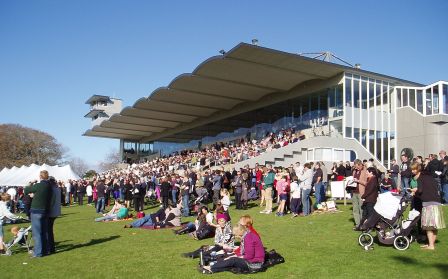
Cambridge Raceway, New Zealand on Jewels Day 2012

Cambridge Raceway, on Jewels Day 2012

Cambridge turned on a nearly perfect day weatherwise for the Harness Racing Jewels –  a few records tumbled, a couple of favourites stumbled, and overall it was a fitting climax for the racing season.

Yes, the course, distance and the draw can combine with little luck in the running and the fact that some of these horses are coming to the end of a pretty big season… and I don’t think anyone would claim that the Jewels winners are necessary the best of the best horses taken over the full season. But the winners can say they beat the top earners in their age group in one of the real tests of speed, on the day that it mattered. Congratulations to them and their trainers, owners and breeders.

The shocks – Bettor Cover Lover being beaten, Gold Ace scratched, and Ideal Scott fading out.

The highlights for me?

A 2yo trot where,  although some made mistakes, the improving quality and class of young trotters made for an excellent race. Big, bold Royal Aspirations (Monarchy-Aspiring Gal-Sundon) was dominant – fantastic feat by trainer Fred Fletcher, and a lovely confident drive from Sam Smolenski.

The similarly dominating, crushing run by Smolda (Courage Under Fire-Under the Mattress-Safely Kept)  in the last race – and a NZ record of 1.52.17. By then the beautiful sunshine had clouded over and the temperature had dropped by about 5 degrees. Some of the crowd had already left, and what a race they missed! Smolda took on Ideal Scott, and couldn’t get the lead, but sat parked, challenged again, and won. On that speed, absolutely TOUGH!

Two other runs caught my eye in terms of  horses who had to do it so tough and still ran on bravely for a place… Cheer The Lady’s run for 3rd in the 3yo fillies Diamond from draw 13 and parked wide without cover for a significant time. And I understand she was pulling a flat tyre for the last 800m. Gutsy! Likewise Border Control’s run from draw 6, parked out and having to come wide and yet made considerable ground in the straight. There were several more – interested to get comments from those who noticed some “wow” moments.

Now looking at the breeding of those who came 1st, 2nd or 3rd in their age/sex race:

Here’s a quirky one – Safely Kept appears as a damsire of the 3yo pacing colts and geldings winner (Smolda) and the 3yo trotters winner (Cyclone U Bolt) – Safely Kept was a sire able to leave good quality in both gaits over the course of his career, but never had many foals here, so a quite remarkable feat to pull off as a broodmare sire on one day of top racing!

Trotting 2yos – 1st and 2nd places taken by horses sired by Monarchy (out of  Sundon and  Yankee Reb mares) and Monarchy doesn’t really have a rep as a sire of young trotters. And in the trotting 3yos Ruby – 1st and 2nd places taken by horses sired by Dream Vacation (out of Safely Kept and Sundon mares).

Bettor’s Delight sired the 1st, 2nd and 3rd placegetters in the pacing 4yo mares Diamond (out of Christian Cullen, What’s Next and Save Fuel mares), as well as siring the 3rd horse in the 2yo fillies Diamond (from a Holmes Hanover mare), the 3rd horse in the 3yo Diamond (from an Albert Albert mare). Bettor’s Delight also sired the 1st and 3rd placed horses in the colts and geldings 2yo Emerald (out of Butler BG and Artsplace mares) and the 3rd placegetter in the 3yo Emerald (out of a Frugal Gourmet mare). The conclusion I’m drawing here is not just the class of Bettor’s Delight as a sire (particularly in races that need speed and huge desire to win) but that he is doing such a great job as a sire with a wide range of mares/damsires.

Unfashionable damsires to poke their noses into a win or place were Jaguar Spur, Albert Albert and Frugal Gourmet. You just never know – and I kinda like that!

No space here to put the full results, but those reading this can find all the details including the breeding of each horse on the HRNZ website (see the link on the right side bar of my blog)under the Results/Cambridge page.

The only quibble I had about the whole day, is that lack of real “event buzz” on course, and that might partly be the laid back Kiwi nature, or the pleasure of relaxing in the sunshine…but it did feel more like a highly successful “Summer at the Races” event rather than the Jewels. There was an absence of bright buntings, active compere on course, and I didn’t even spot signs in Cambridge township pointing to the event.  I felt a cheery local band playing some live jazz would have kept the crowd warm between races when the day started to cloud over. But those were minor quibbles on a great day. I am sure lessons can be learnt to keep this great concept buzzing into the future.

PS  What was the name of that Pizza stand again? They were scrumptious! Italian pizza base, real fresh basil…Yum!

Read Full Post »

Apologies for a bit of a gap in blogging, but there are a number of reasons (recalcitrant mouse and old computer, got new computer but delay in hooking up, got a virus – me, not the computer! – and being dizzy with the viral infection made me fall, falling cracked a rib – oh, and I’m moving house) so it is a challenge to blog at the moment, but after a week or so me and my computer should be in full working order again!.

However the good news – some topics coming up include a look at Bettor’s Delight and his full brother Roll With Joe, and some observations on other “brothers at stud”. What are the pros and cons from breeding, commercial and genetic perspectives? Also I am collaborating with Ray Chaplin of equineexcellence.biz to do some in-depth analysis of Life Sign sons at stud. This follows our previous collaboration on the great mare Rich N Elegant and her sons at stud (see previous blogs). The question in both cases is: Why do some top sons perform at stud and others are flops? That article will initially be published in Breeding Matters magazine (official magazine of NZ Standardbred Breeders Assn) probably in August and then posted on this blog.

In the meantime, I will continue to post up my usual range of observations and articles as often as I can.

Jewels this Saturday!

Locally (Cambridge, New Zealand) we are hosting the Harness Racing Jewels event this Saturday, where the top earning 2, 3 and 4 year old pacers and trotters compete over a mile for top stakes in one day of fantastic racing. (2 June 2012). The Jewels is an event that has great memories for me with Tintin In America winning the 4yo Emerald for pacers last time it was held in Cambridge in 2010, the 3yo Emerald in Ashburton in 2009, and placed 3rd in the 2yo Emerald in Cambridge in 2008.

It’s also an event the captures the mix of fun day out and intensity of top racing that are the hallmark of The Little Brown Jug and Breeders Crown race days internationally. Well worth supporting – and Cambridge is a really lovely place to visit.  Cross our fingers for a fine day – we’ve had some beautiful clear sunny days after overnight frosts this autumn, and one of those on Saturday would be superb.

Read Full Post »

A great sunshiney day and a good turnout at Alabar’s Waiau Pa property.  You’d have to be a bigger risk taker than I am to pinhook in the current economic climate, particularly weanlings that are from okay but not recently performing families, and you would need to look for potential to develop into a standout individual over the next 10 months, regardless of breeding. That’s a real gift! However weanling sales do offer the opportunity for owner/trainers to pick up something at a very reasonable cost and have a go. The cheaper initial cost takes some of the pressure off and gives leeway to let them develop at their own pace. Kym (who has an eye for young horses and their potential that I will never have) has bought three weanling fillies from the Alabar draft over the past couple of years, and all are developing nicely. It was interesting to see their half sisters/brothers as part of this year’s weanling draft.

I did my usual first walk around the weanlings “blind” i.e. picking out what appeals on type before I know what the breeding is.  I don’t judge on size until I can check the foaling dates, as there were some very early and several late foals in the mix.

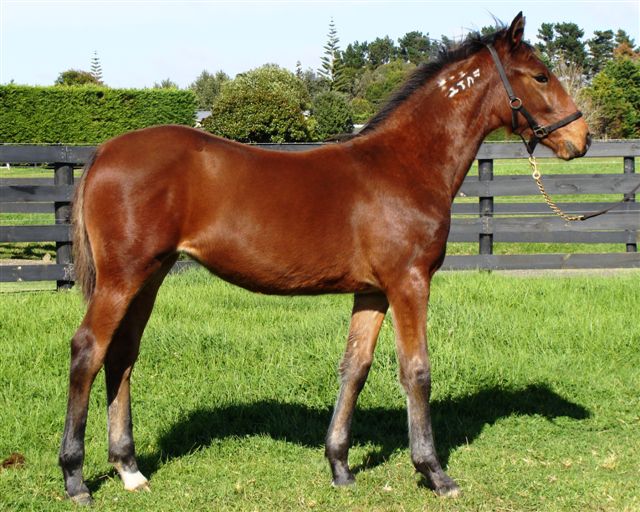
Lot 32 weanling sale at Karaka 2012

Lot 32, Art Major-Heather Laurique filly

Overall, I came up with number 32, an Art Major filly out of Heather Laurique as my top choice – she’s a December foal and so lacks size but was attractive, nicely proportioned, lovely neck and head. She had a spring and energy about her – an athletic type (photo).  I would not normally seek out Art Majors as a personal preference, so it was interesting to find I’d picked her! At the other end of the spectrum in looks, but almost as appealing to me, was number 8, a Real Desire filly out of an American bred mare. A late October foal, she was already showing size and had good strong body and legs, but I reckon she will go through a tall and lanky stage before maturing and probably not a truly early type even though she might get up and running at 2. Compared to 32 she was a plain type, but from the brief encounter I would say she’d have a good temperament.  Number 4 is the Santanna Blue Chip filly out of Alta Magari I mentioned in my last blog – she was smaller than I expected although not a late foal – the dam’s influence perhaps, but very correct.

Lot 21

Lot 21, Shadow Play-Dunbeath colt

Of the colts, I’d take home number 16, a lovely compact but strong looking Grin, and number 21 a Shadow Play out of a Falcon Seelster mare. But there were several colts – and particularly some of the Santanna Blue Chips – that were very appealing.

In fact the overall impression of the Santanna Blue Chip weanlings was  favourable. I thought they looked good correct types, straight in the leg, decent length of body and upstanding.

Lot 25 Shadow Play – Esha colt

Shadow Plays were also on my list to check out on type – overall they looked a finer,  perhaps athletic type. Not leaping out at me in the same way that most of the Santanna Blue Chips did. Number 25 was a stockier, more solid type and an earlier foal than some of the other Shadow Plays. He has thrown in markings to his damsire Elsu (including a blaze) and perhaps Elsu mares will give a bit more ‘solid body’ to their foals.

The sale itself is on this Sunday 20 May when offerings from Woodlands and others will join these weanlings – and of course some mixed aged horses/broodmares.

We are not buying this year, and I may not make it to Karaka this time, but I welcome any comments and observations from those who do.

Read Full Post »

These sales are a great opportunity for those looking for value. They lack the hype of the yearling sales and therefore both the vendor and the buyer are likely to have more realistic expectations.

At these sales you can also see some of the new sires’ foals in larger numbers than many of us might normally – especially in the North Is where Alabar uses this sale rather than the more risky yearling sales to showcase and move on its young stock. The Alabar inspection day is on Saturday 5 May, and there were plenty of people taking advantage of that last year.

I’ll be particularly interested in looking at Shadow Play’s and Santanna Blue Chip’s weanlings, and checking if some of the other sires are starting to show any signs of ‘throwing to type’ that I noticed from prior weanling and yearling sales.  The filly by Santanna Blue Chip out of Alta Magari looks striking in the photo, but there is nothing like seeing these little ones in the flesh. Overall, the Santanna Blue Chips look very nice types. I’m not an expert judge at all (far from it!), but I like to get an overall impression built up from as many individuals as I can see, rather than base my views on a few horses I might know.  At the inspection day,  I can ask the Alabar crew about the weanling’s dam to find out what she might have added to the mix – they are a really helpful, friendly team up there.  Of particular interest to me will be the Gotta Co Cullects, as I am so impressed by the sire and his weanlings/yearlings to date and now have a half share in a filly we picked up at last year’s weanling sale and is breaking in nicely.

In the all aged category, the 2yo Grinfromeartoear filly Provocative could be a good sneaky bid if you want something ready to run – she was unwanted at the yearling sale last year in spite of being a nice type (I recall her in the ring and wondered why she was not attracting more bids, but the Grins aren’t sexy at the sales), and was bought back by the Barlows for about $9000 – and they persuaded Linda Hamilton to take her, with Steven Argue doing the breaking in and training. She qualified nicely enough as a 2yo at Franklin, long before many of the other pricier sales yearlings have made it to the track. Grins tend to need time and can be a little one dimensional in their racing until they mature mentally and strengthen, but those that have natural ability can hold speed and are tough minded – and this filly is from the same family that produced Charge Forward and Covert Action, both Grins of course.  The pedigree match refers in some really nice ways to great mares Breath of Spring, The Old Maid and therefore Spinster, and Grin’s Storm Damage damsire provides the close up footnote to those – one of the things I really like about Grin from a genetic perspective, pulling older references back into the pattern (see my blog on fairisle knitting!)

The South Is sale is much more oriented to broodmares with a bit of a clean out occuring.  I would be interested in getting comments from those in the South Island who can assess some possible nuggets amongst those horses on offer.

More from me – and hopefully others who want to comment – after the Alabar inspection day and sales days.

Read Full Post »

Ray and Sam have added their selections, so we have three very different and interesting ‘stables’ from the 2012 NZ standardbred yearling sales. Mine are based on appealing types on the day and I haven’t put the same emphasis on ‘go early’ that I did last year. None were top lots, some very cheap! Sam has put heaps of thought into his and done a fair bit of close up inspection as he was in the market as a genuine buyer at the sales. Ray has gone for quality families that have been previously successful. A great mix.

Anyone else want to join in?

Just add your selections with reasons to the Comments on my previous Virtual yearling stable blog.

Read Full Post »

« Newer Posts - Older Posts »