Feeds:
Posts
Comments

Archive for the ‘Harness racing’ Category

Lot 140 Christchurch – Getting Closer, a filly from a McArdle mare bred to Courage Under Fire (Withdrawn)

Although withdrawn from the sales, this lot is worth discussing as it is only the second foal from a McArdle dam to show up in a yearling sales catalogue. (last year’s Lot 30 at Karaka was the first, and I’ll mention a bit about that at the end of the blog.)

In this instance, the McArdle dam is Roanne who was bred by Jack Smolenski from Laurent Perrier, and therefore a half sister to the top mare Lancome. Tony Barron bought Roanne at the 2007 yearling sales for $41,000 mainly as a potential broodmare investment. She’s part of Jack Smolenski’s Regal Guest family that regularly produces top performers from its branches, often the fillies showing up at group level.

At the time, the pedigree page shows Roanne’s half brothers The Phantom Guest and In Monaco as good performers but half sister Lancome was yet to start her wonderful career. Since then Laurent Perrier produced the talented Smo, also by Courage Under Fire. So in hindsight the purchase of a smallish McArdle filly in 2007 has turned out to be a very canny move.

Roanne was tried as a racehorse and showed some speed (taking a 1.59.2 winning mark, and 1.57.9 best placed time), but once the win was achieved Roanne was always going to be heading to a breeding career.

Tony Barron describes the choice of Courage Under Fire as Roanne’s first mating as “100% because of Lancome” – who is, of course, a Courage Under Fire mare. “At first I wondered about putting a smaller mare (Roanne) to a smaller sire (Courage Under Fire), but the result is a nice sized filly,” he says. “We bred the mare back to Courage Under Fire the next season and I was clear with PGG Wrightson that if the resulting foal was a colt, we would withdraw the filly from the sale.”

And that’s what has happened, and what Tony Barron describes as a very nice full brother (by Courage Under Fire from Roanne) born this season will be heading for the yearling sales next year.

McArdle has been a bit of a puzzle as a sire so far, and it seems a lot of his fillies need time (and that’s been the same with his colts too, in spite of a couple of precocious ones like Tintin In America).  

His own sire, Falcon Seelster, produced a handful of truly outstanding fillies in New Zealand – Coburg, Hot Shoe Shuffle, De Lovely spring to mind – but Falcon Seelster’s longer term reputation will be more for his colts, his overall quality and quantity of competitive foals and increasingly as a damsire.  (Already his damsire stats are equal to In The Pocket in terms of foals to winners). So it is quite possible McArdle will go the same way.

Having said that, there are some nice McArdle fillies like Elusive Chick showing up now, and that’s what McArdle really needs at this point in his siring career – a few more winners that go on to perform at the group level and excite us rather than just good overall percentages.  

There were only 7 McArdle fillies for sale in the 2007 yearling catalogue, 6 of them at Christchurch. Interestingly that $41,000 price that Tony Barron paid for Roanne that year was equalled by Lot 129 Zenardle (McArdle-Zenara), who was also from a longstanding good family founded on Zenover (grandam of Elsu and 4th dam of Tintin In America, so that filly had a strong Falcon Seelster/McArdle connection in terms of successful sires).

Zenardle had only one race start before embarking on her broodmare career, and she can claim the very first damsire credit for McArdle at the yearling sales. That was last year (2011) when a Bettor’s Delight filly from Zenardle was bought for $10,000 by Steve Clements of Brisbane Pastoral Company Ltd and is now an unraced 2yo in Australia.

So in both cases, these two McArdle mares (Roanne and Zenardle) were originally sold at the same yearling sales  in 2007 and for the same good price. They both come from strong old families that can produce top performers. They have both been put to quality proven sires, and both are smaller sires with reputations for speed and more chance of producing early types.

It will be interesting to follow them and their offspring  in the years to come.

Read Full Post »

Continuing my look at some of the new damsires in the yearling sales catalogue for 2012:

Lot 14 and 101, Karaka – Courage Under Fire mares from same family, both bred to Jereme’s Jet

These yearling colts are bred by David Phillips – and he’s saved me investigating why by writing an extremely detailed advertisement in the Feb 9 Harness Weekly: “Jereme’s Jet: the Golden Cross”.

These are the only Courage Under Fire mares with yearlings in the catalogue this year, although there were three last year and I would expect more to start turning up in coming years.  If David Phillips is right, they will be lining up at the door of Jereme’s Jet! However I reckon Courage Under Fire mares will be well positioned to go to a range of quality sires.

The advert is typically idiosyncratic, but it is refreshing to see a breeder openly explaining to anyone who wants to read the small print exactly why he has bred along these lines. David lists “the wonderful reverse sex of Sampson Hanover…in mid pedigree, the fact that JJ and Vance Hanover (sire of dam of CUF) are from the same dam’s family; the relationship of Adios Butler and his sister, and Light Brigade and his sister; the reverse sexed Albatross; and more.”

Phew! On the catalogue page none of them show up – and that’s to do with the limitations of space because most of the double ups or brother/sister connections in the yearlings’ pedigree are 6 or more generations back. So I guess he’s saying that the nature of these double-genetic double-ups and the positions they are in will result in a higher likelihood of genetic excellence in the yearling colts, even though they are relatively far back in the current yearling’s pedigree.

I’m not a fan of double-ups for their own sake, but good on him for making a call on the Jereme’s Jet x Courage Under Fire cross and putting it out there in print for all to witness. It’s refreshing to see someone committing to that, and being very open about their breeding decisions. Whether we agree or not is up to us. Some buyers and trainers will ignore it and simply like Jereme’s Jet as a potential ‘early’ sire, and see a Courage Under Fire mare as adding potential “gait speed” and “heart” to the equation. Either way, the combination might work well.

I’ll be interested to see the colts themselves at the yearling sales auction. Jereme’s Jet is an exciting sire, with a slightly different twist on pedigree which is great,  and he is a very muscular horse.

What David Phillips doesn’t mention in the advert is the maternal family of both these mares – the genetic match is almost entirely about the Courage Under Fire aspect of their pedigree rather than their maternal family, i.e. the recent entrance of Courage into the mix which he has obviously done with purpose. Both mares were lightly raced and indicated some speed. It’s an interesting maternal line, coming from a full sister to Soky’s Atom (Jef’s Galleria). More recently there have been ups and downs getting Red Electric Moon in foal. It would be great to see Courage Under Fire and then Jereme’s Jet injecting a real revival into the family fortunes. 


Read Full Post »

In my latest article in Breeding Matters I wrote about some of the relatively new sires that are making an early appearance as damsires at the 2012 NZ yearling sales:

Mach Three (Lots 112, 129, 131, 291 at Christchurch)
Bettor’s Delight (Lots 132 and 283 at Christchurch
Courage Under Fire (Lots 14 and 101 at Karaka) 
McArdle (Lot 140 at Christchurch)
Washington VC (Lots 24, 49, 169 and 323 at Christchurch) 
Elsu (Lot 17 at Christchurch)
Western Terror (Lot 68 Karaka)

I’d like to have a look at some of these in a bit more detail over the next few blogs, because it’s interesting when breeders move into new territory.

None of the Mach Three, McArdle, Courage Under Fire, Bettor’s Delight, and Elsu mares are successful racehorses retired with a significant reputations or wins to their name. Only two (by Courage Under Fire and McArdle) won a race. That’s no surprise. Untried or lightly raced dams are common in the catalogue, and it just means the yearling is relying more on other factors than their mum’s success – factors such as the family reputation, individual type, and of course the popularity of his damsire and the selected sire with trainers and buyers.

Besides, the top performing fillies and mares from these sires are still doing the business on the track or were only recently retired to stud, and they will start appearing at future sales.

Featuring : Lot 17 Christchurch, Jack Black

 – a Mach Three yearling from Elsu mare “Black And Royal” (2006).

This is Elsu’s first appearance in the yearling sales catalogue as a damsire. (Correct me if I’m wrong!)

This yearling comes from the Spirit Of Venus family which produces really good horses now and then. The black type on the page is impressive, but the odds are intriguing. Spirit Of Venus had 15 foals for 4 winners (Nketia and Ciccio Star being the standouts, with Whata Spirit getting 4 wins and the only other winner was her second foal Pitman, a colt by Midshipman who managed only 1 win.)

While the Yarndleys bred most of Spirit Of Venus’ foals, Michelle Carson bought the mare when she was older and proving harder to get in foal, and chose Elsu (who was standing in his first season) because he was “supremely fertile”. She recalls being on the spot early in the morning, watching him being collected, then took the fresh semen and “drove like a maniac back home” where the vet was on standby.

The result was a gorgeous black filly with white markings, which she named Black And Royal. Mainly due to timing and resources, the mare is genuinely untried as a racehorse. There were delays and “in the end I thought I might as well start breeding from her,” Michelle Carson says.

The Elsu-Spirit of Venus cross means Black And Royal has a heap of excellent old New Zealand bloodlines with no double ups until well back in its pedigree, when the maternal family of Elsu brings in U.Scott and Spinster (and those are two excellent double ups to have on board in combination), so it’s an old fashioned but quality foundation for a modern broodmare.

Matching the mare with Mach Three was less for pedigree reasons, Michelle says, and more because she loves the Mach Threes – “They are beautifully gaited, and have a long, reaching stride,” she says. She was involved with Mach Of A Man, a very promising juvenile whose career was curtailed by bad luck and injury.

Michelle sold Jack Black as a weanling, because of having too many to raise and prepare on her own. Allan Clark for Highview Standardbred Ltd in Riverton was the buyer. He says Mach Threes can sometimes be plain types of yearlings, but Elsu has added type. He describes the yearling as a lovely colt, almost black, not a big type but a strong barrel and “quarters like an Angus bull”. A real two year old type.

Black And Royal’s next foal is by Christian Cullen.

Read Full Post »

As I said in my last blog, going to stallion parades and yearling parades can be a great way for breeders to see types ‘in the flesh’.

It can challenge the prejudices or misconceptions that inevitably creep in when we base our views on promotional material or a bad experience with one individual horse or what we’ve heard on the grapevine.

I like observing the yearling parade day in a state of mind that says: “Just look at each yearling coming into the parade ring – ignore the lot number, ignore any practice commentary from the PGG team and just respond to the type of yearling in front of you before your vision is clouded by too much information.” If one grabs you then check out what it is – and the results might surprise.

American Ideal

American Ideal at Woodlands Stud parade 2011, photo Bee Pears

Last year I did this at the 2011 Australasian Classic Sale at Karaka, and rediscovered American Ideal. Four of the five yearlings by American Ideal were ones that appealed strongly to me on type, enough to make me jot down comments and note their lot number – and discover their common sire.

A couple of years before that, I had been the Woodlands Stud stallion parade and saw Bettor’s Delight, Pegasus Spur and American Ideal paraded up close. Perhaps I was distracted by the strong energy of Bettor’s Delight, a sire who is not big in size but has a big personality and is built like a brick shithouse! And perhaps I was too busy admiring Pegasus Spur, who has a heap of character, stands tall and looks a bit like a Friesian horse! Anyway, I came away with the impression that American Ideal was a smaller stallion and quite plain. He hardly registered with me.

But lo and behold, a couple of years later here were three yearlings for sale that, on type, I really liked – all by American Ideal. They weren’t big, bold horses but they seemed evenly developed and strong, and what you might call go-early types. I really liked them.

Lot 41 was sold for $80,000, Lot 92 for $10,000 and Lot 93 for $60,000. The only filly sold for $7500, and I hadn’t seen her parade. I’d be interested to find out how they are getting on (note to self).

So when I went to the Woodlands Stud stallion parade again later that year, I was keen to have another fresh look at American Ideal.  Again, all three sires were paraded – Bettor’s Delight still strutting like he owns the place (he’s certainly helping to pay for it!), Pegusus Spur checking out the crowd, chewing on the grass, happy to run up and show us what a lovely mover he is. And then American Ideal – oh not as small as I remembered (15.2h), very relaxed, very professional, a lovely walker, not showy but strongly built right through the body.

He’s doing a top job so far on the track in America as well as starting to show up here – Ideal Scott, Besotted, etc.  American Ideal himself performed well at 2 years and superbly at 3 years old.

And in North America he has crossed successfully with mares we can offer here from sires like Artsplace, Falcon Seelster, Life Sign (almost inbreeding, interesting).

So although he doesn’t have the glamour profile of a Bettor’s Delight or an Art Major, American Ideal yearlings certainly opened my eyes to a very nice type of stallion who seems to be stamping his foals.

Read Full Post »

Yearling sales are only three months away – the catalogue is already out. Why not use the sales as a way to test your skills and breeding theories? Can you be as clever as Cran Dalgety, as good as Geoffrey Small or as magic as Mark Purdon in finding the nuggets of gold amongst the hundreds of hopefuls?

This is a great time to test your ability to pick future winners based on their pedigree, family performance and individual type.

By yourself, or with a group of friends, select your own ‘virtual stable’ of yearlings and follow their careers.

There’s no need to waste sellers’ time with inspections – just use what is publicly available such as the catalogue, further pedigree databases if you want, the videos and photos, and the yearlings themselves on Parade Day and as they go through the ring.

You can make up the rules to suit yourselves, but the key is to keep it simple and avoid long lists that get altered as the reality of racing starts to kick in. The best option is  about 6 yearlings each. You can use a budget limit, or just pick without regard for the yearling’s price on the day. It works best if the decision deadline is on Sales Day or soon after. 

Follow your sales picks over the next few seasons, and see what happens. At the end of each season, there might be a “shout” by the loser or a TAB voucher for the winner, or whatever suits your pocket and the number of people involved.  You might judge success on number of “virtual stable” wins, or the horse with the highest earnings – or for their 2yo season just qualifying is worth celebrating.

Because this is a lot harder than it seems!

I first tried this with a friend at the Sale of the Stars 2009. We each picked three yearlings from the North Island (Australasian Classic) Sale, and three yearlings from the South Island (Premier) Sale. Our six selections had to be split between colts and fillies. 

Of the total 12 yearlings we picked between us, only one has (halfway through their 4yo season) earned more than its purchase price. Three of our fillies never qualified but are at stud already.

I was fortunate to pick Charge Forward for my stable, the lovely Grinfromeartoear-Pure Envy colt who cost $30,000 and has so far earned $82,082 with 7 wins. My next best was (by coincidence) another colt bought by the ATC Syndicate – McArmbro, cost $36,000 and ended up with 17 starts for no wins and 8 places and only $5276, before going to Australia and adding 7 wins for a lifetime earning total of $28,301 to date.

My friend’s best pick was Return of the King (Christian Cullen-Hot Blooded Woman) who cost $41,000 and was exported immediately to Australia where he’s managed 6 wins and 20 places for a total of $31,446 to date. Another of her selections was Meet Me In Seattle which looked very promising but then his form tapered off with only $9,674 in the bank so far. 

I have a huge respect for those who buy astutely and successfully at yearling sales! I certainly found selecting from the catalogue (on pedigree and family performance alone) was a disadvantage for the South Island sale, as I could neither get there in person or watch it on TV. I can understand why buyers/trainers place a premium on type.

This year we limited selections to four yearlings (either sex) from the 2011 Australasian Classic at Karaka.  I watched the Parade without my catalogue, picking out what I liked purely on type before checking its breeding. (In my next blog I’ll talk more about that, because it is a great way to test your biases when it comes to preferred sires!)

My “virtual yearling stable” picks are
Lot 79 Outlaw (Bettors Delight – Gift of Grace),
Lot 154  Alta Christiano (Christian Cullen – Right This Time),
Lot 92 Eye for a Deal  (American Ideal – Illmakemyname
and Lot 179 Sugar Ray Brogden (Grinfromeartoear-Swift Mirage).

A friend has picked
Lot 69 Los Amante  (Grinfromeartoear – Erinyes),
Lot 146 Mexicano  (Christian Cullen – Precious Maiden)
Lot 177 Isa Smiling (Pegasus Spur – Sun Isa)
Lot 27 Assasin – (Art Major – Almost an Angel).

So far we have two qualifiers (Mexicano and Sugar Ray Brogden) and Mexicano has tasted success at the races.

Developing a good eye for a nice horse, good families and potentially successful pedigree matches takes time. The yearling sales are a wonderful opportunity for any of us to observe some of the better bred horses in the flesh and to compare types.

So come on, start your homework now, and I’ll come back to this topic closer to the 2012 yearling sales and compare notes.  

Can you pick a champion?

Read Full Post »

I want to sing the praises of pacing stallion Shadow Wave, born 1955 and died 18 years later.

Shadow Wave's grave

Shadow Wave's grave

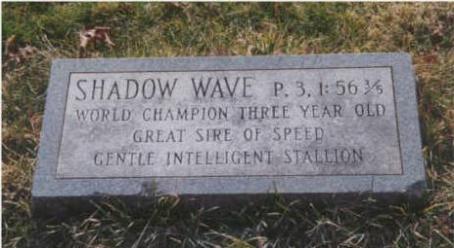
His gravestone records him thus:
SHADOW WAVE P3 1.56 3/5
WORLD CHAMPION THREE YEAR OLD
GREAT SIRE OF SPEED
GENTLE INTELLIGENT STALLION

“Gentle and intelligent” – those words tell us a lot about the horse, and the love and respect he had from those who managed him.

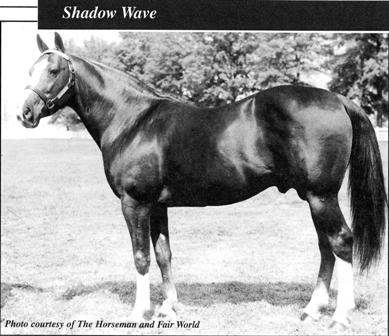
He was a chestnut with distinctive markings – four white socks and a prominent blaze the full length of his face. I’ll come back to that shortly. The only pictures I’ve sourced of Shadow Wave are the two in John Bradley’s wonderful book “Modern Pacing Sire Lines” which also records detail about his racing career, his breeding and his offspring. Bradley describes him as “a lanky, attractive chestnut” who “has added strength to pedigrees and is a very positive influence.”

Shadow Wave, from John Bradley's book

Shadow Wave

Shadow Wave was a son of Adios. He was unraced as a 2yo but went on to be a top performer at 3yo – the winner 20 races including The Little Brown Jug and named World Champion. He left plenty of good, fast horses, but no sires that carried on his line, which is how sires are judged. However his legacy really comes as a damsire and as a source of quality genes that, given the right conditions, can carry his influence over an extended number of generations.

He’s not Mr Fixit. But he is a strong integral part of a lovely fair-isle knitting pattern of breeding I am trying to create (I say “try” because there are no instant guarantees, given the nature of nature). He is a strong coloured yarn held behind the pattern and ready to be introduced to make an impact. Hang onto your knitting needles!

Shadow Wave’s strong white blaze is unusual in top sires, and distinctive white face markings pop up in some of his top progeny and their descendants. Is this a sign of the strength of his influence, sometimes over several generations?

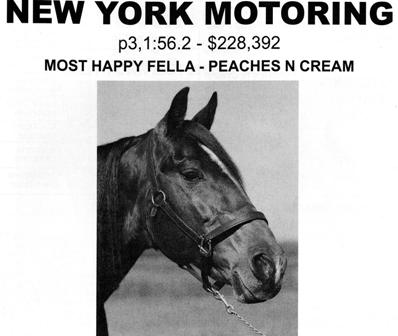
New York Motoring, distinctive star to blaze to snip markings

Take a look at these sires and offspring who have become part of the outstanding Zenover family and its different branches in recent times – they all have Shadow Wave genes – speed and strength. This family really appreciates Shadow Wave – and the feeling is mutual.

New York Motoring (sire of Interchange and Zenola Star) Shadow Wave is his damsire.
Payson’s Brother (mated with Interchange and grandsire of Copper Beach) Shadow Wave link through the sire line of No Nukes.

Payson's Brother

Payson's Brother - his sire is No Nukes who is by Oil Burner out of Shadow Wave mare

Elsu (son of Interchange). New York Motoring is his damsire.
Destination Moon (Grinfromeartoear son of Zenterfold). Shadow Wave appears twice in his  pedigree, once in his sire’s and once – via New York Motoring – in his dam’s.

Just to highlight Shadow Wave’s influence on the world-wide stage, amongst his filly foals were Dottie Shadow (dam of Oil Burner, $535,541), Tiny Wave (dam of Big Towner, $547,126), Ingenue (dam of Falcon Almahurst, $400,776), Real Hilarious (grandam of Die Laughing ($2,164,386) and also of Go for Grins ($302,003)), and Resourceful (grandam of Armbro Operative ($1,012,712).
Elsu

Elsu - son of Interchange

Shadow Wave is also the sire of Peaches N Cream, who is the dam of New York Motoring ($230,492) and Happy Motoring ($538.495), two well performed brothers by Most Happy Fella who are influential as sires and damsires in their own right. Happy Motoring pops up as the sire of On the Road Again ($2,819,102), and the grand-damsire of Pacific Rocket ($2,333,401). New York Motoring is the damsire of Elsu ($2,083,352), and the grand-damsire of Tintin in America ($934, 305).

Of course Oil Burner turned out to be the sire of No Nukes, and so brought Shadow Wave’s influence into many modern pedigrees.

Destination Moon as a foal - Grinfromeartoear from Zenterfold

New York Motoring was a prominent sire in New Zealand through the 1990s and therefore Shadow Wave is included in many mares’ pedigrees in New Zealand.

Shadow Wave’s appearance in the pedigrees of Panorama and Safely Kept means he is also poking his white-blazed nose into many quality Australian pedigrees as well.

More recently, Shadow Wave has appeared though Shifting Sands and Blue Horizon and Tiny Wave in the maternal lines of sires available in New Zealand, Australia and North America – Real Desire, Red River Hanover, Mach Three and of course Grinformeartoear. New sires with double ups of Shadow Wave include Artistic Fella and Shadow Play. You can see from all these sires that the white face and sock markings are often not present, but having Shadow Wave in the background may mean they pop up in some of these sires’ progeny in a “where on earth did that come from?” moment.

So while Shadow Wave may not have ‘created waves’ as a sire of sires, he has been – and is still – a very positive influence in the pedigrees of many horses today.

He is one of those sires whose genes seem to “punch above their weight” and blend well with other influential (not necessarily the most obvious or modern) genes. He was known for working well with mares of his time from trotting lines. He seems to love finding his own sire Adios and some of the great old bloodlines that New Zealand breeders access through Tar Heel, Albatross, Good Time and others.

I don’t believe in double ups for their own sake, but Shadow Wave is a sire who thrives on meeting himself in a pedigree, and can influence through maternal and sire lines equally.

If he’s there, he adds value. And this can be reinforced by breeding choices.

Those white markings are a lovely reminder of  the continuing influence of this gentle and intelligent stallion.

Read Full Post »

A recent article in Breeding Matters, the magazine of the New Zealand Standardbred Breeders Assn, talks about the skills and understanding that Kym Kearns brings to her work with horses. I’ve reproduced that article so more people can get to read it.

I’m lucky to have Kym’s involvement in raising and preparing the horses I breed. I see first hand the added value I get from this.

One story she’s told me that wasn’t included in the article, is the time when a young Kym led her horse up the steps of her family’s home, on to the verandah and in the front door. (Needless to say no-one else was home at the time!) After letting the horse have a good look around, she backed him out again – no damage done. This wasn’t an old horse with no energy and perfect manners. This was a relatively young horse she had broken in and educated herself, if I recall right it was a Arabian thoroughbred called Blue.  Her

Kym Kearns allows Tintin's yearling half brother Destination Moon to inspect the float

reasoning, as a teenager, was that she was familiar with where he lived, his paddock, his home. So she wanted to reciprocate and give him a look at where she lived.  It’s an insight into the mutual respect she builds with a horse that enabled them both to walk such a risky line!

Much later, 2006 it would be, I watched her walking yearling Tintin in America around the Cambridge Raceway and quietly letting him inspect and get familiar with all the surroundings, including the  “trainers tote” box where in future many dollars were passed over the counter and placed on Tintin the very successful racehorse! 

Kym has the patience to build a horse’s confidence within clear boundaries. Their curiosity is all part of their mental development, and her curiosity about what makes them tick, individually, helps her ‘read’ a horse and develop its character and potential.

That lays a foundation that asute trainers can – and do – build on.

Read Full Post »

The following article is a summary of a report commissioned from Ray Chaplin of equineexcellence.biz in Australia. The full report is available free of charge by emailing equineexcellence direct at contact@equineexcellence.biz

Ray’s report takes a close look at Life Sign, and why that sire struggled to make the expected big impact on the Australasian breeding scene. Ray’s analysis uses the concept of an EEA™ “Genetic Excellence Affinity©” which reflects the correct positioning between a sire and dam and hopefully is expressed at breeding. For more information about this, visit the equineexcellence.biz website.

All thirty (100%) of Life Sign’s top performers across North America and Australasia meet this Genetic Excellence Affinity © criterion. Interestingly, Ray pinpoints Holmes Hanover as a broodmare sire that offers a “Genetic Excellence Affinity©” with Life Sign – but Frank Marrion in his comments holds up this same cross as something to afford on type. Ray’s statistics certainly show that only 33% of Life Sign/Holmes Hanover cross foals bred in New Zealand were winners (27 foals for 9 winners) but the average earning per starter with that cross was NZ$66,285 compared to Life Sign’s average earnings per starter for all broodmare sires of $NZ20,634. Food for thought!

“What if?” by Ray Chaplin, equineexcellence.biz

World champion pacer, Life Sign 1990 ($US 1,912,459; 1:50.3) has proved to be one of the most outstanding stallions of the modern era in the USA. With seven millionaires, average earnings per starter of $95,694 from a total of 1394 foals, he has accrued sire winnings of over $US104 million in North America.

But what if Life Sign’s stud career had commenced in Australasia and not in North America? Would he have ever have become the “champion sire” he is?

Probably not, in the opinion of www.equineexcellence.biz

It is doubtful under this imaginary scenario that he would have received anywhere near the numbers of quality, genetically matched mares to have enabled him to put his best hoof forward as a stallion.

Life Sign provides astute breeders with a valuable “Sign” post into the world of genetics and the influence of differing gene pools that prevail from country to country and even state to state.

The Life Sign whose frozen and fresh semen has been available to Australasian breeders is exactly the same Life Sign as the sire who has established himself as one of the greatest ever North American sires. We are talking about a stallion that has left numerous elite standardbreds and in excess of 2,000 foals of racing age internationally – ample numbers to smooth out the impacts of any “type” issues. The difference in siring performance “down under” can be attributed to the size and quality of the necessary gene pool that was available to this champion son of Abercrombie in Australia and New Zealand.

The following table illustrates why Life Sign, had he originally stood down under, would have probably be shunned by breeders in North America if shipped back home thus providing little hope of him ever becoming a “Champion” sire.

LIFE SIGN (Statistics as at March 2011 – subject to change)

New Zealand
Foals 223   Starters 77   Winners 66 (30% wtf.)
Australia
Foals 1047   Starters 296  Winners 157 (15% wtf.)
USA/Canada
Foals  1394   Starters 1092   Winners 971 (70% wtf.)

Av earnings per starter (Country of birth only) $NZ 20,634 $AU16,116 $US95,694

Why? Because the gene pool he needed to do his best work as a sire was simply too small – especially in Australia. There was little chance that Life Sign would be afforded such a potent opportunity with the limited number of genetically correct high quality mares available to him “down under”.

The five leading broodmare sires in North America for Life Sign are Tyler B mares (56) average earning per starter $US94,816; Troublemaker mares (32) $US 88,396; Jate Lobell mares (143) $US 87,405; Cam Fella mares (58) $US 86,062; and No Nukes mares (251) $US77,302.

Twenty percent (4) of the leading Life Sign earners in both New Zealand and Australia are from mares whose broodmare sires appear in his top ten earners in the USA.

This suggests that if Life Sign had access to sufficient numbers of high quality mares in Australasia by these broodmare sires his siring record down under would have been significantly enhanced.

Holmes Hanover mares are responsible for another 20% (4) of the top twenty Life Sign performers in Australasia. Holmes Hanover creates the same EEA™ “Genetic Excellence Affinity©” between Life Sign and his mares as does Troublemaker and Cam Fella. Given the affordability of Life Sign now, this could be an opportunity for Australasian breeders with quality Holmes Hanover mares.

Whilst Life Sign never had a chance to repeat his USA siring deeds, he has and still does represent good value as an Australasian sire when matched to quality mares with whom he can establish an EEA “Genetic Excellence Affinity©” The sires of these suitable matrons go beyond the Troublemaker and Holmes Hanover mares highlighted in this report.

Life Sign as a Broodmare Sire

For those breeders who have bred Life Sign fillies from quality mares opportunity still abounds Life Sign is proving to be an excellent broodmare sire in North America. In the USA Life Sign’s top ten foals as a broodmare sire all lay claim to a common EEA™ “Genetic Excellence Affinity©” between sire and dam – exactly the same EEA™ “Genetic Excellence Affinity©” that was common to all ten of his leading progeny as a sire!

Frank Marrion on Life Sign

While Ray Chaplin sees genetic affinity as vitally important, Frank Marrion emphasises the compatibility of traits and type. The following comments were taken from recent personal correspondence and from an article on Life Sign in Harness Weekly in 2006:

Broodmares in North America are more advanced in evolutionary terms and it must always be remembered that some sires will perform differently with different gene pools, or different countries. Life Sign is also suited to a particular type of mare, a type which is more prevalent in America compared to New Zealand or Australia, where they tend to be coarser and later maturing.

There is a perception out there that Life Sign has been a failure because he hasn’t sired a ‘champion’, as if all one had to do was put any old mare to him to get one…It doesn’t work that way of course, particularly when little consideration is given to our type of mare and the type of stallion we are sending her to. While speed is a trait of the Direct Scooter sire line, quite the opposite is the Abercrombie/Life Sign line. They are generally very genuine horses, but lacking speed and/or early maturity. They tend to be big horses which need time to strengthen up. Life Sign has crossed very nicely with the right kind of In the Pocket mares (e.g. Classy Filly). But you wouldn’t want to breed a mare by Holmes Hanover to Life Sign because Holmes Hanover horses (although very genuine) are often big boned horses which lack speed, so breeding to Life Sign would just double up on the ‘lack of speed’ factor.

Bee Pears on Life Sign

It was about 2000 when Life Sign was introduced to New Zealand – our interest in breeding strong staying ‘cup’ horses had been replaced by the desire for speedy juveniles who could get a quicker and bigger return on investment. Top overseas sires were seen as the way to go for speed.

Life Sign came with great credentials, and he had left some super juveniles in America such as Real Desire, Island Fantasy and I Am a Fool. But overall his siring record is much more about leaving horses that get better as they strengthen and age. Add to that, his first few crops were by frozen semen and small numbers, which made it even harder to get the noticed, regardless of percentage foal to winner success.

His first small crops were pretty well received by Yearling Sales buyers but totally outnumbered by In the Pocket and Falcon Seelster offerings and of course Christian Cullen was coming right onto the scene in significant numbers.

Commercial reality is that most new sires are given a very short timeframe to show up before buyers (and then breeders in response) drop them like hot cakes. Our commercial breeding market is dominated by Yearling Sales and the pressure of high stakes for juvenile racing. By the time his larger crops were ready to sell or race, Life Sign’s reputation as a sire of horses that need time was well established, and his best performers only confirmed that. That inevitably meant his access to quality commercial mares reduced.

Poor performance by his siring sons didn’t help at all – until Real Desire came along more recently (with a Troublemaker dam).

The fact that Life Sign still shows up well in siring statistics for Australia and New Zealand is a credit to what he has achieved in spite of small suitable gene pool and the pressure to breed early speed.

Read Full Post »
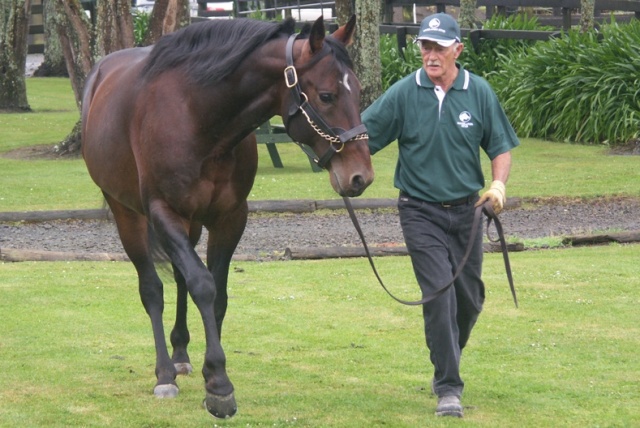
 

It is with tremendous relief that I’ve learned the treatment of Tintin’s soreness problem has been successful, in that he is now much more comfortable and is possibly heading for a career at stud (now confirmed he will be standing at Nevele R stud).

I look over what he did as a racehorse –
p2, 1:55.9; p3, 1:53.2 $934,305 16 wins. At 2, wnr G1 Sires’ Stakes 2yo Final, 2nd Listed NZ Yrlg SS Open, 3rd G1 NZ Welcome Stakes, Listed 2YO Emerald. 2YO NZ record holder over 1950m. At 3, wnr G1 3YO Emerald, G1 Australasian Breeders Crown Final, NRM Sires’ Stks heat, 2nd G1 NZ Derby, 2nd G1 Sires’ Stks Final. At 4, wnr G1 4YO Emerald, G1 NZ Messenger Championship, G2 4YO Futurity Stks, G3 Kumeu Stks, 2nd G1 Akld Cup. NZ record holder over 2700m.

Wow!

And also the excitment he brought to racing.

Tintin with Zenterfold and Kym Kearns

A young Tintin with Zenterfold and Kym Kearns

But what I remember most is the young Tintin full of character, cheeky, assertive, tough minded from an early age. He radiated determination and energy as potent as a coiled spring. Thanks to Kym’s ability to educate a young horse without supressing their spirit, he could bring all that energy with him to the trainer, and Geoffrey Small knew the family and recognised the talent, and could channel that energy and assertiveness into remarkable performances on the track.

What could he be as a sire? People will look to him for speed – we need another Bettors Delight, a sire that can add speed and is forgiven for not necessarily adding size. Of course speed on the track doesn’t necessarily convert into leaving speed as a sire. But in Tintin’s favour, he has a remarkable family behind him, and both a dam and sire who were speedy. As well as genotype, he has phenotype on his side – those quick flex muscles and the body type that can certainly express speed more easily than bigger, heavy types.

In a future blog, I’ll dig into this in more detail. But for now, I’m celebrating Tintin – a neat horse, a thrill to be part of – and wishing him, above all, comfort and freedom from pain.

Read Full Post »

(A rich and elegant puzzle Part 3 of 3) With all things lined up in their favour, why are four of Rich N Elegant’s sons not proving to be top sires? And why is there one son who is?  That’s the intriguing question I posed to Ray Chaplin of Australian pedigree consultancy equineexcellence.biz

This blog can only summarise Ray’s work  – his full report with the tables is available free of charge by emailing contact@equineexcellence.biz and it is well worth a read.

So good on paper and on the track – but not the impact at stud: Why? – by Ray Chaplin

Considered by many to be the greatest standardbred mare in harness racing history, Rich N Elegant is the first mare ever to produce three sub 1:50 performers: Red River Hanover (1:48.4), Royal Flush Hanover (gelding) (1:49.3) and Rocknroll Hanover (1:49.4).
Assessing her dam line

Rich N Elegant is by Direct Scooter out of the Abercrombie mare Proven Perfect who had four foals for three winners (75%wtf). Her second dam Shifting Sands by Shadow Wave from the Ensign Hanover mare Golden Miss had thirteen foals for eight winners (57%wtf). These results indicate a significant genetic upgrade has taken place.

We identified the source and positioning of this EEATM Genetic Excellence Affinity between Direct Scooter and Proven Perfect and armed with this information we researched the breeding barn performance of Rich N Elegant’s second and third dams. From the nineteen progeny of these mares one stood head and shoulders above the rest – the 1969 Bret Hanover colt Strike Out. Strike Out exhibits the same EEATM “Genetic Excellence Affinity” between sire and dam as does Rich N Elegant, and both these performers are by sires with proven superior genetic attributes – Direct Scooter and Bret Hanover.

Assessing her sires:

Rich N Elegant has produced top performing racehorses from three different sires: Western Hanover (for Rustler Hanover, Richess Hanover, and Red River Hanover), Cam’s Card Shark (for Royal Flush Hanover), and Western Ideal (for Rocknroll Hanover).

We assessed the genetic excellence indicators of the dams of each of these sires and compared the strengths of Wendymae Hanover (dam of Western Hanover) with Jef’s Magic Trick (dam of Cam’s Card Shark) and Leah Almahurst (dam of Western Ideal).

Western Hanover takes the bronze medal, Cams Card Shark the silver and Western Ideal the gold, based solely on the race and breeding record of their dam.

We believe that the dam line of a sire plays an important role in the overall genetic makeup of any progeny the sire produces. Western Ideal has a significant genetic strength advantage over Western Hanover.

Assessing her sons:

We then assessed and compared the race records and premier racing achievements of Rich N Elegant’s big four stallions. These results were benchmarked against leading stallions in the USA and Australasia today – Bettors Delight and Art Major.

Rocknroll Hanover clearly shines, with Bettors Delight and Art Major following. Rustler Hanover and Red River Hanover rate less, and Richess Hanover rates least.

These same sires were next assessed and benchmarked on their progeny records to date, looking at USA, Australian and New Zealand results as at October/November 2010.

Rocknroll HanoverWith far fewer starters, Rocknroll Hanover is already ahead of the accumulated totals of his three siring siblings in terms of worldwide starters, $1M plus earners and $500K plus earners.

Interestingly, of Rocknroll Hanover’s five $500K plus progeny to date, four (including his highest two earners Rock N Roll Heaven and Put On A Show) are from quality Artsplace mares.

Whilst it is early days, these insights may have important implications for those breeding to Rocknroll Hanover in Australasia. Currently he has thirteen Australasian bred 3yo+ foals but none of them are from Artsplace mares. Given the limited number of Artsplace mares in Australasia, time will tell if Rocknroll Hanover is able to emulate his North American breeding barn performance in the Southern Hemisphere.

Conclusion:

Well, the research evidence in this report does not provide a categorically proven answer to the question “What’s going on here?”

However our research suggests that the reason is primarily linked to “genotype” excellence factors of the individual stallions, the genetic strengths of the mares they served and the number of those that created a proven EEA™ “Genetic excellence affinity©” between sire and dam when expressed at conception.

Of the eleven progeny $500K+ that were sired by Rustler, Red River and Richess all exhibit the same common EEA™ “Genetic Excellence Affinity©” between their respective sires and dams as does the leading lady in this report “Rich N Elegant”

Another factor may well be how many quality well matched mares each stallion received in his first two books which would contribute to ongoing stud success as a result of attracting a continuing supply of quality mares

Finally there may be a “halo” effect resulting from the combined racetrack success of Rich N Elegant’s three Western Hanover colts and therefore a tendency to evaluate each of these sires on the basis of their combined efforts rather than as individuals (even though they are full brothers).

Read Full Post »

« Newer Posts - Older Posts »