Feeds:
Posts
Comments

Archive for the ‘Horses’ Category

After a 3-blog diversion into “Neddaland” I’m back looking at the new damsires in the 2012 yearling sales. In previous blogs I’ve covered Elsu, Courage Under Fire and McArdle. Now I’m focusing on the two damsire credits for Bettor’s Delight.

Lot 132, Premier Day One, is a colt named Full Disclosure by Christian Cullen out of Maddison Lee. He is one of only two yearlings in the 2012 yearling sales catalogue with a Bettor’s Delight dam – but he certainly won’t be the last.

With Bettor’s Delight building such a strong reputation as a sire now, and as a sire of good fillies, the next few years will see more of his earlier (frozen semen) mares getting in foal  to commercial sires and appearing in the sales catalogues.

And in the future his huge crop numbers will see a swarm of Bettor’s Delight broodmares, all looking for the sire/s that will ‘click’.

And that’s an interesting thing to ponder on, as I will over next couple of blogs – and I invite your thoughts (please post as comments and share your ideas).

Because it’s a bit like Sundon mares in trotting – the sires that unlock that Bettor’s Delight treasure trove of mares will write themselves a chapter in NZ standardbred history.

What proven, new or potential sires do you think will take up that role successfully, and why?

Lot 132 Full Disclosure

Lot 132 Premier Yearling Sales, a Christian Cullen colt from a Bettor's Delight mare

But for now, let’s take a closer look at Lot 132. Lyn O’Connell of Twisted Stick Lodge is the breeder and is very familiar with the family – in fact (as Lyn McLachlan) bred the very good filly Adios Dream from Deborah Dundee, this yearling’s 3rd dam.

Lot 132’s dam Maddison Lee was one of Bettor’s Delight’s first frozen semen crops via Nevele R Stud. She was a 2004 foal, when Lyn recalls the stud fee was around $10,500, so she was bred with a longer view as a quality broodmare. Lyn describes the mare as ’round and not very athletic’ and although she did qualify she didn’t show enough to pursue as a race horse.

She says the choice of Christian Cullen as the sire for Maddison Lee was strongly influenced by the success of Christian Cullen mares going to Bettor’s Delight (with Highview Tommy being one example). “That cross is well regarded and successful, so I am just doing the same in the opposite direction.”

However the yearling has thrown more to the dam’s family, and is neither a big bold Christian Cullen replica, nor the solid round type that Bettor’s Delight can produce. She describes Full Disclosure as a racy type, very athletic, who “paces fast and free legged around the paddock, and wants to be on the go. ”

“In fact he reminds me a lot of Adios Dream and Courage Under Fire as a type – it’s the smaller ones from this family that seem to turn into the good racehorses.”

In the next blog I’ll check out Lot 283, Lexus Franco, the other yearling with a Bettor’s Delight dam. In the meantime, start gazing into your crystal balls and give me some thoughts on who you see as a good future cross for Bettor’s Delight mares, particularly for the many who have In The Pocket and Holmes Hanover as their damsire.
Read Full Post »

The qualities that Nedda had, she passed on to her daughter Nedda Guy, and Nedda Guy passed them to On Time who passed them on to the great racehorse and sire Good Time, his full sister Our Time, and several of her other nine foals (all winners). These enduring qualities were a result of several factors – but probably the most significant one is a thoroughbred mare called Esther.According to www.worldclasstrotting.com entry (this site has a great section on foundation mares/remarkable dams)

“Esther is the only thoroughbred that ranks as a foundation mare with the harness horse. And it all started with Leland Stanford, who wanted to experiment by crossing thoroughbred mares to his sire Electioneer 125.”

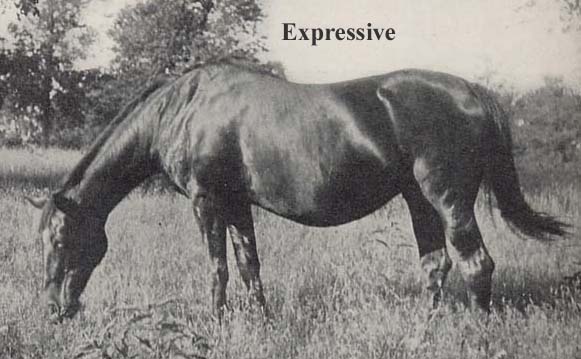
Expressive

Expressive, dam of Atlantic Express (sire of Nedda)

In 1879 he bought several mares, one of which was Esther, and the resulting foals were all raised as trotters.

One of Esther’s daughters was Expressive (by Electioneer) who was a great racing mare and left some good progeny later in her broodmare career including Atlantic Express, the sire of Nedda.  Atlantic Express is also the damsire of Dean Hanover, one of trotting’s quality racehorses of the 1930s who became a good sire and such an influential damsire. It is Dean Hanover who sired Goddess Hanover, the dam of super mares Cassin Hanover and Arpege – a ‘golden family’ of trotting that led to Angus Hall, Andover Hall, Texas, world champion Ayres,  and many more.

Another of Esther’s daughters was Mendocita (by Mendocino, a son of Electioneer), who didn’t race but whose own daughter Cita Frisco was the dam of the outstanding Volomite.

Volomite, sire of On Time

Volomite, mated with Nedda Guy to produce On Time, Olympia and Mighty Ned

So when Nedda’s daughter Nedda Guy was bred to Volomite, her progeny were 4×5 to Esther on maternal lines. The results are covered in my previous blog.

(Nedda herself was bred once to Volomite for a colt called Prologue who took a mark of 2.10 as a 3yo in 1932 and later stood in a very small way as a sire, first in US and then in Sweden.  But that’s breeding, it doesn’t work 100% of the time for many reasons.)

But let’s get back to Esther – what makes her so special? Followers of standardbred breeding will be familiar with the “x factor” theory, which points to strong evidence of large hearted lines being carried on the x chromosone, and thus able only to be passed from from dams to sons and daughters, but not from sires to sons. Esther is a thoroghbred mare that traces back through her dam Colisseum to Glencoe, sire of Pochahontas – and Glencoe is one who is recognised as a primary carrier of the giant heart of Eclipse. If you want more on this, find the books by Marianna Haun which although mainly about applying the theory to thoroughbred lines also cover trotting examples.

Nedda had another card up her sleeve – her own great-grandam was Ethelwyn (the great trotting family also known as Kathleen) who traces back in two directions on x lines to Eclipse.

Now none of this would have guaranteed Nedda the ability, speed and courage that she showed and that she passed on. But it certainly would have helped maximise her chances.

Sometimes harking to the best of those great heart lines even well downstream can work. That might be by double ups, or it might be by referencing very compatible bloodlines again.

For example, as John Bradley points out in Modern Pacing Sire Lines, some of Good Time’s most successful sons and daughters had 3×3 crosses to Volomite (e.g. Race Time, Good Counsel) and others had 4×4 or similar double ups to Guy Axworthy who was Nedda Guy’s sire.

But I’d like to finish by returning to where this 3-part blog began – a salute to wonderful mother and daughter trotters, Nedda and Nedda Guy.  They had speed, determination, public affection, and even the ability to give punters a fright by making a slow getaway in a race…. Some things never change! For Nedda, born almost 100 years ago, to trot a mile in 1.581/4 is something to marvel at. What a sweetheart! What a trotter!

I was wondering what modern day mother-daughter combination has caught the trotting imagination like this? Petite Evander-Pride of Petite in New Zealand  immediately sprang to mind.

Any others you can think of? Comments please!

Read Full Post »

Nedda Guy was one of Nedda’s five foals and by far the most significant. She inherited her mother’s speed and toughness – and her ability to win public admiration as well as races. She was the star of the 1931 trotting season until a career and life-threatening injury occured – but even that didn’t stop her.

Henry McLemore, writing a column in The Huntingon Daily News on August 18 1932 sums up her public affection nicely:

“The roar goes up when Nedda Guy won the first heat of the Shepherd Stake… “A game little filly,” someone explains. “She’d a won the Hambletonian last year but for injuries in the opening heat.”

There are several accounts of that 1931 Hambletonian, but The Milwaukee Journal of August 16, printed this report from Goshen, NY where the heats were held at W H Cane’s farm on a three-corned one-mile track:

“Nedda Guy, 3-year-old filly owned by W H Cane, which went lame during the running of the second heat of the Hambletonian Friday, probably never will start in another race. The little bay filly, which was pre-race favourite, is thought to have suffered a fractured pelvis bone during a warming up mile prior to the first heat….If Nedda Guy was injured before the start of the Hambletonian, her performance was remarkable. She finished fifth in the first heat and then staged a great stretch drive to land second place in the second heat back of Calumet Butler, which stepped the mile in 2.031/4.”

Nedda Guy was assisted off the track, but first had to be paraded in front of disbelieving favourite punters to show how lame she was.

The story has a happy ending, as reported in The Evening Independent the following year:

“When examination disclosed the fracture she was to suffer the usual fate of seriously injured racing horses, but Walter Cox gave her such excellent care that she is now in sound condition and an outstanding contender for honors in the four-year-old division.”

It’s as a broodmare that Nedda Guy is now remembered – one of her five foals was On Time (by Volomite) born in 1938 who was developed as a pacer. She went on to be the dam of fantastic race horse, sire and damsire Good Time, and thus appears in the pedigree of many top racehorses of both sexes and in many leading sires and broodmares. On Time produced not only Good Time, but a younger full sister Our Time who set a world record for 2yo fillies in 1948 and won over $50,000 that year. Our Time was ranked by Frank Irvin alongside Adios, Bret Hanover, Good Time and Good Counsel as the five best horses he had trained, and she pops up in some pedigrees as grandam of Whata Baron (himself a world champion racehorse).

Another of Nedda Guy’s daughters, Olympia (by Volomite), led to a less illustrious line but one that finishes with a flourish – as the bottom line of Big Towner’s pedigree – notice my old favourite Shadow Wave as the damsire, adding his contribution! Big Towner was a horse with tremendous speed who hardly ever raced on the big tracks where he could use it to full advantage.

Yet another of Nedda Guy’s foals by Volomite was Mighty Ned, born 1942, who appears to have been exported to Italy as a trotter where he won the Prix d’Amerique at 6 and 9 years old and was also second in that race at 7 years old (before having a career at stud).

At its best, this  line appears to really stamp progeny – small in stature (Nedda the “little mare”, Nedda Guy the “game little filly”, Good Time who notoriously started racing at 13.1 hands and ended it as a 14 hand sire) but with a big motor (heart), real speed and excellent gait. As a sire, Good Time often passed on those attributes, and the big heart (through his x line to his female foals) has helped him be such a positive factor in many modern bloodlines.

John Bradley’s book Modern Pacing Sire Lines has an excellent chapter on Good Time

Where did that big heart come from?

This is where Volomite comes in.

And Atlantic Express.

That’s what I’ll look at in the next blog – which is also about a thoroughbred mare called Esther.

Read Full Post »

In my last few blogs I’ve been peeking into the future, looking at some of the new damsires appearing at the yearling sales. In the next few blogs I want to dive back almost 100 years and celebrate two exceptional trotters, a mother and daughter, and the damsire that added so much value to their pedigree.

As breeders and owners, we are delighted when our filly or mare takes a record of, say, 1.58 mile rate. Just going 2 minutes these days doesn’t really stand out from the crowd.

So imagine a trotting mare who went 1:591/4 in race conditions and 1.581/4 in a speed trial – 90 years ago.

Her name was Nedda, and she was an outstanding world champion trotting mare who took her record in 1922. This wasn’t a fluke – although in today’s standards her lifetime stake earnings of $12,294 look small, she won 23 of her 43 starts. Incredible!

Nedda is the great-grandam of the wonderful sire and broodmare sire Good Time, so you will find her in many pedigrees of top pacing sires wherever Good Time appears – including Most Happy Fella, No Nukes, Jate Lobell. Through a slightly different route, she’s also in the bottom line of Big Towner’s pedigree.

At Lexington on October 4 with Harry Fleming in the cart (trainer and driver for many of her races), Nedda lowered the world’s record for trotting mares to 1:581/4, which held good for 16 years until Rosalind reduced it to 1:563/4 in 1938.

A New York Times article of August 13 1922 indicates she was in great form that season:

“Sensational Trotter Will Make Speed Trial At Philadelphia Grand Circuit Races.
Nedda, the sensational trotter by Atlantic Express, that stepped to a mark of 1:591/4 last week over the Toledo track, will be one of the features in the Grand Circuit meet at the Belmont Driving Park here the coming week….”

About a month previously, at another Grand Circuit meeting in Toledo, she competed in three heats of The Maumee 2:05 Trot (value $2,620) winning the first heat and coming second in the others, but still pipped for the purse by a gelding called Peter Coley who won two of the three heats. The Lewiston Daily Sun of July 14 records:

“In the first heat, Nedda overtook the field at the quarter post after a bad start and pulled away for a length win…Nedda trotted a great race in the second heat after getting away fully four lengths behind the others at the flag. Peter Coley won by a nose from the fast stepping favourite but Nedda went the fastest mile of the year, separately timed, completing the circuit in 2.023/4. The little mare made the first half in 59 seconds, the fastest half of the year.”

If you think she sounds tough, just wait till you read about her daughter, Nedda Guy, in my next blog!

It is hard to find photos of these historic race horses unless they became sires. I’ve located one of Nedda on the front cover of a USA trotting magazine from the 1930s (appears to be her rather than daughter Nedda Guy) but cannot reproduce it at this stage – will do so later.

I’ll cover Nedda’s breeding record briefly in the next blog, but any photos or other Nedda anecdotes are welcome – searching the web on dial up is a little frustrating (visualise smiley face with gritted teeth..) 

A quirky footnote: Also at that same July 1922 meeting in Toledo where Nedda was competing in trotting heats, a pacing event was run over four heats. The third placed horse overall (with a 1st, 9th, 3rd and 3rd) was a black pacing entire called Abbedale, who of course went on to many great things including siring Hale Dale, one of the most important sires in our pacing history. You can never tell how things will turn out!

Read Full Post »

Continuing my look at some of the new damsires in the yearling sales catalogue for 2012:

Lot 14 and 101, Karaka – Courage Under Fire mares from same family, both bred to Jereme’s Jet

These yearling colts are bred by David Phillips – and he’s saved me investigating why by writing an extremely detailed advertisement in the Feb 9 Harness Weekly: “Jereme’s Jet: the Golden Cross”.

These are the only Courage Under Fire mares with yearlings in the catalogue this year, although there were three last year and I would expect more to start turning up in coming years.  If David Phillips is right, they will be lining up at the door of Jereme’s Jet! However I reckon Courage Under Fire mares will be well positioned to go to a range of quality sires.

The advert is typically idiosyncratic, but it is refreshing to see a breeder openly explaining to anyone who wants to read the small print exactly why he has bred along these lines. David lists “the wonderful reverse sex of Sampson Hanover…in mid pedigree, the fact that JJ and Vance Hanover (sire of dam of CUF) are from the same dam’s family; the relationship of Adios Butler and his sister, and Light Brigade and his sister; the reverse sexed Albatross; and more.”

Phew! On the catalogue page none of them show up – and that’s to do with the limitations of space because most of the double ups or brother/sister connections in the yearlings’ pedigree are 6 or more generations back. So I guess he’s saying that the nature of these double-genetic double-ups and the positions they are in will result in a higher likelihood of genetic excellence in the yearling colts, even though they are relatively far back in the current yearling’s pedigree.

I’m not a fan of double-ups for their own sake, but good on him for making a call on the Jereme’s Jet x Courage Under Fire cross and putting it out there in print for all to witness. It’s refreshing to see someone committing to that, and being very open about their breeding decisions. Whether we agree or not is up to us. Some buyers and trainers will ignore it and simply like Jereme’s Jet as a potential ‘early’ sire, and see a Courage Under Fire mare as adding potential “gait speed” and “heart” to the equation. Either way, the combination might work well.

I’ll be interested to see the colts themselves at the yearling sales auction. Jereme’s Jet is an exciting sire, with a slightly different twist on pedigree which is great,  and he is a very muscular horse.

What David Phillips doesn’t mention in the advert is the maternal family of both these mares – the genetic match is almost entirely about the Courage Under Fire aspect of their pedigree rather than their maternal family, i.e. the recent entrance of Courage into the mix which he has obviously done with purpose. Both mares were lightly raced and indicated some speed. It’s an interesting maternal line, coming from a full sister to Soky’s Atom (Jef’s Galleria). More recently there have been ups and downs getting Red Electric Moon in foal. It would be great to see Courage Under Fire and then Jereme’s Jet injecting a real revival into the family fortunes. 


Read Full Post »

New Zealand standardbred breeders get a relatively small ‘window of opportunity’ to produce commercial foals – and many of us have relatively small financial resources to match!

Add to that, if your mare is foaling in the same season you sometimes are waiting until November to get your first shot at insemination.  Some mares are difficult to get in foal for a range of reasons, and mares just retired off the track can take a while to ‘let down’.  And there are other factors such as the condition of the mare, unusual weather patterns, whether the semen is fresh or frozen etc etc.

It is really important that everyone does their best to get the ‘planets all lined up’. 

Because not getting a mare in foal means the breeder will have to carry a mare through to the following season – not a planned break (which personally I support doing for mares at appropriate intervals) but an unnecessary year’s delay in producing a commercial foal and additional costs of looking after a mare who is not “working”.

So it is really frustrating when a sire with a reputation for being highly fertile appears to be having an off season.

This happened with one of my mares in this 2011/12 season – and I gather I am not alone in having many goes at getting a mare pregnant to Bettor’s Delight, and even then not being successful. Ironically we first tried for frozen semen from Somebeachsomewhere, but were advised that the quality of that semen arriving in NZ was so poor (good on Macca Lodge for being upfront about this and incredibly helpful in getting the deposit refunded), we switched to a local Mr Reliable – Bettor’s Delight – before we even started. 

Alas, by late December we had to finally pulled the plug or risk going into Northern Hemisphere time.

It can happen to a sire. It has happened in the past.  And it will probably be fine the following year.

But from a breeder’s perspective, and I am sure from the perspective of semen bases who have to deal directly with the mare and the breeder, it is good if a potential issue is recognised as soon as possible, because each attempt reduces the ‘window of opportunity”. 

I realise that an apparent drop in fertility affects the return on investment for the stallion’s owners and managers, but it also directly impacts on many breeders who are struggling to keep up with rising costs and do their bit to maintain our breeding numbers. Sure, you don’t have to pay the service fee, but you are still committed to significant costs without the bonus of having a foal on the way.

Good communication. That’s what helps build reputations and relationships for the longer term. In this case, I am sure Woodlands Stud will have a good look into it once the season is tallyed up and share what they find. I do appreciate that sometimes we can jump to conclusions, whereas evidence may tell a different story.  After all, Bettor’s Delight is a fantastic sire and a hugely popular one. And I am sure there are many happy breeders around the country with positive results too.

This is less about this one particular case, and more to make the point of how breeding relies on many complex factors, all working together to get a positive result. It’s in everyone’s interest. Fertility rates are publicised and that’s great for breeders because it is something we have to take into consideration when making decisions about timings and sires.

For my mare, it’s not a huge issue, more a frustration. We will hopefully get a flying start next season.

Read Full Post »

As I said in my last blog, going to stallion parades and yearling parades can be a great way for breeders to see types ‘in the flesh’.

It can challenge the prejudices or misconceptions that inevitably creep in when we base our views on promotional material or a bad experience with one individual horse or what we’ve heard on the grapevine.

I like observing the yearling parade day in a state of mind that says: “Just look at each yearling coming into the parade ring – ignore the lot number, ignore any practice commentary from the PGG team and just respond to the type of yearling in front of you before your vision is clouded by too much information.” If one grabs you then check out what it is – and the results might surprise.

American Ideal

American Ideal at Woodlands Stud parade 2011, photo Bee Pears

Last year I did this at the 2011 Australasian Classic Sale at Karaka, and rediscovered American Ideal. Four of the five yearlings by American Ideal were ones that appealed strongly to me on type, enough to make me jot down comments and note their lot number – and discover their common sire.

A couple of years before that, I had been the Woodlands Stud stallion parade and saw Bettor’s Delight, Pegasus Spur and American Ideal paraded up close. Perhaps I was distracted by the strong energy of Bettor’s Delight, a sire who is not big in size but has a big personality and is built like a brick shithouse! And perhaps I was too busy admiring Pegasus Spur, who has a heap of character, stands tall and looks a bit like a Friesian horse! Anyway, I came away with the impression that American Ideal was a smaller stallion and quite plain. He hardly registered with me.

But lo and behold, a couple of years later here were three yearlings for sale that, on type, I really liked – all by American Ideal. They weren’t big, bold horses but they seemed evenly developed and strong, and what you might call go-early types. I really liked them.

Lot 41 was sold for $80,000, Lot 92 for $10,000 and Lot 93 for $60,000. The only filly sold for $7500, and I hadn’t seen her parade. I’d be interested to find out how they are getting on (note to self).

So when I went to the Woodlands Stud stallion parade again later that year, I was keen to have another fresh look at American Ideal.  Again, all three sires were paraded – Bettor’s Delight still strutting like he owns the place (he’s certainly helping to pay for it!), Pegusus Spur checking out the crowd, chewing on the grass, happy to run up and show us what a lovely mover he is. And then American Ideal – oh not as small as I remembered (15.2h), very relaxed, very professional, a lovely walker, not showy but strongly built right through the body.

He’s doing a top job so far on the track in America as well as starting to show up here – Ideal Scott, Besotted, etc.  American Ideal himself performed well at 2 years and superbly at 3 years old.

And in North America he has crossed successfully with mares we can offer here from sires like Artsplace, Falcon Seelster, Life Sign (almost inbreeding, interesting).

So although he doesn’t have the glamour profile of a Bettor’s Delight or an Art Major, American Ideal yearlings certainly opened my eyes to a very nice type of stallion who seems to be stamping his foals.

Read Full Post »

Yearling sales are only three months away – the catalogue is already out. Why not use the sales as a way to test your skills and breeding theories? Can you be as clever as Cran Dalgety, as good as Geoffrey Small or as magic as Mark Purdon in finding the nuggets of gold amongst the hundreds of hopefuls?

This is a great time to test your ability to pick future winners based on their pedigree, family performance and individual type.

By yourself, or with a group of friends, select your own ‘virtual stable’ of yearlings and follow their careers.

There’s no need to waste sellers’ time with inspections – just use what is publicly available such as the catalogue, further pedigree databases if you want, the videos and photos, and the yearlings themselves on Parade Day and as they go through the ring.

You can make up the rules to suit yourselves, but the key is to keep it simple and avoid long lists that get altered as the reality of racing starts to kick in. The best option is  about 6 yearlings each. You can use a budget limit, or just pick without regard for the yearling’s price on the day. It works best if the decision deadline is on Sales Day or soon after. 

Follow your sales picks over the next few seasons, and see what happens. At the end of each season, there might be a “shout” by the loser or a TAB voucher for the winner, or whatever suits your pocket and the number of people involved.  You might judge success on number of “virtual stable” wins, or the horse with the highest earnings – or for their 2yo season just qualifying is worth celebrating.

Because this is a lot harder than it seems!

I first tried this with a friend at the Sale of the Stars 2009. We each picked three yearlings from the North Island (Australasian Classic) Sale, and three yearlings from the South Island (Premier) Sale. Our six selections had to be split between colts and fillies. 

Of the total 12 yearlings we picked between us, only one has (halfway through their 4yo season) earned more than its purchase price. Three of our fillies never qualified but are at stud already.

I was fortunate to pick Charge Forward for my stable, the lovely Grinfromeartoear-Pure Envy colt who cost $30,000 and has so far earned $82,082 with 7 wins. My next best was (by coincidence) another colt bought by the ATC Syndicate – McArmbro, cost $36,000 and ended up with 17 starts for no wins and 8 places and only $5276, before going to Australia and adding 7 wins for a lifetime earning total of $28,301 to date.

My friend’s best pick was Return of the King (Christian Cullen-Hot Blooded Woman) who cost $41,000 and was exported immediately to Australia where he’s managed 6 wins and 20 places for a total of $31,446 to date. Another of her selections was Meet Me In Seattle which looked very promising but then his form tapered off with only $9,674 in the bank so far. 

I have a huge respect for those who buy astutely and successfully at yearling sales! I certainly found selecting from the catalogue (on pedigree and family performance alone) was a disadvantage for the South Island sale, as I could neither get there in person or watch it on TV. I can understand why buyers/trainers place a premium on type.

This year we limited selections to four yearlings (either sex) from the 2011 Australasian Classic at Karaka.  I watched the Parade without my catalogue, picking out what I liked purely on type before checking its breeding. (In my next blog I’ll talk more about that, because it is a great way to test your biases when it comes to preferred sires!)

My “virtual yearling stable” picks are
Lot 79 Outlaw (Bettors Delight – Gift of Grace),
Lot 154  Alta Christiano (Christian Cullen – Right This Time),
Lot 92 Eye for a Deal  (American Ideal – Illmakemyname
and Lot 179 Sugar Ray Brogden (Grinfromeartoear-Swift Mirage).

A friend has picked
Lot 69 Los Amante  (Grinfromeartoear – Erinyes),
Lot 146 Mexicano  (Christian Cullen – Precious Maiden)
Lot 177 Isa Smiling (Pegasus Spur – Sun Isa)
Lot 27 Assasin – (Art Major – Almost an Angel).

So far we have two qualifiers (Mexicano and Sugar Ray Brogden) and Mexicano has tasted success at the races.

Developing a good eye for a nice horse, good families and potentially successful pedigree matches takes time. The yearling sales are a wonderful opportunity for any of us to observe some of the better bred horses in the flesh and to compare types.

So come on, start your homework now, and I’ll come back to this topic closer to the 2012 yearling sales and compare notes.  

Can you pick a champion?

Read Full Post »

I want to sing the praises of pacing stallion Shadow Wave, born 1955 and died 18 years later.

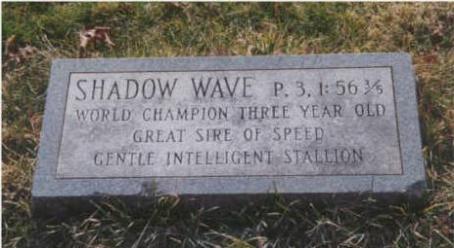
Shadow Wave's grave

Shadow Wave's grave

His gravestone records him thus:
SHADOW WAVE P3 1.56 3/5
WORLD CHAMPION THREE YEAR OLD
GREAT SIRE OF SPEED
GENTLE INTELLIGENT STALLION

“Gentle and intelligent” – those words tell us a lot about the horse, and the love and respect he had from those who managed him.

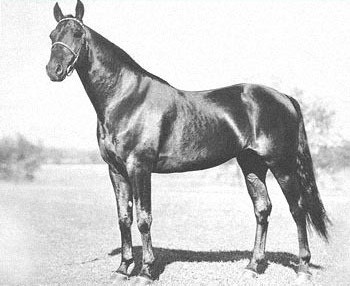
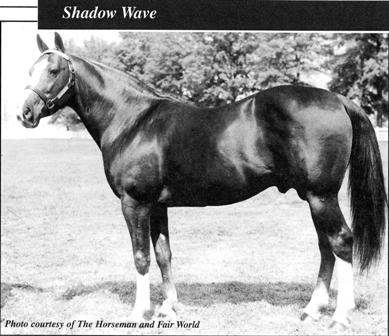
He was a chestnut with distinctive markings – four white socks and a prominent blaze the full length of his face. I’ll come back to that shortly. The only pictures I’ve sourced of Shadow Wave are the two in John Bradley’s wonderful book “Modern Pacing Sire Lines” which also records detail about his racing career, his breeding and his offspring. Bradley describes him as “a lanky, attractive chestnut” who “has added strength to pedigrees and is a very positive influence.”

Shadow Wave, from John Bradley's book

Shadow Wave

Shadow Wave was a son of Adios. He was unraced as a 2yo but went on to be a top performer at 3yo – the winner 20 races including The Little Brown Jug and named World Champion. He left plenty of good, fast horses, but no sires that carried on his line, which is how sires are judged. However his legacy really comes as a damsire and as a source of quality genes that, given the right conditions, can carry his influence over an extended number of generations.

He’s not Mr Fixit. But he is a strong integral part of a lovely fair-isle knitting pattern of breeding I am trying to create (I say “try” because there are no instant guarantees, given the nature of nature). He is a strong coloured yarn held behind the pattern and ready to be introduced to make an impact. Hang onto your knitting needles!

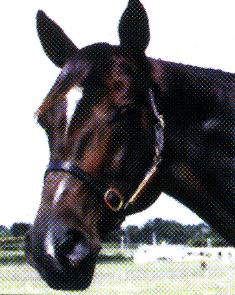
Shadow Wave’s strong white blaze is unusual in top sires, and distinctive white face markings pop up in some of his top progeny and their descendants. Is this a sign of the strength of his influence, sometimes over several generations?

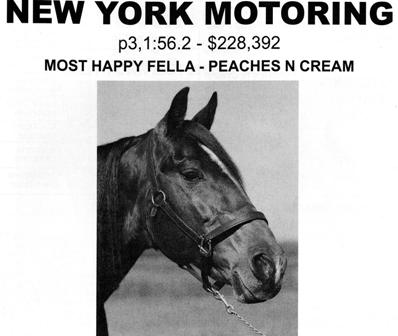
New York Motoring, distinctive star to blaze to snip markings

Take a look at these sires and offspring who have become part of the outstanding Zenover family and its different branches in recent times – they all have Shadow Wave genes – speed and strength. This family really appreciates Shadow Wave – and the feeling is mutual.

New York Motoring (sire of Interchange and Zenola Star) Shadow Wave is his damsire.
Payson’s Brother (mated with Interchange and grandsire of Copper Beach) Shadow Wave link through the sire line of No Nukes.

Payson's Brother

Payson's Brother - his sire is No Nukes who is by Oil Burner out of Shadow Wave mare

Elsu (son of Interchange). New York Motoring is his damsire.
Destination Moon (Grinfromeartoear son of Zenterfold). Shadow Wave appears twice in his  pedigree, once in his sire’s and once – via New York Motoring – in his dam’s.

Just to highlight Shadow Wave’s influence on the world-wide stage, amongst his filly foals were Dottie Shadow (dam of Oil Burner, $535,541), Tiny Wave (dam of Big Towner, $547,126), Ingenue (dam of Falcon Almahurst, $400,776), Real Hilarious (grandam of Die Laughing ($2,164,386) and also of Go for Grins ($302,003)), and Resourceful (grandam of Armbro Operative ($1,012,712).
Elsu

Elsu - son of Interchange

Shadow Wave is also the sire of Peaches N Cream, who is the dam of New York Motoring ($230,492) and Happy Motoring ($538.495), two well performed brothers by Most Happy Fella who are influential as sires and damsires in their own right. Happy Motoring pops up as the sire of On the Road Again ($2,819,102), and the grand-damsire of Pacific Rocket ($2,333,401). New York Motoring is the damsire of Elsu ($2,083,352), and the grand-damsire of Tintin in America ($934, 305).

Of course Oil Burner turned out to be the sire of No Nukes, and so brought Shadow Wave’s influence into many modern pedigrees.

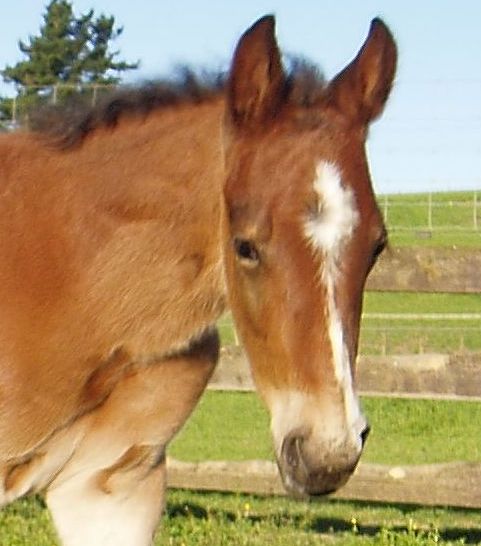
Destination Moon as a foal - Grinfromeartoear from Zenterfold

New York Motoring was a prominent sire in New Zealand through the 1990s and therefore Shadow Wave is included in many mares’ pedigrees in New Zealand.

Shadow Wave’s appearance in the pedigrees of Panorama and Safely Kept means he is also poking his white-blazed nose into many quality Australian pedigrees as well.

More recently, Shadow Wave has appeared though Shifting Sands and Blue Horizon and Tiny Wave in the maternal lines of sires available in New Zealand, Australia and North America – Real Desire, Red River Hanover, Mach Three and of course Grinformeartoear. New sires with double ups of Shadow Wave include Artistic Fella and Shadow Play. You can see from all these sires that the white face and sock markings are often not present, but having Shadow Wave in the background may mean they pop up in some of these sires’ progeny in a “where on earth did that come from?” moment.

So while Shadow Wave may not have ‘created waves’ as a sire of sires, he has been – and is still – a very positive influence in the pedigrees of many horses today.

He is one of those sires whose genes seem to “punch above their weight” and blend well with other influential (not necessarily the most obvious or modern) genes. He was known for working well with mares of his time from trotting lines. He seems to love finding his own sire Adios and some of the great old bloodlines that New Zealand breeders access through Tar Heel, Albatross, Good Time and others.

I don’t believe in double ups for their own sake, but Shadow Wave is a sire who thrives on meeting himself in a pedigree, and can influence through maternal and sire lines equally.

If he’s there, he adds value. And this can be reinforced by breeding choices.

Those white markings are a lovely reminder of  the continuing influence of this gentle and intelligent stallion.

Read Full Post »

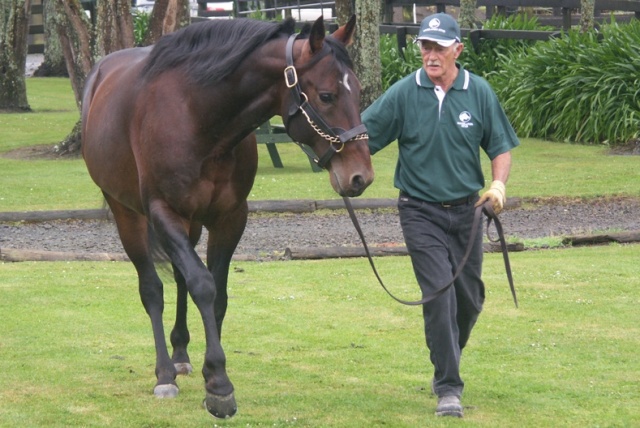
A recent article in Breeding Matters, the magazine of the New Zealand Standardbred Breeders Assn, talks about the skills and understanding that Kym Kearns brings to her work with horses. I’ve reproduced that article so more people can get to read it.

I’m lucky to have Kym’s involvement in raising and preparing the horses I breed. I see first hand the added value I get from this.

One story she’s told me that wasn’t included in the article, is the time when a young Kym led her horse up the steps of her family’s home, on to the verandah and in the front door. (Needless to say no-one else was home at the time!) After letting the horse have a good look around, she backed him out again – no damage done. This wasn’t an old horse with no energy and perfect manners. This was a relatively young horse she had broken in and educated herself, if I recall right it was a Arabian thoroughbred called Blue.  Her

Kym Kearns allows Tintin's yearling half brother Destination Moon to inspect the float

reasoning, as a teenager, was that she was familiar with where he lived, his paddock, his home. So she wanted to reciprocate and give him a look at where she lived.  It’s an insight into the mutual respect she builds with a horse that enabled them both to walk such a risky line!

Much later, 2006 it would be, I watched her walking yearling Tintin in America around the Cambridge Raceway and quietly letting him inspect and get familiar with all the surroundings, including the  “trainers tote” box where in future many dollars were passed over the counter and placed on Tintin the very successful racehorse! 

Kym has the patience to build a horse’s confidence within clear boundaries. Their curiosity is all part of their mental development, and her curiosity about what makes them tick, individually, helps her ‘read’ a horse and develop its character and potential.

That lays a foundation that asute trainers can – and do – build on.

Read Full Post »

« Newer Posts - Older Posts »