Feeds:
Posts
Comments

Archive for the ‘Pedigree matching’ Category

Over the past 6 months I have written a series of articles for Harnessed magazine, which I have now posted as part of the list under the Articles section of this blog. You can find the Articles section on the tabs across the top of my blog.

The articles track the breeding performance of fillies and mares who participated in some of the great races of 10 or 20 years ago, and the last one of the series (which I will post up when it has been published in Harnessed) does the same for the sires who first stood here 10 years ago.

Researching these articles was both inspiring and depressing. Depressing because there are so many descending lines from mares which either end poorly or never even start. There are mares who are hardly given a chance in terms of quality sires, and mares that are given many, many chances for little reward. There are mares who miss or slip repeatedly, and mares that breed almost entirely one sex or the other. There are many top race mares who leave nothing nearly as good as themselves.

But the research was also inspiring, because there are mares (often brought cheaply) who have excelled on the race track and in the breeding barn, and mares who have kick-started a fading maternal line and given it two or three strong branches for the future. There are breeders who have upgraded families, and breeders who have successfully taken chances rather than played it safe.

It all shows just how tricky it is for a maternal line to continue on successfully over a decade or more, and how challenging it is to be a good breeder.

When you read these articles, remember that the statistics for progeny were correct at the time of writing. Many of the mares’ progeny will have raced and hopefully won since I wrote the articles, new foals will have been born, and yearlings sold for big or small prices at the 2015 or future yearling sales.

You are welcome to update, correct or add to the articles in the “Leave a comment” area at the bottom of the Harnessed magazine articles page.

Finally I urge you to subscribe to Harnessed magazine as a top quality monthly publication about harness racing and standardbred breeding in New Zealand, and insights from further afield. It is the official publication of Harness Racing New Zealand. You can subscribe here

Read Full Post »

Following on from my last post, where I noted the absence of Western Hanover as a damsire of commercial sires, this time I look at our local sires and see where the damsires are coming from.

Once again, there is a big name almost totally missing – In The Pocket.

In The Pocket, a super son of Direct Scooter, was the southern hemisphere equivalent of Matt’s Scooter, and he did a similar remarkable job as a sire of speedy sons and daughters.

But unlike Matt’s Scooter, so far In The Pocket’s influence on New Zealand sires is very much as a sire of sires (Changeover, Christian Cullen, Courage Under Fire) rather than as damsire of sires.

To date there is only one sire standing with In The Pocket as his damsire, and that is Tintin In America (by McArdle). That surprises me, given In The Pocket’s record as a sire here over such a long period. There is also one sire with Christian Cullen (top sire and son of In The Pocket) as a damsire, and that is Highview Tommy (by Bettor’s Delight).

There’s several reasons why I would love to see more of In The Pocket in the damsire role of our locally bred sires. He was a horse not only known for his speed and determination, but also his heart. Whether or not you totally agree with the “x factor” theory of Marianna Haun, there does seem considerable evidence to show that a larger heart may be passed on the x chromosome, i.e. able to be passed from a male horse to his female progeny but not to his male progeny.

If this is the case, then one of the most important qualities of In The Pocket will be able to be passed on to a sire when he is in the maternal line.

In the Northern Hemisphere, this role has been picked up by Matt’s Scooter (as well as him being a sire of sires).  He is a key element in the maternal line of some of the good sires coming through – American Ideal of course, but also Shadow Play and Well Said.

Becoming a successful sire is very hard. Becoming a sire of sires is almost impossible. Becoming an important damsire of sires is also a mountain to climb, or rather a totally different and more technically difficult face of the same mountain perhaps.

I hope Tintin In America can advance his cause in that regard, and I also hope In The Pocket gets more chances in the future as a damsire of champion sires. We need him in the “engine room” of more of our sires – the the back pocket where we like to keep our reserves of cash.


Read Full Post »

The answer is: YES. Stallions and mares have different rules.

What I am less sure about is the WHY. Sure, when it comes to racing I know it needs tougher and exceptional fillies and mares to step up to compete in the best classes – and it can be done.

But when it comes to breeding, I believe the only reasons for separate rules for the males and the females is for the health of the horse, the impact on the overall industry, and the ability for those investing ( the breeders) to get a fair go at a return.

That’s why I read with a lot of interest the American newsletter Harness Racing Update which talked about the mixing of siring duties with a horse that continues his racing career. As the article said (and it is a good article, well written and reasoned) there are many horses in Europe who have done this for years, and in North America the penny is just starting to drop. You can have a bet each way, if the stallion is able and willing and managed correctly. I really like that idea, as it keeps great male horses racing (with an added incentive to keep proving their worth) and it allows those slightly-less famous horses with great breeding and/or performance a chance to prove their worth in the breeding barn.

So…why is there the resistance to mares doing the same? The resistance to embryo transfer has been (still is?) enormous and bureaucratic compared to the freedom stallions now have to race and breed at the same time. It is regarded as something almost scandalous to take an egg off a racing mare. If our champion mare of today Adore Me used a surrogate mare to breed a foal while she raced on, how would you feel about that?

Now compare that to how you feel about a champion stallion having a go at siring in his off season with 20 or more mares.

male femaleIt’s about transferring sperm and eggs. It’s not rocket science.

The rules changed when AI was approved. And the rules need to be reviewed in the light of the current industry’s future. The focus needs to be more on industry needs and horse welfare, than the ideological resistance of some people based on – how do I say this politely? – prejudice that may be a remnant of our own human struggle with inequality among the sexes.

Another example is the ability of a sire, via artificial insemination (AI) to cover in theory many hundreds of mares across a range of countries. Whereas a mare (although accessing a number of sires potentially), must settle on one stallion – you hope – to get pregnant during one season.

Isn’t this a form of wastage, when compared to the stallion’s options?

A while back I floated the idea of a mare being able to get more than one foal per season via surrogate mares. It was greeted with a warm reception from many breeders who saw how, like stallion owners, you need to maximise you investment while you can.

But the effort to get things changed – particularly internationally – seems a long way off. I doubt if it has been more than “raised”, if that.

If that is the case, then I think breeders are being short-changed.

More than that, I think the old arguments about what is okay for the boy but wrong for the girl are lurking in a way that a future looking industry doesn’t need.

You can put good rules around anything. If you REALLY want to. It just takes effort and good will.

I’d go for just allowing a mare to breed twice in a season (hey, we know it is hard enough to get one positive strike, but it would be lovely to have two options).

And that would be enough to double the potential breeding of each mare in New Zealand, although reality is that the cost of providing for good surrogate mares has to be taken into account and only breeders with good quality mares would probably look at the option. But isn’t that the right signal?

The results for the industry would be more foals on the ground, from quality mares. And probably from more diverse sires, if the rules were set correctly.

We are so used to seeing top sires dominating the progeny in one race – Bettor’s Delight, Sundon, Mach Three, etc.

Why are we so adverse to seeing a mare’s name more than once on the ledger?

It makes you think, eh.

Anyone reading my blog will know how much I love the mares I have. This is not about “being greedy”. It is about opening our minds to think EQUALLY and FAIRLY about breeding. In the end, the choices are still (and should be) individual and personal and with some sound financial basis, and within the rules. But maybe it is time to change those rules to a more equitable situation between sires and mares.

What do you think? Responses welcome to this blog.

Read Full Post »

This blog is about a mare born in 1890. Her name was Princess Royal, and through three daughters Regal McKinney (born 1907), Queenly McKinney (1908) and Roya McKinney (1911), she has made an incredible contribution to trotting and pacing breeding. They are usually collectively known as “the McKinney sisters”.

The name of a sire/broodmare sire is often more obvious in pedigrees because stallions have so many more opportunities to leave sons and daughters – usually somewhere between 30 and 300 progeny a year – whereas a mare has perhaps between 5 and 15 opportunities (i.e. foals) in her whole lifetime. So when I see a mare in the background of so many top sire lines, damsire lines and bottom maternal lines, I want to give that mare the credit she deserves.

This blog is not a tip o’ the hat. It’s a hat thrown high in the air.

Three cheers for Princess Royal! Hip hip…HOORAY!

Scotland as a 2yo

A grandson of Princess Royal – the famous racehorse and sire Scotland as a 2 year old.

Princes Royal and her daughters are from the Jessie Pepper family. Jessie Pepper, who was blind, had 18 foals, and the seventh of them was Annabel. She was the dam of Estabella who in turn was the dam of Princes Royal. Princess Royal’s sire was Chimes (a son of Electioneer) and the foundation of so many of the pacing sire lines of today.

Just check out a few of the influential lines that trace back to her three daughters (I recommend you look through the super Classic Families database to discover all the threads).

Here is a brief summary of her contribution through her three daughters:

Roya McKinney is the dam of 11 foals including great sire Scotland, his fast brother Highland Scott, and his sisters Rose Scott and Elsie Scott (all sired by the Peter Scott, a son of Peter The Great), as well as another daughter La Roya by Guy Axworthy.

Three of Roya McKinney’s daughters bred on particularly well, and her son Scotland has been such an influential sire I can’t possibly list his achievements here:

  • The Rose Scott branch gave us the sires Tar Heel, Hickory Smoke, Hickory Pride, Armbro Goal (whose dam was the World Champion mare Armbro Flight), and Earl.
  • The Elsie Scott branch contributed with Falcons Future, and No Nukes, and trace through No Nukes sister TMI to the very good mare Artistic Vision and her top performing sons Rock N Roll Heaven (becoming a top sire himself) and Clear Vision.
  • The La Roya line can be traced down through several generations from her daughter La Reine (via Maggie Counsel, Meadow Maid and Maryellen Hanover) till you find outstanding branches like Napa Valley (grandam of Vintage Master) and Silk Stockings (dam of NZ sire Silk Legacy and Temujin who is the damsire of Live Or Die) and Village Jiffy; and tracing down through another daughter of La Roya, Midway, you will find Falcon Seelster.
  • Scotland’s influence in both pacing and trotting is immense. He turns up multiple times in so many top pedigrees as a sire of top broodmares (Emily Scott, Scotch Claire – grandam of Direct Scooter, and Lady Scotland – and through the latter to Breath O Spring). He is a sire of important sires and damsires including Spencer Scott (who was the sire of Speedy Crown and Rodney), Darnley, Hoot Mon, and The Intruder).  In New Zealand one of his sons U Scott has had an incredibly strong and positive influence on our breed.
  • One of Roya McKinney’s other daughters, Luxury, traces to El Patron who stood as a popular sire in New Zealand from the mid 1970s to 1990.

Queenly McKinney found herself a place in history when she foaled the first winner of the Hambletonian in 1926, Guy McKinney (f.1923). One of his most enduring legacies as a sire was the colt Spud Hanover, born in 1936 and earned only $7,917 but is the sire of the good racehorse Florican who is the damsire of Speedy Crown (and one of the multiple Princess Royal influences in that remarkable horse). Florican’s sire line leads to Sierra Kosmos. Florican has Spencer as his damsire, and is just one of many examples of the crossing of Spencer with the Princess Royal family for outstanding results. Another of Guy McKinney’s notable credits is the mare Vivian Hanover, the great grandam of Albatross and Henry T Adios. In fact Albatross has three separate traces to Princess Royal in his maternal line – through The Old Maid/Guy Abbey/Regal McKinney, though Tar Heel/Rose Scott/Roya McKinney, and through Vivian Hanover/Guy McKinney/Queenly McKinney. Albatross was by far the best of his dam’s foals of course, so bloodlines are no guarantee in themselves. However leaving something as incredible as Albatross is still something to be wondered at, given the odds that are against any mare. Similar interwoven threads of the three McKinney sisters and Roya McKinney’s son Scotland can be found in many top pedigrees.

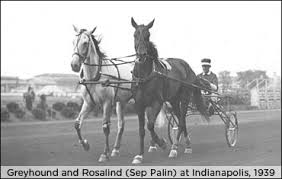
Greyhound and Rosalind trotting i

Greyhound and Rosalind trotting in their famous dual harness. Scotland (son of Roya McKinney) was the sire of the great race mare Rosalind. Guy Abbey (grandam Regal McKinney) was the sire of Greyhound.

Regal McKinney found a place in standardbred history through her daughter Abbacy who was the dam of Guy Abbey. Guy Abbey was the sire of The Old Maid as mentioned above, but also sire of world champion Greyhound. He turns up in the pedigree of many good trotting sires as the damsire of Hoot Mon. Scotland is the sire of Hoot Mon. So that puts the two sisters Regal and Roya McKinney 2 x 4 in Hoot Mon’s pedigree, and Princess Royal herself 3 x 5.

Another interesting pedigree in this regard is Valley Victory who has Scotland or one of the McKinney sisters through multiple links on many lines of his pedigree.

Princess Royal is a great example of one of those amazing “clusters” or “hubs” of breeding where a mare from a good line suddenly cranks it up another notch or three and creates a number of strong quality branches, both male and female lines. Another is Spinster, who was served by Scotland and Guy Abbey and created yet another hub, and then the line continues to build remarkable momentum with multiple contributions from The Old Maid, Lady Scotland and later Breath O Spring.

Whether you start with Estabella or Princess Royal doesn’t really matter. The wonderous facts are there for all to see in a lasting legacy of quality racehorses, quality mares and broodmares, quality sires and broodmare sires and stunning crosses of gold.

Hip Hip Hooray, Hip Hip Hooray!!


Note: When using the HRNZ Info Horse database, I see that it places Regal McKinney as a daughter of Roya McKinney rather than as a sister. This also occurs in one other publication I have noticed. It is incorrect. She is a daughter of Princess Royal.

Read Full Post »

And a winner! In a 2yo pace workout at Ashburton yesterday, the filly Dame Puissant went the mile in a relaxed rate of 2.10 but came home in 28.1 to win by about 2 lengths.

It is the first Tintin In America foal to appear at workouts, and although they didn’t go under the qualifying time, it is all good experience for the young ones.

Congratulations to breeders Glenferrie Farm (who also own Tintin In America) and owners Kimberley Butt and Matt Cross.

The filly is out of P-Forty Seven mare Glenferrie Magic (3 starts for 1 win, 2 seconds).

Flag up to me any others you spot, especially in Australia.


The 2yo Tintin filly called Be A Legend  that I share with Brian West has completed her second prep and is out for good spell; the report is that she has a lovely gait, is a nice sized filly and has ability to do what is asked of her, but needs more time to mature in terms of manners. That’s all good. So few fillies have the maturity to handle pressure as early 2yos, but at least we now have more of a line on her overall ability.


Read Full Post »

“Winning by a long neck.”

My Tintin In America x Sophie’s Choice foal knows how to get to the reward line.

Young foals can look as awkward as folding deck chairs, or as graceful as a ballet dancer, all in the space of a few minutes.

This one manages the convolutions of the former with the agility of the latter in one successful movement.

Tintin In America x Sophie's Choice foal

Winning by a long neck – Tintin In America x Sophie’s Choice foal

Read Full Post »

Note: correction to this article – the correct photo for the Tintin colt Zee Dana is now shown on this page. My bad!

Dave Kennedy (of “Dana” named horses fame) has bred four mares to Tintin In America – “I have 2 of 32 in his first crop and 2 of 32 in second crop also. So thought having 6.25% of both his crops in NZ must be pretty good lol,” he writes.  Dave was a member of both the ATC 06 and 08 syndicates, which is one reason why he has supported Tintin and Changeover as a breeder.

The other reason he sent his mares to Tintin In America was the quality Tintin showed as a racehorse – the sort of attributes you want in a sire: the ability to keep improving, the ability to run consistently good times, and to compete (and win) at an elite level.

I can’t believe that people forget his first real run in top open company running Monkey King so close from so far back in the Auckland Cup. Also that his last 3 starts ever were 3 wins as a 4yo and 2 were Group Ones and he was early favourite for NZ Cup when his career was over [due to injury]. Maybe they are worried his feet worries are hereditary. But in my opinion he’s the forgotten horse of the siring ranks.

On type, how are Tintin’s foals shaping up so far?

For Dave, the omens are good.

I’m sure Tintin can inject a some of that with his own speed and both McArdle and In the Pocket in the blood. This was my reason behind breeding two in his first year. Some speed and get up and go with the Ready To Run in mind. His sale [as a sire] only paid for one service but I had a big cumbersome Dream Away mare that needed a speed injection and I also had a mare that crossed well with McArdle as I raced Dana Mac from the mare. Even though the ready to run was gone [cancelled] I was so impressed to see the colt free legged pace at speed with his mother. That and the look of him and the filly that followed that I thought I would send some of my better mares to him with the idea that they might have a better chance of making the sales.

The mares Dave Kennedy has sent to Tintin In America are

  • OK Deb
  • Samantha Franco
  • Squidgy
  • Zwish

 I’ve seen a few of the pics you showed and also Brian [West]’s one and I must say he throws very nice foals and a lot are reddish bays with long blazes. 2 of mine are splitting images in that way and the 3rd (the one who was going to the Ready To Run) was reddish bay also with only star. The 4th is brown/black like its mum. They are going more bay as they get older.

Dave has kindly sent in this photo of the 2yo filly Snowy Dana (with the blaze) which Dave says “broke in nice too but too early to tell as waiting for 2nd prep still”, and below is also the 2yo colt Zee Dana currently for sale via Greg Payne who has described him as “a lovely balanced horse with speed and staying power..”

Snowly Dana

Snowy Dana (Tintin In America x Squidgy, 2yo filly)

Tintin In America x Zwish 2yo colt Zee Dana

Zee Dana (Tintin In America x Zwish 2yo colt) 

Dave has taken a good punt on Tintin as a sire, but for good reason.  For more information about Tintin In America contact Nevele R Stud – or leave your thoughts or questions in the “leave a comment”  option at the end of this blog.

Read Full Post »

Here I am, born yesterday. It’s a funny old spring weather here in the Waikato.

One minute sun, next minute rain. It’s warm, then cold.

I’m just getting used to it, and hanging out with my Mum who is teaching me what to do.

Hello, world…

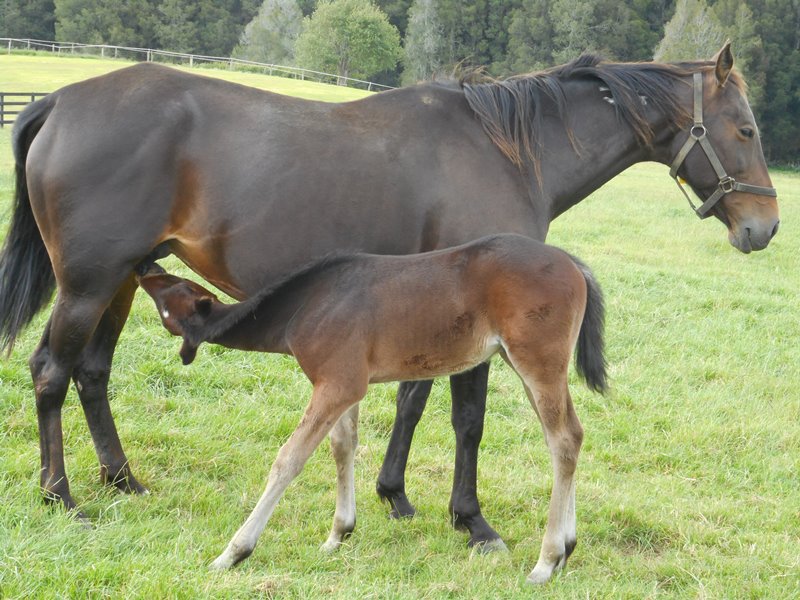
Zenterfold x RRHeaven day one

Filly foal from Zenterfold, day one. By Rock N Roll Heaven.

Read Full Post »

Folklore has it that Gene Abbe was foaled in the infield at the Putnam fairgrounds in Ottawa, in Ohio.
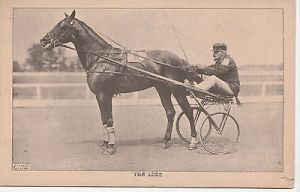
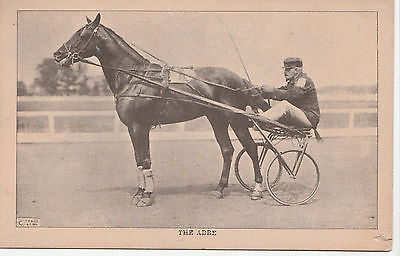
The Abbe

The Abbe, grandsire of Gene Abbe.

He was a son of Bert Abbe who is a son of The Abbe. The main siring son of The Abbe was of course Abbedale, who left sons Dale Frost and Hal Dale and the rest is history.

Bert Abbe  was a fast racehorse himself (1.59 in the 1920s) and his second dam was a daughter of the famed Dan Patch. He must have done an okay job as a sire. But as a sire of sires, Bert Abbe left Gene Abbe, and that was it.

Gene Abbe’s dam Rose Marie took a record of 2:05 in 1927 and produced 9 racehorses from 11 foals, but Gene Abbe was clearly the standout.

So you can see there was speed from Bert and toughness from Rose, and that just about sums up Gene Abbe.

A foal of 1944, as a 2yo he won 14 of his 16 starts – for a total stakes of just $2,940, but remember that was wartime and 70 years ago.

He raced successfully through his career until he was a 6yo, then retired to stud. 151 starts, 49 wins 46 places, $51,239 lifetime earnings, and a huge reputation.

But that was just the start.

As a sire he did something no other has achieved – he was the horse that kick-started artificial insemination, thanks to the work of Hal S. Jones who managed Pickwick Farms in Ohio in the 1950s and 60s.

Jones, now in his 80s, played a major role in developing the use of artificial insemination in Standardbreds during his years at Pickwick Farm near Bucyrus. The demand for the services of the stallion Gene Abbe was so great that Jones had to find ways to inseminate multiple mares each time Gene Abbe was bred. That resulted in experiments that proved successful and soon led to the widespread use of artificial insemination in breeding trotters and pacers. A native of Kentucky, Jones served in World War II and then assisted his father in managing Mac-Dot Farms, a Standardbred breeding and training facility outside Columbus, in the late 1940s. He moved to Pickwick Farm in 1951 and stayed there for almost two decades, establishing an enviable reputation for his work ethic and horsemanship. That led him to a position at Blue Chip Farms in New York in 1969, then getting established as a breeding facility. Jones took the 25-year-old Gene Abbe to Blue Chip with him despite the fact that many people felt the old stallion would not adjust well. Gene Abbe sired his best performer, Big Towner, at age 29, a year in which he served 32 mares at Blue Chip. Gene Abbe continued to breed mares into his mid-30s. (Extract from US trotting article 2012)

Jones developed an artificial insemination technique in which Pickwick stallion Gene Abbe was bred to 181 mares.
This innovation made Gene Abbe the first stallion of any breed to register more than 100 foals in one breeding season.
Jones’ method changed Standardbred breeding forever. (http://www.recordonline.com/article/20100705/Sports/7050328#sthash.ULByePgA.dpuf)

In a Hoof Beats article in 1984,  Hal Jones himself threw a bit more light on what drove the innovation, and it wasn’t the need for standardbred breeding diversity:

(Pickwick Farm owner Walter Michael) was interested in the quantity of mares we bred, not necessarily the quality of mares we bred….He wanted to know how many mares a stallion was breeding, not how good they were.
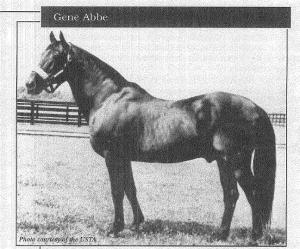
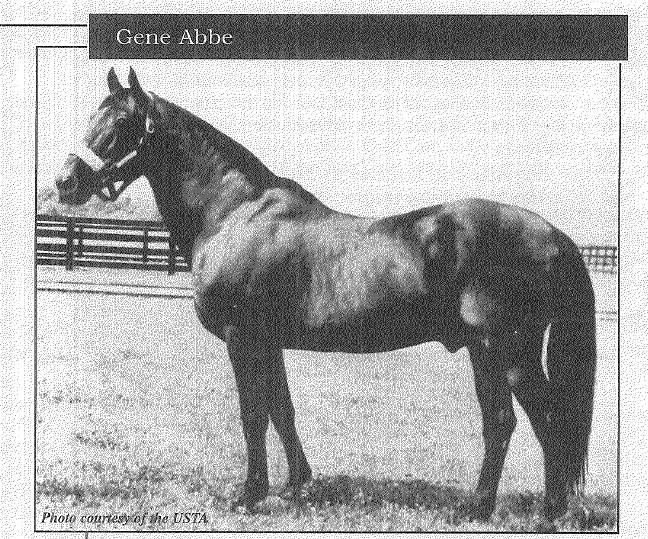
Gene Abbe photo USTA

Gene Abbe, photo USTA

In spite of this attitude, or perhaps because the numbers, Gene Abbe was a successful sire of good racehorses, both male and female, and his longevity in that role meant he appears in the forefront (i.e. the first 4 generations) of so many good horses today.

Before following his legacy as a sire and broodmare sire, let’s give a big tip o’ the hat to Gene Abbe the racehorse.

In a conversation with Fred Parks this summer, the New York state reinsman who had Gene Abbe prior to his purchase by the Kniselys, he stated that Gene Abbe was the safest free-legged pacer he had ever handled or seen for that matter-had to be literally knocked off his feet to make a break. Fred drove him to his 11/2 mile victory over Grattan McKlyo and Indian Land when the Bert Abbe pacer came from dead-last after being run into and won going away. Gene Abbe raced better than 2:00 several times and whipped his share of the 2:00 brigade also, still ranking as the top money-winning stallion by Bert Abbe. We noticed in a visit last summer that Gene Abbe goes right into a pace when just walking from his stall. Possessed of terrific whiz from his two-year-old form, Gene Abbe is out of a free-legged mare, Rose Marie 2:05 (hmt) and her first five foals all took marks of 2:081/4 or better on the twice-arounds. She was by the 2:021/4 sire, Martinos 2:121/4 (half-brother to the 2:00 sire, Peter Henley 2:021/4) and carries real racing pacing inheritance back of that. We always used to root for this gallant pacer at the races, having a weakness for the free-legged variety, and feel sure that he will be another 2:00 siring son of Bert Abbe before the books are closed.
Extract from Barn To Wire.com 1952 Harness Horse: Eventime Farm, Ohio, where Gene Abbe first stood after retirement from racing. 

In his chapter on Gene Abbe in Modern Pacing Sirelines, John Bradley traces his career from that very good 2yo season to being a tough and successful racehorse – “a three-year odyssey which would take him from coast to coast and to Canada, racing against the nation’s best Free-for-allers and holding his own.”

It is a breeding and CV based on toughness and durability rather than sheer speed.

Gene Abbe has one of the longest stud careers on record, standing commerically from 1951 to 1977, with a total of 1073 foals for 871 starters (81% starter ratio). His biggest crops were in the early 1960s, when he was second only to Adios on the money-winning pacing sire listing (although with greater numbers on the track than Adios).

He was a sire of good tough racehorses like himself. One of his best was Rex Pick, an ultra tough pacer who did battle with our great Cardigan Bay in FFA events in North America.

Blaze Pick was a good son of Gene Abbe – he took a record of 1.59 and stood at stud but only had three progeny in 2.00 from a small number of foals. One of his non-record mares was J.R. Amy who turned out to be an amazing broodmare. She left 13 winners from 14 foals including four in 1.55, and one of them was the very influential sire and broodmare sire Jate Lobell (by No Nukes).  I won’t start to list his impact in this blog – it is a huge one. Another of J.R. Amy’s foals was Jiffy Lobell (by Oil Burner) who shows up  in New Zealand breeding (after being imported here) via her daughters Rebecca Sunrise and Georgina Lobell. Interestingly, a mare like blog follower Brian Cowley’s Black Raider (Safely Kept X Secret Passion) combines both these influences from Gene Abbe/Blaze Pick/J.R. Amy in her pedigree.

One of Gene Abbe’s best daughters was Poplar Wick who won over $100,000 – her full brother Wejover was brought out here (New Zealand) as a sire in 1973 by Roydon Lodge, who had high although understandable hopes for him:

“His oldest stock are three-year-olds, and while there haven’t been many winners by him yet, this is not unexpected as the Gene Abbe offspring are usually four before they develop into mature racehorses. We know from stock we have that he will produce some good winners in 1979….None other that Jim Harrison, famed United States blood line expert, said of Wejover, whom he knew very well: “He had extreme early speed lasting through his career. As a sire he is an outstanding outcross. He should not only be a good sire, but I believe should be an exceptional sire of fillies.” (extract from The Roydon Heritage by Sir Roy Mckenzie, p156)

Hindsight is a great thing. Wejover was not a success here at stud and later moved to Australia but had very poor results there a sire as far as I can see (please let me know if I have missed something here).

One of Gene Abbe’s other daughters, La Byrd Abbe, has had a longer influence in New Zealand pedigrees, being the dam of the great American racehorse Nero. Nero’s best performing full sister sister Marquess De Sade was imported to New Zealand halfway through her breeding career and was bred (by R D Stewart, Mrs G E Stewart, J A Bracegirdle) to Smooth Fella, Holmes Hanover and others for mixed results in the longer term. Nero’s other full sister Skipper’s Romance leads us (via her daughter Sheba Hanover) to very good performers here like Bit Of A Legend and Smooth Ice/Classy Filly, and (via her son Seahawk Hanover) to Blossom Lady.

It is the “fate” of some great racehorses and sires like Gene Abbe and Tar Heel to struggle to find a prolific siring son or sons to carry on their branch.

This quote from John Bradley’s Modern Pacing Sires sums it up well:

Gene Abbe was one of those stallions who appeared to be ahead of his time, given his modest pedigree and his lack of opportunity with the sport’s best mares until very late in his career. It’s amazing what he did accomplish against some strong competition and he certainly rates as a legendary sire as far as the pacing breed is concerned. Let’s hope one of Big Towner’s sons can keep this line going.

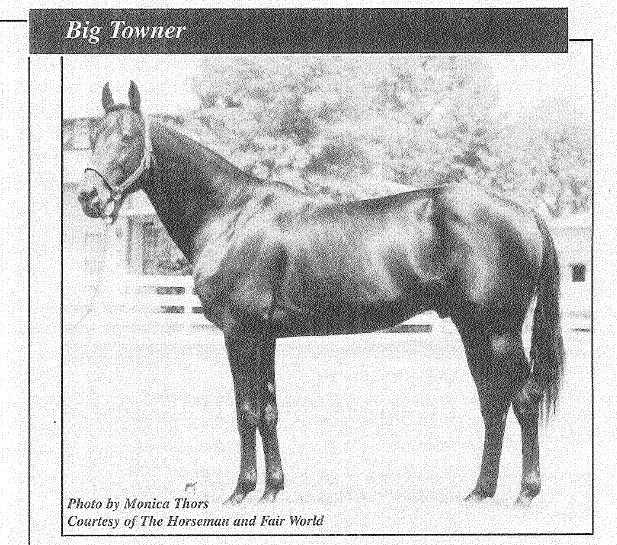
Big Towner Photo Monica Thors

Big Towner, Photo Monica Thors

Right at the very end of his siring career, he produced Big Towner – one of the most underestimated influences in our modern breed. A great racehorse and Gene Abbe’s best siring son by far, Big Towner pretty much followed in the same mould, and has done the same great job as his dad.

But it’s there that this siring line has faltered, swamped by the wave of Meadow Skipper line sires. However the Gene Abbe influence continues because of Big Towner’s huge success as a broodmare sire and in some quirky ways where Big Towner’s sons have also left a brief but enduring mark.

Perhaps the most successful son of Big Towner downunder was Walton Hanover, although he stood in Australia and  was not a big player at all in the New Zealand siring scene. Walton Hanover is the sire of Totally Ruthless (who also stood in New Zealand and Australia but with little top level success) and damsire of New Zealand breds Arden Rooney ($NZ225,093), the Kaikoura Cup winner just recently, and Georgetown who won over half a million dollars before being exported to America, as well as being the damsire of the mare Secret Potion $NZ285,312. Walton Hanover’s live foals-to-winners statistics in Australia seem to be just over 50% which is really good for this part of the world.

Several other descendants of Gene Abbe and Big Towner on either their sire or dam line have also played a big part in the Australian stallion scene including Towner’s Big Guy, Broadway Express, Jet Laag, Pacific Fella, JC’s Suprimo and his close relation Aces N Sevens, Stature, Sandman Hanover, Northern Luck, Brioso Hanover.  Their siring was almost all done in Australia rather than here, and I’d be interested to get some readers’ comments on how their various contributions are viewed in hindsight by Australian breeders.

Man Around Town, a grandson of Big Towner, stood in New Zealand through the 1990s and into the first decade of this century, and sired some very good individuals – mainly tough top mares like Robyn Blue, Imagine That, Kym’s Girl and Royal Rascal; the latter is the dam of Fiery Rascal and Twilight Rascal.

None of Big Towner’s sons or grandsons have really kept the Gene Abbe siring line alight vigorously at the top level. But that in no way diminishes the overall contribution of Gene Abbe and Big Towner to standardbred breeding overall – right down to the present day.

Gene Abbe and Big Towner are both what I call an engine room sire.
The “genes” passed on are tough, durable and deliver quality, just like Gene Abbe himself.


Read Full Post »

I was browsing through one of Alabar’s newsletters from November 2013 and came across an article about Big Jim’s first foals in New Zealand (which were just arriving) and a related article “Doubling up Big Towner a good thing”.

Here’s some of it:

There’s now strong evidence to suggest the duplicating Big Towner in pedigrees can lead to positive results and that could be a pointer for Big Jim given he is out of a Big Towner mare. Big Tonwer was a great stallion who topped the North American Sires Premiership at one time, He was a leading broodmare sire and it is through his daughters that his legacy lives on. Many successful stallions possess a dose of Big Towner in their maternal line….Art Major mares look ideal for Big Jim as not only do you get the Big Towner connection but also Artsplace, which shoud suit Big Jim down to the ground. Other potential sources of Big Towner include Walton Hanover, Pacific Fella, Aces N Sevens, Jet Laag and Northern Luck.

The rest of the article was mainly noting the stallions who have Big Towner in their maternal line – Art Major, Always A Virgin, Allamerican Native, Pacific Fella – and how some of their best performers have duplicates of Big Towner.

These sires/broodmare sires are more relevant to Australia rather than New Zealand. So it has been harder for NZ breeders to take obvious advantage of duplicating Big Towner with a sire like Big Jim or more recently Sportswriter and Always A Virgin who again have Big Towner prominently in their maternal line. Our most obvious choice might be Man Around Town mares (like Kym’s Girl and Imagine That) but they are few and far between, and Big Towner sits as the grandsire of Man Around Town rather than on the immediate maternal line. After that we are looking in quite obscure places like daughters of the beautifully bred (but perhaps not suited here) Union Guy.

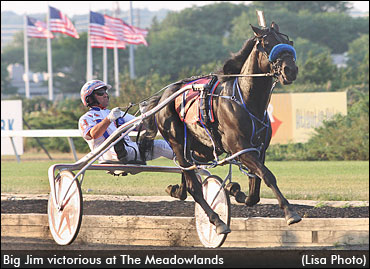
Big Jim

Big Jim a modern champion 2yo pacer with a damsire born in 1974. (Photo Lisa)

It is very interesting to see that up-close influence of Big Towner is still so THERE in the breeding of modern top racehorses and successful sires. These are very modern horses who have Big Towner (born in 1974) as a damsire or grandamsire. Even more remarkably, the sire of Big Towner, Gene Abbe, was born in 1944.

Crikey!

Of course my quirky old heart-throb Grinfromeartoear does a similar thing by bringing Storm Damage (born 1977)  as his damsire. But he can’t beat the Gene Abbe factor. That is a quite an exceptional “back to the future” element in modern pedigrees.

What really impresses me about Big Towner and his sire Gene Abbe is how current and recent they remain in a number of commercially successful sires – not just as a one-off, a freak.

I’ve blogged about Big Towner before, please check it out if you haven’t read it before.

In my next blog I will go into a bit more depth about Gene Abbe. What an interesting horse he is!

And then I’ll return to the present and see what breeders in New Zealand are doing, or might do, to get the best from the sires that carry these genes.

As always your perspectives from different countries, or from personal experience, are welcome. Send your thoughts to bee.raglan@xtra.co.nz or use the comments/rsponse option at the end of this blog.


Read Full Post »

« Newer Posts - Older Posts »