Feeds:
Posts
Comments

Archive for the ‘Standardbred breeding’ Category

Destination Moon racehorse

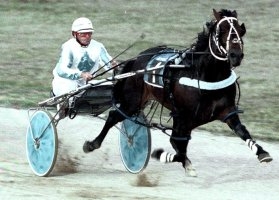
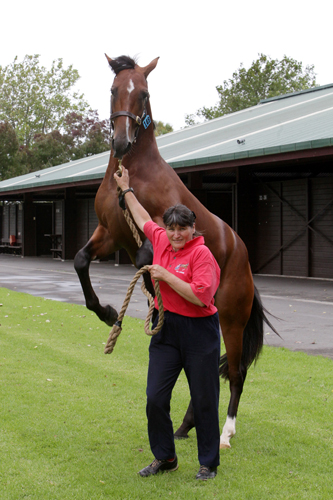
Take off – Destination Moon at 2012 yearling sales with Kym Kearns

He’s named after a book about flying to the moon. And from the photo, you can see he was keen to take off long before race day!

It was great to see Destination Moon get his first win last Friday at Alexander Park. The field was not nearly as strong as his first race a couple of weeks earlier, which was a Sires Stakes heat with the speed on, but the way he won was impressive.

He reached the front early and ran confidently in the lead, not switching off, keeping a good margin to the others and pulling away to win by over 2 lengths with little encouragement needed from Joshua Dickie in the bike.

Destination Moon is the half brother to Tintin In America and full brother to The Blue Lotus (3rd in Sires Stakes Fillies 3yo final), from my wonderful mare Zenterfold. His sire Grinfromeartoear is not highly commercial but if you get the right match he adds a lot of value and leaves some tough horses with speed.  “Duncan” (as we nicknamed Destination Moon) was a lovely type as a yearling and sold for $68,000 to Rosslands Stud Ltd (Kerry Hoggard) at the 2012 yearing sales.

He has shown up in his workouts and qualifying trial just prior to racing, but pleasing to see there wasn’t a rush to get him into the 2yo Sires Stakes if he wasn’t ready.

Recently I spoke to trainer Steven Reid about Destination Moon’s next steps, and he says he will be racing till the end of June then have a spell before being aimed at the 3yo Sires Stakes heats, which come up early in the new season and culminate around NZ Cup time.
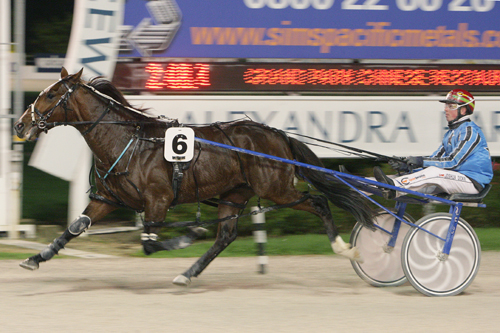
Destination Moon pacer

Destination Moon wins on 24 May 2013 at Alexandra Park

Steven says he was “rapt” with the win – “He just cruised that, and it is how he’s been working at home.”

He describes Destination Moon as having the potential to step up and be quite a good horse.

Tintin In America and The Blue Lotus now have a Real Desire half brother weanling who is hanging out in our paddock with a full brother to Flying Isa, great mates.

More about him and an update on other branches of the family coming in a blog soon.

Destination Moon’s pedigree is one I wanted because Grin offers some physical and genetic influences that really complement his dam Zenterfold.  I have always taken on board Aria Small’s advice that the family love the old blood – the Spinster/Old Maid/Scotland connections, which it has on its bottom line through Bachelor Hanover. And that has been a touchstone for me in getting a good nick for the mare. Grin hauls that old blood up through his remarkably close-up Storm Damage damsire, and also in his maternal line through Shifting Scene and Race Time (a son of Breath O Spring and half brother of Storm Damage). Shifting Scene is part of the lovely Golden Miss maternal line that you see in many classy families (Rich N Elegant, Real Desire’s maternal line etc) and of course the overlooked element in that line is my dear old Shadow Wave.  In Zenterfold’s pedigree, Shadow Wave pops up promptly as the damsire of New York Motoring, who I believe is a key figure in what have developed into the two best branches of the Zenover family – Interchange and Zenola Star, both sired by New York Motoring. Finally you have the Direct Scooter and Tar Heel influences of In The Pocket, the sire of Zenterfold and so grandamsire of Destination Moon. These are again classy old bloodlines and with a fairly up close dose of trotting blood and both are descending from Volomite and maternally tracing to the wonderful Roya McKinney and Scotland/Rose Scott. Zenterfold’s grandam Now And Zen is also chokka with trotting blood via her sire Chiola Hanover. Chiola Hanover goes back to Volomite and the Scotland influences as well. But none of that is an issue for Grin, thanks to his breeding, especially Storm Damage who is described by John Bradley as having “some of the oldest bloodlines still available for pacers” – his dam was 24 years old when she foaled him, and he is a remarkable “sleeper” in the pedigree of a modern day sire.

Phew! that’s a little peep into some deep old echos in a 2yo pacer just launching his career.

Of course what I also liked about Grin was his ability to leave guts, character and grittiness, which The Blue Lotus showed in her races too. That gave the Zenterfold speed-at-all-cost attitude something to hang its hat on.

Cover Destination Moon book

Cover of Tintin book

It’s what might work for a particular family that counts. And that’s what I think about, more than what is the most fashionable option at the time.

Destination Moon has a long, long way to go. The rocket is just launched, yet to fire the booster engines and go into the statosphere.

I hope he ends up amongst the stars.
Read Full Post »

A bonus from my trip to the NZSBA breeders conference in Christchurch was the opportunity to visit Nevele R Stud and see Tintin In America, whom I bred, and some of his weanlings.

My visit was a lovely echo of my only other trip to Nevele R, which happened the year I decided to put Zenterfold to McArdle, which resulted in Tintin In America being born.

That day was just the same – raining, and the array of famous racehorses/sires standing in their paddocks with their covers on, looking just like any horse. I particularly recall Courage Under Fire (standing at Nevele R at that stage) who looked almost lost under his cover, being the small horse he is, as the rain poured down around us.

Tintin In America, Sire

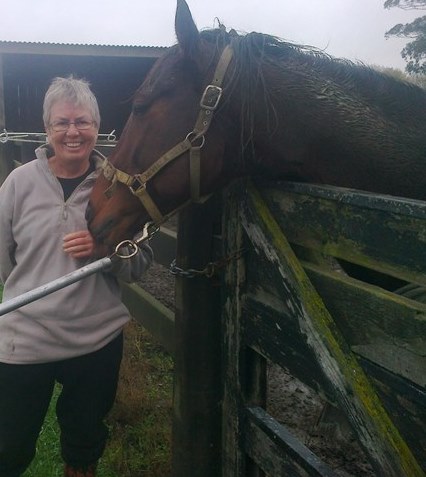
Breeder Bee Pears with Tintin In America at Nevele R Stud, May 2013

That was about 8 years ago. Kym and I were shown around personally by Bob McArdle;  it was a fascinating tour with plenty of commentary by Bob, followed by a fairly robust discussion as we all sheltered in our Hilux ute and debated the merits of putting my mare Zenterfold to Falcon Seelster (which Bob advocated) or McArdle (which I was more interested in doing).

As history shows us, I stuck with McArdle.

So it was lovely last Saturday to come full circle and be standing alongside Tintin In America the sire, in the rain, at Nevele R all these years later.

Tintin retired very sore in one leg joint after super seasons as one of our top racehorses from 2yo to 4yo, and almost reaching a million dollars of earnings.

The good news is: he is very well in himself and full of attitude in the paddock, and very fertile in the barn. Thanks to Nevele R in doing such a good job in settling him in to his new career.

There’s no doubt what sticks in people’s mind about Tintin is his incredible acceleration and speed.  As he grew older he developed the strength to hold that sprint longer. At times, he appeared to be low flying down the home straight. That sort of acceleration is hard to come by.

He was a medium sized horse, but a first foal from a medium sized mare. From what I have seen, his foals are quite striking types of good size. I saw two at Nevele R and both had white blazes which could be their own family influences but I have also noted the blaze/snip influence in Tintin’s family. Interesting.

I’d love to hear from people who have foals/weanlings by Tintin. Email me at bee.raglan@xtra.co.nz and tell me about them.

Personally, I am negotiating a share in a well bred weanling filly by Tintin In America, and have leased another mare to put to him with a very interesting pedigree match. But more about those  at a later date.

I’m a careful and thoughtful breeder and I believe he’s worth a good punt as a sire.

Read Full Post »

I’ve just returned from the NZ Standardbred Breeders Conference in Christchurch on Friday 17 May. I applaud the organisers for gathering a great line up to get us thinking, and tip o’ the hat to Michael Guerin – his Q&A sessions with Karen Parsons and Cran Dalgety were a highlight, and his summing up at the end of the conference was a call to action that would have set the conference alight if it had come at lunchtime.

My only quibble with an otherwise very good conference:  poor timing at the start meant the workshop/discussion session at the end was truncated and lacking focus. It was an ideal opportunity for John Mooney et al to get some support and direction from active and interested breeders through real workshopping of ideas. Having that number of well informed breeders from different parts of the country in the same room is rare. It creates an exchange of ideas that surveys and submissions can never achieve.

Perhaps a raft of workshops on specific ideas arising from the conference (and elsewhere) could be held around the country over the next 6 months to put some flesh on the bones and give some life to Mick Guerin’s apt comment that the breeding industry must settle on its priorities and get much more coordinated and clever about its tactics to push those into the wider harness racing (or general racing) agenda.

A quick note on two of the presentations:

Dr Jenny Cahill spoke on the importance of genetics. Her recap on the basic principle of “pairs” was an apt salute to the equal importance of sire and mare. It takes two to tango, right down to the chromosone level! She also placed a realistic perspective on the contribution of genetic making up to a performance horse, noting that complex inherited traits ( e.g. some performance measures, height, temperament, and a number of diseases) are affected by a number of genes and usually also modified by environmental factors (such as training and nutrition).

As equine genetic research moves into the field of complex traits, Dr Cahill said breeders need to feed into research programmes what they are most interested in finding out. For example, the dairy and beef industries are further down that path and have clear objectives of what research can help them produce better products for a changing market.

For some equine breeders, genetic research will be a step too far to contemplate, but it is going to happen. We must embrace and direct it, or we are just burying our heads in the sand. Dr Cahill says “the ultimate goal of this research is to be able to use the information gained for the good of the horse, owners, breeders and trainers and to be able to screen individual horses for these traits.”  This would include testing for heritable conformation faults and diseases, and also good gaitedness and even the type of performance they are “wired” to achieve (speedy sprint, medium distance fast, stamina/slow).

All this has HUGE implications for breeders, buyers and sellers. Some thoroughbred markets are already using available information. How would we use it? What impact would it have on numbers bred and sold if we cut out all those horses in advance who will only make up the numbers in a race? How would it change our yearling sales, if overnight buyer-requested testing became available? Fascinating stuff to ponder!

Dr Clarissa Brown Douglas, speaking on nutrition of the mare and foal, gave a wealth of useful information, emphasising the importance of feeding correctly in those critical formative times. Her take-out messages were simple: Managing growth is a balancing act. The last trimester is a vital time to ensure the foal gets the minerals, trace elements and vitamins required. Get to know the nutritional value of what you are using – pasture and hay as well as commercial feeds and balancers.

Some of the facts that stood out for me:

  1. Mares milk lacks minerals so in that vital last trimester, the foal stores the minerals it needs in its liver for use during the first 90 days of its life.
  2. A foal is born with only 17% of mature bone mineral content, and maximum bone mineral content is not achieved until a horse is about 5 years old.
  3. The 6-12 month period of feeding a weanling is a “window of opportunity” and you need to monitor growth rate so you don’t overload the immature skeleton structure.
  4. Yearling preparation is best done gradually over 90 days.
  5. Be aware of the potential for high glucose/insulin response in young horses – low glycemic feeds are a good way to prevent this.

So it really makes you think about the pressure we put on such an undeveloped creature when we race horses as 2yos! And if we continue to do that, it places a big responsibility on breeders to lay the best foundation possible.

I am sure NZSBA will be publishing the papers presented by all speakers at the conference on their website. It’s great food for thought.

The industry analysis (both harness racing in general by Edward Renall, and breeding industry by John Mooney) provides some good basis for discussion.

But as Mick Guerin said, we need to pin down and agree on our priorities, and push our agenda forward in a united way. We will get nowhere by griping and sniping, riding the ocean like flotsam and jetsam, carried on currents that seem out of our control.

I grabbed a chance right at the end to raise my idea of increasing the breeding option to one foal and one ET per mare per season, outlined in other blogs. I got a strong positive response from several breeders to this suggestion – including a commitment from John Mooney to start following it up.

Likewise Brian West raised the need to get a monetary return into breeders’ hands via a % slice of stakes, as they do in France where breeders are recognised as the key investors in the industry’s product.

These ideas are not as “out of the box” as we might think. As I said, a series of workshops or think tanks around the country could pull together some recommendations.

Let’s get some fresh voices and fresh ideas in the mix.

Great conference, exciting times!

Read Full Post »

Complete change of tack from my recent blogs – here’s a blog about my mare Have No Secrets.

Many of you willhave discovered one of my early pageswhere I wrote about My Learning Curve when I first started breeding standardbreds.

The mare I wrote about was Have No Secrets, by Camtastic out of the Vance Hanover mare Mafia Miss, who herself was a daughter of Joyable.  This is the family of Robert Reid’s good mare Plead, and the best branch of the family has been the Pat Hanover/Miss Clevedon line.  Joyable was a very nice racehorse, earning over $220,000 racing in Australia; her progeny included the speedy youngster Gran Montana, but not much else. Mafia Miss produced a durable pacer in Seven Hills who raced in Australia for many wins, and in fact most of her progeny other than Have No Secrets ended up in Australia (the Kellys in NSW) but their breeding efforts have been very disappointing. Nothing much has really fired at all, apart from Miss Adriana and Miss Livia from Have No Secrets’ half sister Midnight Madam (by What’s Next).

I fell in love with Secrets at the yearling sales and when she put her head on my chest in her box at Karaka I told her “I’m taking you home.” After realising early on the “Secrets” was not interested in being a racehorse, I bred three foals from her – and went up that steep learning curve which My Learning Curve relates.

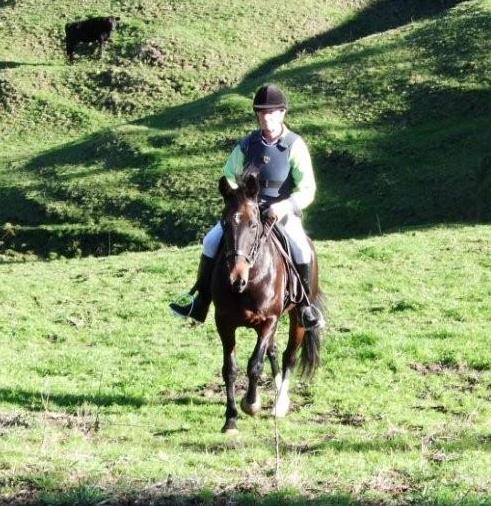
Iain and Secrets hacking on Iain's property.

Iain and Secrets hacking on Iain’s property.

She is now 14 years old. We’ve looked after her well and she’s been an asset, never a burden.  Kym broke her in to saddle early on, and she has been ridden occasionally, including a memorable afternoon when she was 3yo and I was perched in the saddle. Me riding is not a pretty sight, but Secrets was patient with me, even ensuring I stayed on board when we slipped into a ditch rather than giving that cunning little tilt-and-off that horses will try when they know you are a nervous rider.

She’s always showed a character that was gentle, kind and yet had a distinctive personality and an interest in whatever was going on.

For the usual reasons – lack of paddocks, tight finances  – it was time to move her on to a place where she could also be more active, have more company.

It was with great pleasure that I found Iain, who is an experienced rider and has a property near Hamilton he wanted to explore on horseback. After a few weekends of getting to know each other, he and Secrets have paired up wonderfully well. Iain’s kept me posted about progress, hence this lovely photo. “She is so inquisitive as she explores new territory – what is around the next bend. Definitely not a plodder, a lady with character and attitude,” he writes.

Secrets has found an excellent home and is loving her new life as a hack.

It’s never easy finding homes for ex-racehorses, and I know there are calls that have to be made from time to time. There are people and groups who can help if you want to try harder to give your horse a life after racing – and certainly breaking a horse to saddle (if they have a good temperament) early in their life can be a life-saver later on – as well as an option for training regimes at certain times.

In this case, credit to Kym for ensuring Secrets was ride-able.

And credit to Secrets for being so sweet and such a character that finding a good home was the only option.


Read Full Post »

Wrapping up my short series on some positive steps for our breeding industry.

These are, in general, solutions that are in our hands. While significantly higher stakes would help all parties in the industry and create a more buoyant market for breeders, breeders and their representatives are not in a position to directly make that happen.

What we can do is make decisions on the four aspects I’ve covered – or at least lead the charge in pushing for change.

The four things I’ve suggested all increase the ability of breeders to be masters of their own destiny.

  1. Allow breeders to breed 2 foals from an individual mare (no more than 2) per breeding season.
  2. Place a limit of 100 on all NZ available stallions for the next 3 years.
  3. Create meaningful breeders bonuses related to first win (larger amount) or all wins (smaller amount per win) or % of stake of all NZ-bred horses – this is a progeny bonus, not just applicable to fillies.
  4. Breeding credits, and paid to the original breeder (not the future owner of progeny).

Allowing a mare to breed up to two progeny in the same season, using embryo transfer, appears to be something governed by the rules of harness racing, and therefore able to be changed. It is well within the jurisdiction of our representatives (whether at conference level or at governance level) to lead a change in this direction. For a good overview of the logistics here is an article that outlines it in layperson’s language.  The logistics and costs of embryo transfers will limit use. It is not opening the floodgates to factory farming, nor is it likely to dramatically increase the number of registered foals. But it will provide breeders with another option in terms of managing their investment in a mare, and it may well encourage breeders to experiment a little more in their choice of sires. Check out my original blog on this for the full list of benefits.

Placing a limit on books is a tricky one because of legal rulings. It may need some hard negotiations and some clear parameters, but a short-term agreement maybe covering 3 seasons could be enough to ensure greater diversity and commercial viability of both sires and stud farms to keep our industry healthy. Yes, successful sires (and their owners) should be rewarded by getting increased numbers of mares. But there is a point where, over a number of years, dominance can skew a market (and even the genetic make-up of our commercial mares).  Eventually the market will self-correct – or more likely set the pendulum swinging in another direction. Settling the market into a healthier, less extreme pattern over the next few years will build a stronger and more stable foundation for our industry.

Finally the idea of mares credits and breeders bonuses – these depend on having a pool of money that can be distributed. And that’s the rub. I believe the only way the breeding industry will strengthen is for breeders to develop some funded schemes that are independent of the funding of the wider racing industry.

It’s true, that sometimes you have to put more in to get more out.

As a breeder, I already pay numerous “series” eligibility payments that are designed to make my mare’s progeny attractive to buy. In the yearling sales marketplace they are essential – but you will see many, many yearlings who are paid up for multiple series still receiving only $5-10,000 sale price.

Basically, breeders are paying several hundreds of dollars per yearling for series which are extremely hard to win and offer small, if any, immediate return to the breeder even if the horse makes it into the final of these series.

So why not have an additional option – payment into a scheme that relates directly to the breeder and the mare’s progeny and rewards breeding success – either a mares credit scheme or a breeders bonus for wins. I would be a willing payer of $250 per foal or per mare bred, for example, if I knew it was making me eligible for reward and recognition as breeder if that horse goes on to succeed.

I would willingly pay a small annual fee if it kept me in a breeder’s bonus scheme. I would see that as an incentive and an investment, rather than a cost.

Money attracts money. Positivity attracts positive responses.

I think potential sponsors would be keen to step up and contribute more to breeders schemes if breeders started developing some really exciting options that would give breeding a more modern and commercial shape.

So yes, I will put up my hand (and I am by no means a wealthy person) and say: Let’s put more in. Let’s create something that is ours. Don’t wait for handouts. Have more control because it is our funds, from breeders and for breeders.

Where do you stand on that?

Read Full Post »

OK back to part 4 of my 4 solutions to the NZ standardbred breeding industry. This time – mare credit schemes.

Any struggling industry has to make calls about how much effort they put into keeping  loyal (existing) customers and how much they incentivize new customers.

But are we getting the balance right.

The push with current mare credit schemes in some Australian jurisdictions is to provide mares credits ( usually for service fees) attached to their fillies who hopefully then become a more attractive as breeding propositions for the current or future owners. The focus is on the future – trying to get more value embedded in fillies as racing then breeding prospects.

Mare credits go with the filly produced (and for that filly’s owner to use) rather than to the original broodmare or the breeder who produced the filly.

So we are downplaying the role of the breeder and broodmare, and up-playing the role of the progeny’s owner as a “potential breeder”.

Hanging out a carrot for someone who may prefer onions.

While the carrot eaters are very, very hungry.

Say I bred a filly from my mare.  Sold the filly at the yearling sales, got $15,000 and cover my costs, just.  She is paid up in a mares credit pool, which may (or may not) have made her more attractive to buy. That filly becomes a 5 win mare with some potential to make a good broodmare. But who gets the reward for those wins? Not me, the breeder who made the decisions and took the risks. Not necessarily the person I sold my broodmare to, when I couldn’t afford to keep her any longer. No.  The rewards appear to go to the person who currently owns the female offspring, even if they are not interested in breeding …  Que?

There is a breeder and a broodmare out there, trying to gain traction, who is missing out on the rewards of success. But in our desire to stimulate a future market for buying fillies and breeding from them, we  could be cutting back the scarce benefits for current “loyal customers”, the breeder and the broodmare.

That is why I strongly advocate looking at mares credit schemes – but that they are attached to the successful broodmare and her owner rather than the offspring filly and her owner.

Quality broodmares is what we need to encourage and reward.

Breeding is a long and often hard road to achieve success, with many risks along the way.

Isn’t that experience and effort worth investing in?

My suggestion is that mares credits are attached to the current owner of the broodmare and are accumulated and transferable to any of her female progeny. So the original breeder of a successful filly has the opportunity to use credits for the broodmare herself, or trade credits to owners/leasees of the mare’s fillies or include them as incentives for sale of her fillies at any age.

There is little cost to the industry unless credits are “cashed in”. But this system would provide some recognition for the breeder’s role in providing winning fillies/mares and future breeding stock.

If we look at mare credit schemes in New Zealand, here’s hoping we take a harder look at who really needs to benefit and how.


Read Full Post »

If ever there was a horse that epitomises the Anzac spirit in the modern era, it is Courage Under Fire.

Courage Under Fire in action

Courage Under Fire in action

Aptly named, Courage Under Fire was a racehorse loved and respected in both New Zealand and Australia for his heart, gait and sheer willpower which overcame his pint-sized (14.3h at a push) frame.

He was born (1995) and developed in New Zealand, owned by Australian Greg Brodie, and raced at the top level in both countries.

He was simply a superb racehorse as a 2, 3 and 4yo, winning 24 out of 24 starts in a run that reminds us currently of Black Caviar – and “The Pocket Rocket” was just as much a crowd pleaser.

A really lovely summary of his racing career by Adam Hamilton can be found here on the excellent Addington Raceway Timeline webpages, written when Courage Under Fire retired.

The admiration he had earned “under fire” on the racetrack continued on both sides of the Tasman Sea when he went to stud.

He’s left 10 crops of foals so far (2002-2012) – it’s a milestone worth celebrating. His NZ bred foals have just topped the 1000 mark, and in Australia now exceed 500 and many more to come I hope! His oldest progeny are now 9yos. He’s got the ability to leave really good horses, and to inject a needed element of speed and toughness. And he hasn’t stamped his small size.

His popularity in Australia as a sire is undiminished, and he is still getting full books there, with good supplementary bookings for his chilled semen coming from New Zealand.  He first stood at Nevele R in New Zealand for several years, then after a stint under the Stallion Station he has found a home more recently at Alabar Australia. He is currently standing at a $6000 service fee which indicates how well he is regarded at this stage of his career.

His siring career could be headed in the same direction as his damsire the great Vance Hanover, carving out a great reputation over a long period, not leaving a major siring dynasty in his own right, but likely to provide some very good broodmares in the future.  Many of his best sons are geldings – Pembrook Benny, Sleepy Tripp, Smolda.

Thoughts on Anzac Day

Completely on a different tack, I’d like to give a tip o’ the hat to the horses who have literally performed under fire through many different wars. Forget the awful Spielberg movie and search out some of the real stories to be found about these horses and their handlers.  I hate war for what it does to people, to animals, to the environment. It’s a soul-destroying aspect of life, and its only good side is the other part of the human condition it reveals – courage, resiliance, and humanity shown by individuals against all odds. That’s what I think about on Anzac Day.

Read Full Post »

Number 3 of my 4 solutions for the New Zealand standardbred breeding industry is to place a limit of 100 on all NZ available stallions for the next 3 years (i.e. number of NZ mares served regardless of where the sire stands).

Many people will say there is no point in even raising this issue, because it was done and dusted many years ago when there was a legal ruling based, presumably (because I cannot find any easy reference to it) on the “restraint of trade” argument. That was the end of the matter.

But I believe a short sharp period of limited books will, in conjunction with the other 3 solutions I’m putting forward, provide a bridge to the future for our Kiwi standardbred breeding industry.

The restraint of trade argument is a strong one that carries much weight in Western economies. To be valid, any restraint must be agreed to by both parties (for example in an employment contract), the extent of the restraint needs to be reasonable, and generally there needs to be some benefit in it for both parties.

Restraint of trade is balanced by other commercial laws directing competitive behaviour and preventing cartels, anti-competitive practices, mergers that over-dominate competitive markets, plus consumer protection laws.

These things are presumably intended to set some parameters within which” the market” will usually sort itself out.

And many in the breeding industry will say that is what will happen again here, with a fertile sire like Bettor’s Delight eventually over-supplying the market and breeders moving on to other sires once the average market price takes a downward turn. It’s happened before with Vance Hanover, Sundon, In The Pocket and Christian Cullen. Maybe but given the long cycles of breeding and the current dire straits of the breeding industry, are we willing to wait and see? There are some features of the current situation – the huge dominance of one super sire for several years now; the reduced pool of broodmares; the financial situation of harness racing in general – which means we have to turn the history channel off and get out of our armchair.

So let’s start from the assumption that my proposal is not about a law change, but a change of mindset.

A change from laissez faire reliance on “market forces”, hoping they will trigger changes in time to prevent some very negative flow-on affects.

A change in attitude from “she’ll be right, we’ve seen this all before”. And letting another 3 years slide by to see if it turns out that way.

The aim is to slice the cake more equitably without over-influencing breeders’ choices, during a period where the industry is in danger of contracting to insignificance. Tweaking the market rather than totally controlling it.

What we need is a proactive willingness from stallion owners, breeders and studs. Because in hard times, it is collaboration rather than competition that pulls us through.

Limiting sires’ books over a short period will result in:

  • A wider distribution of the service fees paid by breeders across studs and sire owners, which enables a healthy diversity of industry players to survive – and that protects the competitive environment of the future.
  • A wider range of quality sires who will have a chance to prove themselves at stud, because history tells us that we cannot really predict who will become a top sire.
  • A more diverse future broodmare pool, racing stock and even potential sires.
  • A stronger representation of different types and new sires at yearling sales, giving more representation to breeders who are willing to look “outside the square”. A sire needs 20 yearlings across the sales to really break into the perception of buyers as a commercial stallion.
  • And more active, adventurous thinking (hopefully) on the part of breeders when they choose a sire for their mare, instead of just following the crowd and singing the mantra “best to the best”!

So how could a book limit work in practice?

The number of sires affected is very small – probably Bettor’s Delight the most,  Mach Three and perhaps American Ideal significantly, a little bit for those sires who sit around 100 mares anyway, such as Gotta Go Cullect and Changeover, Washington VC and maybe a couple of others whose stocks are on the rise.

So initially the impact of any agreement would fall on the owners of Bettor’s Delight. And if agreement needs a sweetner,  it could be that a transition which recognises the reduction from a higher income, so it may reduce to a maximum of 175 in Year 1, 150 in Year 2 and 100 in Year 3.  Mach Three is owned by the Muscara family, but it may be that the loss of services to him results in a shift of more services to other sires they also own.

Fact is, in each year a book limit may provide a relatively small number of additional services split around other current or new sires – perhaps around 250.  The shift would initially favour other popular sires until they also reach the 100 book limit, and then breeders would need to look further afield.

Who would benefit then? There are several quality stallions who hover around the 50/60 mare mark, and are currently at a make or break point but need more time (i.e. more progeny at 3+ years) to gauge yet how good they are as sires; and there are top sires available by frozen semen or shuttling who are at risk of being withdrawn from the market because they can’t get the numbers here to justify their costs.

Book limits by agreement for a short period might not be a game changer, but it could put a “salary cap” type requirement on the “players” in our industry. It’s not a new concept in sport, or industries that look to the wider interests and not just the immediate return.

They’ve done it in America, the bastion of the free market place, so it must be possible!

Just out of interest:

Some of the general principles and pros and cons of limiting numbers of mares that a stallion can serve are canvassed in numerous articles and forums about live service vs artificial insemination, especially comparing the thoroughbred industry (which of course doesn’t allow AI foals to be registered in The Stud Book) and our standardbred industry which embraced AI many years ago. This blog on The Breed blogsite in 2009 provides quite a neat review of the pros and cons and differences between the thoroughbred and standardbred approaches – and is worth going to just to read the fantastic quote at the end of the blog from North American harness racing figure Stan Bergstein.

Read Full Post »

In this blog I look at the second of my 4 suggestions for the standardbred breeding industry in NZ – Creating meaningful breeders bonuses related to first win or all wins of all NZ-bred horse.

There’s a bit of confusion about the aim of breeders bonuses. Too often the idea gets mixed up with mare credit schemes and incentives for owning fillies and mares. These are very important to the future of the industry and growing the pool of mares.

But in many of the proposals coming forward,  the reward goes to owners of the offspring or future breeders, rather than the original breeder of the horse.

Current breeders have four opportunities to get a return on their high risk investment:

  1. By selling the offspring.
  2. By selling the broodmare.
  3. By retaining a foal to race (and therefore changing role to “owner”, and future rewards count as owner’s rewards)
  4. By winning the extremely limited and hard to get breeders bonuses currently available (e.g. winning the Breeders Crown)

What stands out is the “one-off” nature of all these rewards. Getting a financial return often ends the financial connection with that horse as a breeder.

So in reality breeders have few and fragile opportunities to recoup the years of costs and risks they have carried for each foal they produce and each broodmare they look after.  Let’s look at a comparable situation for owners, trainers and drivers.

Let’s dramatically reduce race meetings held, and allow owners to line their horse up for three races only per season where the stake money is huge but the chances of winning the race are just the same as now.  Would they go for that? I doubt it.

Let’s say we ask trainers to carry all the costs of training a horse and get paid in full only at the end of the horse’s career. Ha! Can’t see that one flying with trainers, unless they have a stable full of top racehorses.

Or say we ask drivers to drive for no cost, but at the end of each year have owners obliged to pay a one-lump sum to their drivers, based on how well horses driven by that driver have performed – but that judgement is up to the owner to decide, perhaps with input from the trainer.  Can’t see much support for that one either!

But the industry expects the breeder to carry this sort of risk and cost for several years, and to have their “one lump sum” payment left in the hands of “market forces” i.e. a sale.

What’s the alternative? Not an alternative, because selling is still the best way for breeders to cover their costs in a timely way. However a sales price can be a fickle way of predicting future performance.

Instead I propose a secondary, small income stream for breeders through breeding bonuses that are either

  • paid (in a smaller amount) per win of the horse bred, regardless of ownership and regardless of where the race is run, or
  • paid (in much larger amount) for the first win on the horse bred regardless of where the race is run.

Breeders bonuses are a much surer way of rewarding actual success.

They reward breeders of horses who may not have sold for true value at the time but go on to perform well, and recognise the role the breeder has in laying a part of the foundation for this success.

When I say “income stream” I am thinking of the principle, rather than the amount. It is an ongoing return dependant on performance, not a payment that would provide an independent income as such.

How can it be funded? Options include:

  • an annual fee (per mare bred and perhaps matched by stallion owners for any available sire)
  • a tiny percentage of all total stake money paid into one  breeders bonus pool
  • an annual subscription so only breeders who want to be part of the scheme pay in, but only their horses trigger a bonus
  • an additional fee paid at foal registration time (by the current owner who will usually but not always be the breeder)
  • a fee paid as part of the entrance fee to yearling sales, and bonuses only paid to the breeders of yearling sales racehorses
  • an optional fee paid at branding time

Or a mix of these, or other suggestions people have. But we mustn’t let the mantra “There is no money” hold us back from looking at options and doing the sums.

Administrative concerns would mean the onus has to be on breeders in the scheme to update their account details, which is why an annual subscription, however low, can help ensure details are current.

The key thing is that the breeder’s bonus comes back to the breeder, not to the current owner. Even mare credits should surely go to the broodmare’s owner or the breeder of the foal, rather than to the current owner of the racing filly/mare who earns it.

I was disappointed to see in the NZ Standardbred Breeders Assn survey on “options for encouraging breeders to stay in the industry” that options for breeder’s bonuses had the bonus returning to the owner. And most of the other options were about mares/fillies racing opportunities and mares credits, which often do not reward current breeders except in a “by association” way. It’s great breeders are being asked, but I wish the options list had been less prescriptive (See survey options at end of this blog).

Yes, the future winning performance of a horse will enhance it’s family’s reputation. But that doesn’t always flow back to the breeder – look at what the sibling of very good 2yo colt Isaiah sold for at this year’s Australasian Yearling Sale as just one example. The building of a family can take years and generations, and sometimes too late for the breeder who most contributed – they may well have sold the mare or quit the industry.

There are a number of breeding schemes in practice around the world. I am hopeful the NZ Standardbred Breeders’ Assn will see the survey as just a wee toe in the water, and come up next with a discussion paper on how various international schemes work, pros and cons, and possible applications for NZ breeders.

Rewarding current breeders has to be a priority.

A coordinated, across-the-board breeding bonus scheme is needed.

What we don’t need is more one-off prizes for the elite races that most good racehorses and their breeders will never to able to achieve.

Options listed in the NZSBA survey mentioned in this blog, which asked breeders to order in preference:
1. Reduced HRNZ fees for DNA testing, branding and foal registration;
2. Financial bonus for winning NZ bred and owned horse i.e same owner/breeder.
3. Financial bonus to the breeder only regardless of ownership
4. Financial bonus paid to owners for winning fillies and mares only
5. More 3YO 4YO and 5YO fillies and mares races at for the lower and medium rated horses
6. One off financial bonus for horses’ first New Zealand start in a race – fillies and mares only, paid to owners.
7. One off financial bonus for horses’ first New Zealand start in a race – all horses, paid to owners.
8. A scheme that puts a winning bonus into a trust for a mare’s future breeding career and redeemable for the first mating.

Read Full Post »

I’ve never been keen on embryo transfers except when the mare is unable (for whatever reason) to carry naturally.  I worried about us getting into a ‘factory farming’ situation where the complex mix of nature (genes) and nuture (early upbringing) was lost in the hurry to make money above all.

I’ve changed my mind. Not my principles, just my mind.

I believe the ability to breed two foals per season from one individual mare creates opportunities for the breeder and the industry overall which just cannot be discounted. And I believe two foals should be the limit.

Of course, the idea will be discounted. I am sure there is a piece of obscure government legislation, some racing industry committee or board, or just a clause in HRNZ rules that requires everyone to unanimously agree on changing from the status quo…well, I’m not interested at this stage about why we CAN’T do this. I am only interested in discussing whether it will help our breeding and overall harness racing industry, given the decreasing number of foals and breeders we have.

It’s not exactly going to open the floodgates – but it may help the flow.

So let’s tick off what the benefits could be:

For breeders

  1. It allows a potentially greater and more frequent return on investment (the broodmare) over her limited productive years. Therefore it makes a good broodmare a sounder financial investment (even allowing for the cost of embryonic transfer and an additional carrier mare), and gives the breeder more opportunity in a shorter period of time to discover the ability of the mare as a producer.
  2. It gives breeders the chance to spread their risk among a wider range of sires. For example, a breeder may go to a “tried and true” top commercial sire with one foal and a risky but exciting new sire with the other. Or perhaps a compatible but less commercial sire, and keep the foal to race. So newer or well priced sires may benefit from this proposal, and get access to better quality mares.
  3. It allows breeders more chance to get one healthy foal, and perhaps a foal of the sex they prefer. The high risk nature of breeding means that any significant conformation problem or injury, or even getting a filly rather than a colt, can prove a real disappointment to the breeder and impact hugely on the likely sales result or racing outcome. Double the chance does not double the risk – it may not half it, but it can reduce it significantly.
  4. More breeders using embryo transfer will bring down the costs of the process, and therefore cost will be less of a barrier.
  5. It creates a new ‘career option’ for mares who are not commercially bred but have the qualities to make really good carriers and ‘surrogate mums’ to their foals. Some mares may have a top record and carry great genes but are not the best at delivering and raising foals. And some mares may not have top (or desired) breeding, but have the good nature, physique and quality colostrum to add value to a foal. Rather than creating the ‘factory farming’ scenario I was worried about, embryo transfer can create a market (lease or sale) for mares who may otherwise be lost to us – and they could still be available to breed in their own right if required. Some breeders will already have mares more suitable to be surrogate mums than to continue as commercial broodmares.
  6. The limit of two foals per mare per season (and from different sires) means that the market will not be inundated with “doubles”. This is not a cloning exercise. It is likely that numbers will be a very small proportion of total foals initially. So breeders will not be ‘competing against themselves’ and the overall genetic pool will not be unduly affected. Much less affected, indeed, than it is by the tsunami of sperm coming from highly popular sires!

It is easy enough to note ET at registration of foals – an administrative hassle no doubt, but what isn’t. And in any subsequent notation a simple (E) after the name could provide the flag required for those who want to know and for the record the surrogate mare’s name should be recorded.

Who would take up an option like this? Not heaps of breeders, initially. But more as the merits sink in. Probably it would appeal to the biggest breeders, and also the smallest. The latter being people like me, who have a really good mare but rely on her results for any re-investment in breeding, which makes expanding a slow and fragile venture.

Of course some breeders may want to breed a mare twice every second year.  The mare is not exhausted from breeding and there are many who believe resting a mare can produce a quality foal.

So for the industry:

  1. It creates a way of increasing foal numbers without necessarily increasing the number of mares bred – it helps stop the downward spiral of breeding numbers.
  2. It creates opportunities for less proven “higher risk” sires to get progeny on the ground, and perhaps from a better class of mares. It may well be a requirement to breed a mare to two DIFFERENT sires in any one season, if embryo transfer is being used, to encourage this to happen.
  3. It creates more services/service fees for the studs and sire owners, both of whom are important for our industry’s success.
  4. It has the potential to raise the quality and (ironically) the diversity of our breed.
  5. It does not impact negatively on the product (race horses) as perceived by the investing punter.

What do you think?

And before you say: “it’ll never fly” just remember that pigs don’t, but bumble bees do!

Read Full Post »

« Newer Posts - Older Posts »