Feeds:
Posts
Comments

Archive for the ‘Pedigree matching’ Category

I’ve done a few blogs on and off about Tintin In America as a sire, and what might do well with him.

Now it’s time for me to put ‘my money where my mouth is’ and have a go at breeding to him myself.

Obviously my two mares breeding mares are not suitable – being his mum and his half sister! So I have been keeping an eye out for something that would be compatible and interesting in type and pedigree.

Sophie's Choice

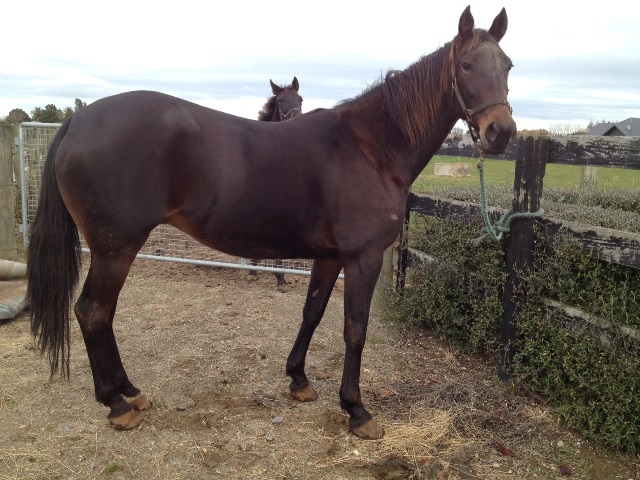
Sophie’s Choice

I’ve been lucky to lease the mare Sophie’s Choice (Rustler Hanover-Mattalie Cole) from Lynda Mellsop.

She’s a 10yo mare with 3 wins to her name, no star but a nice type, and to0k a record (placed) of 1:57.8. She is a tall mare about 15.3h, but not heavy boned and has an attractive head. She’s had 3 live foals to date, by American Ideal (not raced), Art Major (2yo), and a weanling by Bettor’s Delight. After failing to get the mare in foal to Christian Cullen last season, Lynda decided to lease her out.

Sophie’s Choice was bred by N S Gibson and raced in the South Island for trainer Lance Hanrahan in 2006 and 2007 for 3 wins and 6 places from 18 starts, including wins at Forbury Park and Addington.

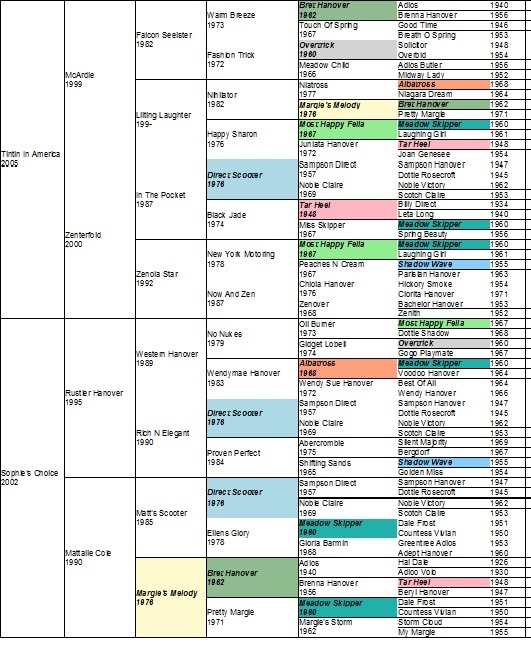
The obvious point of interest for a match with Tintin In America is that the dam Sophie’s Choice (Mattalie Cole by Matt’s Scooter) is a half-sister to Nihilator, who is McArdle’s damsire and in my view was influential in the type of horse Tintin turned out to be. This is expressed as a 5 x 3 to Margie’s Melody. This family on the bottom maternal line is really hard to find in New Zealand.

A foal by Tintin In America would also be 4x4x4 to Direct Scooter. I am looking to inject a bit of speed into the mare, so I see that as an advantage, and all these threads of Direct Scooter come from via different routes.

There is also the lovely Golden Miss line coming from Rustler Hanover, who is a son of the great producer Rich N Elegant. The  match of Shadow Wave and Golden Miss produced Shifting Sands, who left three remarkable fillies – Proven Perfect (the dam of Rich N Elegant), Whispering Sands (Real Desire’s and Safely Kept’s great-grandam), and Shifting Scene (whose daughter Blue Horizon is the dam of Panorama, grandam of Grinfromeartoear and for that reason appears twice in the pedigree of new sire on the block Smiling Shard). And Shadow Wave is another element I believe is influential in Tintin In America’s make-up.

So overall it is a nicely balanced and interesting pedigree match, and a type of mare that should complement Tintin well.

We have a long way to go – first step is to get her in foal. In this game, you never take things for granted!  I’ll follow progress on this blog.

6 generations tintin x sophies choice pedigree match Tesio

Read Full Post »

Harvey tweeted this question: “Got a conundrum for you. Bettor’s Delight=great stallion. Falcon Seelster=great broodmare sire. In USA, Falcon Seelster mares have crossed exceptionally well with Bettor’s Delight. In Aust/NZ, the cross has been very average. Why do you think this is so?”

I don’t want to approach this like a train spotter. More a helicopter view of the railway network. I don’t have a nice clean answer.

Comparing stats from different hemispheres or even countries can be tricky. Just as tricky as comparing horses from different eras.

Bettor's Delight at Woodlands Stud NZ

Bettor’s Delight at Woodlands Stud in New Zealand

The latest USTA stats I’ve got indicate Bettor’s Delight x Falcon Seelster mares has delivered 22 foals of racing age, all have started, 21 have won, and half of them have won $100,000 plus. Those are amazing statistics.

Therefore it seems a big drop down to find, via the HRNZ current statistics on Info Horse, that Bettor’s Delight’s foals 2yo and older out of Falcon Seelster mares have numbered 51, for 20 winners to date. Which is a foals to winners percentage of 39%. Sorry haven’t had time to check the Australian equivalents.

Using the latest published Crosses of Gold stats on the NZSBA website (at end of 2011/12 season) the stats are 43 foals of racing age, 17 starters (39%), 13 winners (30%), and 1 (2%) winning $50,000 plus. Compare that to Falcon Seelster’s stats as a broodmare sire for all sires – 49% starters and 35% winners.  And Bettor’s Delights stats as a sire with all broodmare sires – 47% starters and 33% winners.

When figures from North America and Australasia get so far out of alignment, I would look to three possible reasons:

  1. The different types of racing which may skew results e.g. less emphasis here on 2yo racing, different types of tracks and distances, etc etc.
  2. Different genetic pool. Even though the sire and damsire are the same, it ignores the very different genetic maternal lines an grandamsire lines that we have in New Zealand, and different again in Australia. These may have as much influence on the success of a pedigree match as the more obvious sire/damsire cross.
  3. The statistics themselves – are we comparing apples with apples? How are the stats compiled and what are they saying?

I don’t know the answer to the conundrum, if there is one. I’m not so sure that the statistics for Australia and New Zealand are that bad, just average so far, remembering that Bettor’s Delight has some big crops still to move through the 2-5 yo age groups. It seems more to me that the US stats are remarkably good. And not just for Falcon Seelster as a damsire. Looking down the list of other damsires Bettor’s Delight has crossed with in America, starter percentages are mainly in the 80-100% and winner percentages in the 70-100% range. These would be extraordinarily rare in New Zealand.

Let’s look at some of our other top or enduring sires:

  • Live Or Die for example comes up with 51% starters to foals and 36% winners to foals. (56% and 43% with Falcon Seelster as a damsire)
  • Mach Three at 51% and 38% (46% and 32% with Falcon Seelster as a damsire)
  • Christian Cullen shone at 67% and 50% (70% and 56% with Falcon Seelster as a damsire)

So even where Falcon Seelster mares really seems to have clicked with a top sire, the percentages for starters/foals and winners/foals is much lower than commonly seen in the USTA statistics.

Let’s have a look at another 100% USTA statistic for Bettor’s Delight – Beach Towel as a damsire – 11 foals, 11 starters, 11 winners. But in New Zealand? The stats so far for that cross are 50% and 40% – 10 foals for 5 starters and 4 winners. Other 100% US winner crosses with Bettor’s Delight are Laag, Goalie Jeff, Presidential Ball, On The Road Again and Sonsam. In The Pocket has 100% starters as a damsire for Bettor’s Delight in the USTA stats, but only only 47% here in NZ – and yet is regarded as a potent cross here. It certainly rates well compared to our average ratios – but compared to what is “a cross of gold” in the US, we are far behind.

What makes the US stats so much higher? That’s the puzzle I have buzzing around in my Bee brain.

I don’t think the answer lies with Bettor’s Delight and Falcon Seelster. I don’t think the conundrum is unique to that cross.

There’s the a conundrum that crossing a great sire with a great damsire will not necessarily be the most compatible match. But that still doesn’t explain the difference in statistics between the hemispheres.

So the question for me is more: How come US achieves such high starters/winners to foals statistics?

I’d like to throw the original conundrum and also my own question out to readers for some wider responses and insights.

What answers do you have?

(Use the Respond/comments facility at the bottom of each blog to add your views, or you can email me direct at bee.raglan@xtra.co.nz and I’ll collate some replies and add to the blog.

Read Full Post »

Time for a quick catch up on the virtual yearling stable picks – yearlings from the Sales that we pick without having to pay for them, and then track the results.

Briefly my four  2011 stable picks (now 3yos) have been a mixed lot. Sugar Ray Brogden (Grin-Swift Mirage) sold as a hack (palate problem), Outlaw (Bettor’s Delight-Gift Of Grace) going around in Australia for little reward, Eye For A Deal (American Ideal-Illmakemyname) cranking up 6 wins from 22 starts but in the lower staked Australian races,  and that leaves Alto Christiano (Christian Cullen-Right This Time) as the standout performer for me, although he had a major injury setback, came back and won the WA Derby and then got another injury. But he’s won over $240,000 to date, so I am ahead on my initial outlay of $120,000!

Now for the 2012 picks. I invited others to participate and Sam and Ray joined in. From me (4 colts, 4 fillies from the Australasian at Karaka), Sam (4 colts, 4 fillies from the Premier) and Ray (3 colts, 3 fillies across both) – currently 2yos of course so we don’t expect miracles. And some of them may still be racing over the next month or so, so I will update again at the endof the season.

Bee’s stable (fillies first)

  • Kamwood Courage (Courage Under Fire-Kamwood Lass) – 1 start for a 2nd in May $1071
  • Schleck (Muscle Mass-Merckx) – 6 starts for 2 wins, 2 places $4349
  • Stolen Secret (Mach Three-Hot Secret) – nothing yet
  • Delia (American Ideal-Merrily Merrily) – nothing yet
  • Charlie Chuckles (Grinfromeartoear-Charioteer) – nothing yet
  • Derringer (Bettor’s Delight-Bury My Heart) – nothing yet
  • Crixus Brogden (Real Desire-Swift Mirage) – Now named Real Impulse – nothing yet
  • Destination Moon (Grinfromeartoear-Zenterfold) – 4 starts, 1 win, 1 place $8060

So 3 out of 8 starting as 2yos.

Sam’s stable (fillies first)

  • Going To California (Art Major-Child In Time) – qualified and 1 start in Young Guns heat for 6th
  • Code Cracker (Art Major-Cracker Kate) – Nothing yet
  • Petite Royal (Monarchy-Petite Sunset) – 2 starts for 5th and 9th but showing up at trials
  • Digital Art (Art Major-Wave Runner – been to the trials once for a 5th
  • Romeo Denario (American Ideal-Presidential Sweet) – exp to Australia, no starts yet
  • (My) Mach Scooter – (Mach Three-Gail Devers) – exp to Australia, 4 starts 1 win, 2 places $4125
  • On The Rantan (Bettor’s Delight-Funontherun) – renamed On The Town. Nothing yet.
  • Rattling Thunder (Santanna Blue Chip-Tammy Franco) – Nothing yet

Sam also has 3 out of 8 actually making it to the races.

Ray’s stable (fillies first)

  • Change Time (Christian Cullen-Changeer) – 6 starts, 1 place (YSS Graduette) $12,143
  • Going To California (see Sam’s picks) – 1 start
  • Charleston Belle (Christian Cullen-Elite Belle) – nothing yet
  • Gotta Go Artelect (Art Major-Elect To Live) – 4th in a trial 28 May 2013
  • Nureyev (Christian Cullen-Idancedallnight) – nothing yet
  • The Pacman (Christian Cullen-Black Maire) – 2 starts at trials for a 2nd and 5th

So Ray gets 2 out of 6 to the races as 2yos, and a couple of trialists.

Overall we are tracking okay. Go to my blog of 25 March 2012 for my original picks and view the Responses/comments for Sam and Ray’s rationales for their picks. You can use the search function on my blog to find all references to the virtual yearling stables concept.

For the virtual stable for 2013 I’m joined again by Sam and Ray and also Ken Mackay (of Premier Pedigrees)  and his daughter Alana. (see blogof 21 February 2013)


Read Full Post »

It looks like shaping up as a battle of the Mach Three sons, in the same way that several sons of Christian Cullen are going head-to-head as sires in New Zealand.

Auckland Reactor vs Sir Lincoln. If you look at these things as a contest.

Both have very impressive records, but struck niggles and health issues that led to lost opportunities at critical moments.

Sheer brilliance with flaws, vs talented professional with niggles.

It’s a bit like trying to compare Lady Gaga and Adele. Or Brad Pitt and Colin Firth. lol

The temptation is to go with the one you most admired on the racetrack. But as a breeder, my focus won’t be on a close examination of their race or stakes statistics but more on the attributes they showed,  and even more importantly family genetic strengths PLUS what would suit my mare in regard to both of those things.

Let’s have a quick squizz at these two boys. The Direct Scooter sire line legacy here is via In The Pocket, and mainly his son Christian Cullen. In North America the Direct Scooter sire line has survived through Matt’s Scooter, and mainly his son Mach Three.

The sons of Mach Three are in the same position of sons of Christian Cullen – exciting prospects, some already showing huge potential but – a bit like the story of In The Pocket himself – it will depend on the opportunities they get, including whether the mares on offer (geographically and at the time) are what each one needs to really establish himself as a top sire.

The Direct Scooter line has a reputation for leaving speed, often early speed. Some people call it a “hot headed” line, but that’s probably the flip side of having an injection of “want to go”.

Mach Three raced very successfully as a 2yo. And of course with a reputation as a horse with early speed himself, he would attract many mares looking for exactly that quality: speed – which they may not have in large doses themselves. It’s not surprising, then, to find lines with toughness coming up in his mares’ pedigrees – Live Or Die, Cam Fella and his sons, and Beach Towel of course. None of these horses were slow, but their mares tended to be more staying types, tough types rather than sprinters. Falcon Seelster mares also fall into that category – as a generalisation.

Auckland Reactor did not race as a 2yo. But in the next year won the Sires Stakes 3yo Final against Fiery Falcon, Benny Mac, Cavalier, Ohoka Arizona and Steve McQueen. He would have been a big lanky 2yo and wisely not pushed.

Sir Lincoln raced but did not win as a 2yo, but was well represented in the Young Guns Heats of his year – with a 3rd, 4th, 4th, and 6th to the likes of Smiling Shard, Five Star Anvil and Devil Dodger before firing off his 3yo season with a win in the Sires Stakes 3yo Final. His 3yo opposition including Courage To Rule, Smiling Shard, Russeley Rascal, Gomeo Romeo and Kotare Mach.

Auckland Reactor won 11 of 11 starts as a 3yo. Sir Lincoln won 8 of 18.

Auckland Reactor has a reputation of brilliance, and the ability to be super-fast. But did he sometimes win more by dominating through his reputation? Did others sit back in awe and let him get his way? And when he was challenged, was there sometimes a weakness? At times there were nagging doubts, and in this industry the critics are quick to pounce if a champion turns out to have hooves of clay sometimes.

Sir Lincoln has a reputation of strength, but his niggles meant there were times when he underperformed in races, and disappointed. There was always a reason. But he didn’t stamp his dominance on top fields in the way you really wanted him to do. He is an extremely handsome, well conformed horse, but lacks the dashing, exciting aura that Auckland Reactor had.

Do either of them come from a family strong enough to give thoughtful breeders reassurance?

That’s the big question. If Sir Lincoln’s dam Clare De Lune (by Beach Towel) clicks so well with Mach Three – the same Mach Three x Beach Towel cross of Somebeachsomewhere – that is one thing to ponder on. Her filly Lincoln’s Megastar won just last night, first up and impressive. But Clare De Lune’s lack of real success with any other sire leaves me asking some important questions. Is this a family going places, an engine room that is cranking up power? Or is it serendipity – a happy coincidence of a specific nick that works well, a narrow window of opportunity that may relate to a particular mix rather than compatibility with a wider pool of sires and (for Sir Lincoln) mares?  Clare De Lune’s first foal by Bettor’s Delight could not get a win in 48 starts. And the 2012 foal to Rocknroll Hanover is her only other live foal deviation from Mach Three to date. Even though there may well be non-genetic reasons for these outcomes, one thing breeders do look for (or should look for) in a mare is her ability to leave successful foals by several different sires which indicates what some call a “double copy” mare, or perhaps a mare that is calling some important shots in the genetic roll of the dice and really adding value.

Ray Chaplin from equineexcellence.biz in Australia has looked at the same issue for Somebeachsomewhere and his super son Captaintreacherous (by an Artsplace mare) and has a warning for breeders who are latching on to copying that as the next generation cross. Copying successful matches may not be the oracle it appears. You can get a copy of his very interesting article by contacting him at equineexcellence.biz – the link is on my home page.

An interesting note is Cam Fella appearing in both Sir Lincoln’s pedigree and Somebeachsomewhere’s pedigree in a similar role.  (Mach Alert, Mysta Magical Mach and others also has Cam Fella but in a different position so in my humble view maybe not contributing in the same way. )

Auckland Reactor’s family has a stronger look to it in terms of producing qualifiers and winners. Atomic Lass had wide ranging matches for progeny and overall deserved her prize as Broodmare of the Year. That is exactly the “double copy” type indicators I was referring to above.  There are a couple of active branches of Atomic Lass’s family now from her fillies, and Tony Parker is doing a great job in managing this family’s fortunes – although I wonder if the success of Auckland Reactor and the subsequent matching of several different mares from the wider family to Mach Three is more for commercial reasons or pedigree matching reasons or a combination of both. Personally, I believe each branch starts to add complexities to the equation and it is not as obvious as going to the same sire. Having said that, the October Brown filly by Mach Three from the Badlands Hanover sister to Auckland Reactor (Twilight Beauty) looks a promising type. Devil Dodger, May Fly and Silence Is Golden (a beautiful Grinfromeartoear mare who will be the best producer from this family I predict) are others recently or currently making their name. And Mr Parker is an extremely astute breeder!

Where would I go – Sir Lincoln or Mach Three? I imagine the price difference will not be great. Sir Lincoln will be marketed on his “Somebeachsomewhere” cross and his handsome conformation. Auckland Reactor on his brilliance and fantastic public aura.  It’s a choice I delight in seeing, two classy customers with something to offer, both of which individual breeders need to assess carefully in regards to their own mares – rather than their own preferences for the horse they saw racing.

Read Full Post »
Destination Moon racehorse

Take off – Destination Moon at 2012 yearling sales with Kym Kearns

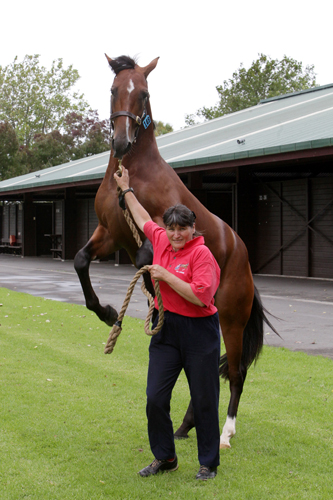
He’s named after a book about flying to the moon. And from the photo, you can see he was keen to take off long before race day!

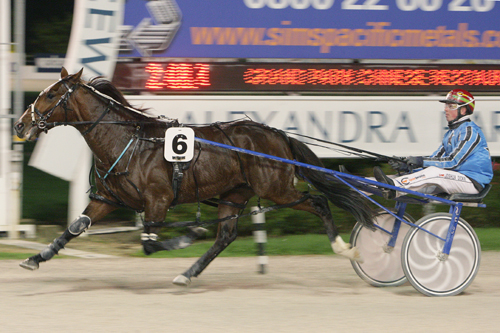
It was great to see Destination Moon get his first win last Friday at Alexander Park. The field was not nearly as strong as his first race a couple of weeks earlier, which was a Sires Stakes heat with the speed on, but the way he won was impressive.

He reached the front early and ran confidently in the lead, not switching off, keeping a good margin to the others and pulling away to win by over 2 lengths with little encouragement needed from Joshua Dickie in the bike.

Destination Moon is the half brother to Tintin In America and full brother to The Blue Lotus (3rd in Sires Stakes Fillies 3yo final), from my wonderful mare Zenterfold. His sire Grinfromeartoear is not highly commercial but if you get the right match he adds a lot of value and leaves some tough horses with speed.  “Duncan” (as we nicknamed Destination Moon) was a lovely type as a yearling and sold for $68,000 to Rosslands Stud Ltd (Kerry Hoggard) at the 2012 yearing sales.

He has shown up in his workouts and qualifying trial just prior to racing, but pleasing to see there wasn’t a rush to get him into the 2yo Sires Stakes if he wasn’t ready.

Recently I spoke to trainer Steven Reid about Destination Moon’s next steps, and he says he will be racing till the end of June then have a spell before being aimed at the 3yo Sires Stakes heats, which come up early in the new season and culminate around NZ Cup time.

Destination Moon pacer

Destination Moon wins on 24 May 2013 at Alexandra Park

Steven says he was “rapt” with the win – “He just cruised that, and it is how he’s been working at home.”

He describes Destination Moon as having the potential to step up and be quite a good horse.

Tintin In America and The Blue Lotus now have a Real Desire half brother weanling who is hanging out in our paddock with a full brother to Flying Isa, great mates.

More about him and an update on other branches of the family coming in a blog soon.

Destination Moon’s pedigree is one I wanted because Grin offers some physical and genetic influences that really complement his dam Zenterfold.  I have always taken on board Aria Small’s advice that the family love the old blood – the Spinster/Old Maid/Scotland connections, which it has on its bottom line through Bachelor Hanover. And that has been a touchstone for me in getting a good nick for the mare. Grin hauls that old blood up through his remarkably close-up Storm Damage damsire, and also in his maternal line through Shifting Scene and Race Time (a son of Breath O Spring and half brother of Storm Damage). Shifting Scene is part of the lovely Golden Miss maternal line that you see in many classy families (Rich N Elegant, Real Desire’s maternal line etc) and of course the overlooked element in that line is my dear old Shadow Wave.  In Zenterfold’s pedigree, Shadow Wave pops up promptly as the damsire of New York Motoring, who I believe is a key figure in what have developed into the two best branches of the Zenover family – Interchange and Zenola Star, both sired by New York Motoring. Finally you have the Direct Scooter and Tar Heel influences of In The Pocket, the sire of Zenterfold and so grandamsire of Destination Moon. These are again classy old bloodlines and with a fairly up close dose of trotting blood and both are descending from Volomite and maternally tracing to the wonderful Roya McKinney and Scotland/Rose Scott. Zenterfold’s grandam Now And Zen is also chokka with trotting blood via her sire Chiola Hanover. Chiola Hanover goes back to Volomite and the Scotland influences as well. But none of that is an issue for Grin, thanks to his breeding, especially Storm Damage who is described by John Bradley as having “some of the oldest bloodlines still available for pacers” – his dam was 24 years old when she foaled him, and he is a remarkable “sleeper” in the pedigree of a modern day sire.

Phew! that’s a little peep into some deep old echos in a 2yo pacer just launching his career.

Of course what I also liked about Grin was his ability to leave guts, character and grittiness, which The Blue Lotus showed in her races too. That gave the Zenterfold speed-at-all-cost attitude something to hang its hat on.

Cover Destination Moon book

Cover of Tintin book

It’s what might work for a particular family that counts. And that’s what I think about, more than what is the most fashionable option at the time.

Destination Moon has a long, long way to go. The rocket is just launched, yet to fire the booster engines and go into the statosphere.

I hope he ends up amongst the stars.

Read Full Post »

A bonus from my trip to the NZSBA breeders conference in Christchurch was the opportunity to visit Nevele R Stud and see Tintin In America, whom I bred, and some of his weanlings.

My visit was a lovely echo of my only other trip to Nevele R, which happened the year I decided to put Zenterfold to McArdle, which resulted in Tintin In America being born.

That day was just the same – raining, and the array of famous racehorses/sires standing in their paddocks with their covers on, looking just like any horse. I particularly recall Courage Under Fire (standing at Nevele R at that stage) who looked almost lost under his cover, being the small horse he is, as the rain poured down around us.

Tintin In America, Sire

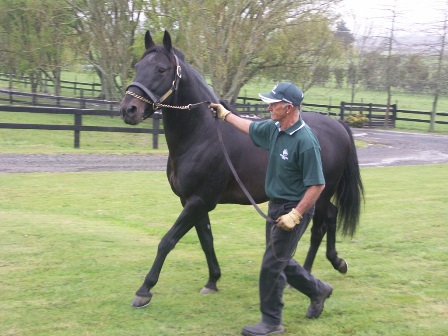
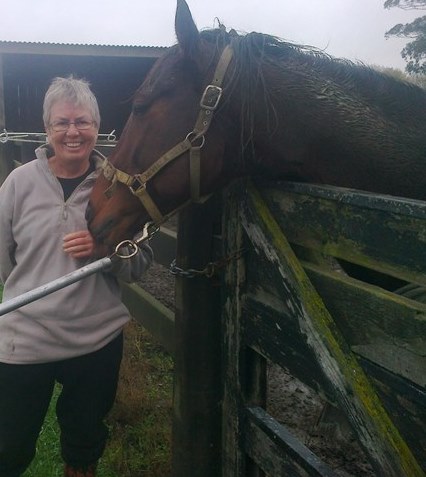
Breeder Bee Pears with Tintin In America at Nevele R Stud, May 2013

That was about 8 years ago. Kym and I were shown around personally by Bob McArdle;  it was a fascinating tour with plenty of commentary by Bob, followed by a fairly robust discussion as we all sheltered in our Hilux ute and debated the merits of putting my mare Zenterfold to Falcon Seelster (which Bob advocated) or McArdle (which I was more interested in doing).

As history shows us, I stuck with McArdle.

So it was lovely last Saturday to come full circle and be standing alongside Tintin In America the sire, in the rain, at Nevele R all these years later.

Tintin retired very sore in one leg joint after super seasons as one of our top racehorses from 2yo to 4yo, and almost reaching a million dollars of earnings.

The good news is: he is very well in himself and full of attitude in the paddock, and very fertile in the barn. Thanks to Nevele R in doing such a good job in settling him in to his new career.

There’s no doubt what sticks in people’s mind about Tintin is his incredible acceleration and speed.  As he grew older he developed the strength to hold that sprint longer. At times, he appeared to be low flying down the home straight. That sort of acceleration is hard to come by.

He was a medium sized horse, but a first foal from a medium sized mare. From what I have seen, his foals are quite striking types of good size. I saw two at Nevele R and both had white blazes which could be their own family influences but I have also noted the blaze/snip influence in Tintin’s family. Interesting.

I’d love to hear from people who have foals/weanlings by Tintin. Email me at bee.raglan@xtra.co.nz and tell me about them.

Personally, I am negotiating a share in a well bred weanling filly by Tintin In America, and have leased another mare to put to him with a very interesting pedigree match. But more about those  at a later date.

I’m a careful and thoughtful breeder and I believe he’s worth a good punt as a sire.

Read Full Post »

I’ve just returned from the NZ Standardbred Breeders Conference in Christchurch on Friday 17 May. I applaud the organisers for gathering a great line up to get us thinking, and tip o’ the hat to Michael Guerin – his Q&A sessions with Karen Parsons and Cran Dalgety were a highlight, and his summing up at the end of the conference was a call to action that would have set the conference alight if it had come at lunchtime.

My only quibble with an otherwise very good conference:  poor timing at the start meant the workshop/discussion session at the end was truncated and lacking focus. It was an ideal opportunity for John Mooney et al to get some support and direction from active and interested breeders through real workshopping of ideas. Having that number of well informed breeders from different parts of the country in the same room is rare. It creates an exchange of ideas that surveys and submissions can never achieve.

Perhaps a raft of workshops on specific ideas arising from the conference (and elsewhere) could be held around the country over the next 6 months to put some flesh on the bones and give some life to Mick Guerin’s apt comment that the breeding industry must settle on its priorities and get much more coordinated and clever about its tactics to push those into the wider harness racing (or general racing) agenda.

A quick note on two of the presentations:

Dr Jenny Cahill spoke on the importance of genetics. Her recap on the basic principle of “pairs” was an apt salute to the equal importance of sire and mare. It takes two to tango, right down to the chromosone level! She also placed a realistic perspective on the contribution of genetic making up to a performance horse, noting that complex inherited traits ( e.g. some performance measures, height, temperament, and a number of diseases) are affected by a number of genes and usually also modified by environmental factors (such as training and nutrition).

As equine genetic research moves into the field of complex traits, Dr Cahill said breeders need to feed into research programmes what they are most interested in finding out. For example, the dairy and beef industries are further down that path and have clear objectives of what research can help them produce better products for a changing market.

For some equine breeders, genetic research will be a step too far to contemplate, but it is going to happen. We must embrace and direct it, or we are just burying our heads in the sand. Dr Cahill says “the ultimate goal of this research is to be able to use the information gained for the good of the horse, owners, breeders and trainers and to be able to screen individual horses for these traits.”  This would include testing for heritable conformation faults and diseases, and also good gaitedness and even the type of performance they are “wired” to achieve (speedy sprint, medium distance fast, stamina/slow).

All this has HUGE implications for breeders, buyers and sellers. Some thoroughbred markets are already using available information. How would we use it? What impact would it have on numbers bred and sold if we cut out all those horses in advance who will only make up the numbers in a race? How would it change our yearling sales, if overnight buyer-requested testing became available? Fascinating stuff to ponder!

Dr Clarissa Brown Douglas, speaking on nutrition of the mare and foal, gave a wealth of useful information, emphasising the importance of feeding correctly in those critical formative times. Her take-out messages were simple: Managing growth is a balancing act. The last trimester is a vital time to ensure the foal gets the minerals, trace elements and vitamins required. Get to know the nutritional value of what you are using – pasture and hay as well as commercial feeds and balancers.

Some of the facts that stood out for me:

  1. Mares milk lacks minerals so in that vital last trimester, the foal stores the minerals it needs in its liver for use during the first 90 days of its life.
  2. A foal is born with only 17% of mature bone mineral content, and maximum bone mineral content is not achieved until a horse is about 5 years old.
  3. The 6-12 month period of feeding a weanling is a “window of opportunity” and you need to monitor growth rate so you don’t overload the immature skeleton structure.
  4. Yearling preparation is best done gradually over 90 days.
  5. Be aware of the potential for high glucose/insulin response in young horses – low glycemic feeds are a good way to prevent this.

So it really makes you think about the pressure we put on such an undeveloped creature when we race horses as 2yos! And if we continue to do that, it places a big responsibility on breeders to lay the best foundation possible.

I am sure NZSBA will be publishing the papers presented by all speakers at the conference on their website. It’s great food for thought.

The industry analysis (both harness racing in general by Edward Renall, and breeding industry by John Mooney) provides some good basis for discussion.

But as Mick Guerin said, we need to pin down and agree on our priorities, and push our agenda forward in a united way. We will get nowhere by griping and sniping, riding the ocean like flotsam and jetsam, carried on currents that seem out of our control.

I grabbed a chance right at the end to raise my idea of increasing the breeding option to one foal and one ET per mare per season, outlined in other blogs. I got a strong positive response from several breeders to this suggestion – including a commitment from John Mooney to start following it up.

Likewise Brian West raised the need to get a monetary return into breeders’ hands via a % slice of stakes, as they do in France where breeders are recognised as the key investors in the industry’s product.

These ideas are not as “out of the box” as we might think. As I said, a series of workshops or think tanks around the country could pull together some recommendations.

Let’s get some fresh voices and fresh ideas in the mix.

Great conference, exciting times!

Read Full Post »

I’ve never been keen on embryo transfers except when the mare is unable (for whatever reason) to carry naturally.  I worried about us getting into a ‘factory farming’ situation where the complex mix of nature (genes) and nuture (early upbringing) was lost in the hurry to make money above all.

I’ve changed my mind. Not my principles, just my mind.

I believe the ability to breed two foals per season from one individual mare creates opportunities for the breeder and the industry overall which just cannot be discounted. And I believe two foals should be the limit.

Of course, the idea will be discounted. I am sure there is a piece of obscure government legislation, some racing industry committee or board, or just a clause in HRNZ rules that requires everyone to unanimously agree on changing from the status quo…well, I’m not interested at this stage about why we CAN’T do this. I am only interested in discussing whether it will help our breeding and overall harness racing industry, given the decreasing number of foals and breeders we have.

It’s not exactly going to open the floodgates – but it may help the flow.

So let’s tick off what the benefits could be:

For breeders

  1. It allows a potentially greater and more frequent return on investment (the broodmare) over her limited productive years. Therefore it makes a good broodmare a sounder financial investment (even allowing for the cost of embryonic transfer and an additional carrier mare), and gives the breeder more opportunity in a shorter period of time to discover the ability of the mare as a producer.
  2. It gives breeders the chance to spread their risk among a wider range of sires. For example, a breeder may go to a “tried and true” top commercial sire with one foal and a risky but exciting new sire with the other. Or perhaps a compatible but less commercial sire, and keep the foal to race. So newer or well priced sires may benefit from this proposal, and get access to better quality mares.
  3. It allows breeders more chance to get one healthy foal, and perhaps a foal of the sex they prefer. The high risk nature of breeding means that any significant conformation problem or injury, or even getting a filly rather than a colt, can prove a real disappointment to the breeder and impact hugely on the likely sales result or racing outcome. Double the chance does not double the risk – it may not half it, but it can reduce it significantly.
  4. More breeders using embryo transfer will bring down the costs of the process, and therefore cost will be less of a barrier.
  5. It creates a new ‘career option’ for mares who are not commercially bred but have the qualities to make really good carriers and ‘surrogate mums’ to their foals. Some mares may have a top record and carry great genes but are not the best at delivering and raising foals. And some mares may not have top (or desired) breeding, but have the good nature, physique and quality colostrum to add value to a foal. Rather than creating the ‘factory farming’ scenario I was worried about, embryo transfer can create a market (lease or sale) for mares who may otherwise be lost to us – and they could still be available to breed in their own right if required. Some breeders will already have mares more suitable to be surrogate mums than to continue as commercial broodmares.
  6. The limit of two foals per mare per season (and from different sires) means that the market will not be inundated with “doubles”. This is not a cloning exercise. It is likely that numbers will be a very small proportion of total foals initially. So breeders will not be ‘competing against themselves’ and the overall genetic pool will not be unduly affected. Much less affected, indeed, than it is by the tsunami of sperm coming from highly popular sires!

It is easy enough to note ET at registration of foals – an administrative hassle no doubt, but what isn’t. And in any subsequent notation a simple (E) after the name could provide the flag required for those who want to know and for the record the surrogate mare’s name should be recorded.

Who would take up an option like this? Not heaps of breeders, initially. But more as the merits sink in. Probably it would appeal to the biggest breeders, and also the smallest. The latter being people like me, who have a really good mare but rely on her results for any re-investment in breeding, which makes expanding a slow and fragile venture.

Of course some breeders may want to breed a mare twice every second year.  The mare is not exhausted from breeding and there are many who believe resting a mare can produce a quality foal.

So for the industry:

  1. It creates a way of increasing foal numbers without necessarily increasing the number of mares bred – it helps stop the downward spiral of breeding numbers.
  2. It creates opportunities for less proven “higher risk” sires to get progeny on the ground, and perhaps from a better class of mares. It may well be a requirement to breed a mare to two DIFFERENT sires in any one season, if embryo transfer is being used, to encourage this to happen.
  3. It creates more services/service fees for the studs and sire owners, both of whom are important for our industry’s success.
  4. It has the potential to raise the quality and (ironically) the diversity of our breed.
  5. It does not impact negatively on the product (race horses) as perceived by the investing punter.

What do you think?

And before you say: “it’ll never fly” just remember that pigs don’t, but bumble bees do!

Read Full Post »

Looking through the 2013 New Zealand yearling sales catalogue, there is a real mix of outcross, close bred and in-between pedigrees on show, which is great. It’s hard to tell if they reflect what breeders are deliberately trying, or more a match based on other preferences (commercial status of the sire, type, previous siblings etc)  that just happened to end up like that.

There are three yearlings, all fillies, from the wonderful USA Lismore family in the Woodlands draft (on behalf of Charlie Roberts). One of which has a very unusually close double up (in this case to the sire Western Ideal). Inbreeding is not something we often see now in New Zealand, so I was interested to find out what was behind it.

In this blog I’ll look at those three lots, and in the following blog I’ll check out an example of the other extreme, Lot 48 at the Australasian yearling sale, an outcross with a strong “colonial” flavour bred by Bryan and Marilyn Macey.

Line breeding US style

Charlie Roberts of Woodlands Stud fame had the opportunity to buy two affordable fillies from the wonderful Lismore family some years ago – Lismurray with a broken shoulder and Lisgarden with a slightly crooked leg – and bring them to New Zealand.

Lot 37 is a daughter of Lismurray called Lisconnie who is a Western Ideal mare. Charlie Roberts has bred her to Woodlands’ American Ideal, who of course is a son of Western Ideal. So that makes Lot 37 2×2 to the sire, and double ups so close on the siring line are unusual these days. Lisconnie’s previous foals were by Artsplace (I’m) Lisart now racing in Australia, and then by Bettor’s Delight for Red Sky Night who has just qualified at Cambridge this month.

Charlie Roberts’ reasoning behind selecting American Ideal as the next sire for Lisconnie is simple – if you are line breeding, breed to the best stallions in the pedigree and to the best stallions available. Not surprisingly, he rates American Ideal and Bettor’s Delight as the best.  He believes there is no problem about breeding so close (what would generally be regarded as inbreeding) so long as the horses are the best quality.

It is an interesting thought, and one that has thrown up some exceptionally good results in history – but also some disappointments. My own concern would be more about type.  In Lot 37 the pedigree is packed with horses that can leave types that we don’t recognise as sheer speed influences – Abercrombie, Cam Fella, Western Ideal himself can tend to leave bigger strong, tough types. However both the female lines have Albatross, and American Ideal does throw Matt’s Scooter into the mix.

It’s a risky breeding that Charlie Roberts is very relaxed about, and I guess he’s in a better position than many of us to experiment if he so chooses.  As they say,  the proof of the pudding is in the eating. And some of us may end up eating our words, while Charlie is eating the pudding!

There was a forum thread about this particular foal and similar close breeding later last year (although I don’t agree with this foal’s cross being described as 2×3 rather than 2×2 – if Tesio says 2×2 that’s good enough for my small brain!)

Lot 45 is Lisdargan’s filly also by American Ideal. Lisgarden is by The Panderosa, which makes this foal 3×3 to Western Hanover, again on the siring lines. And again, you get the double up of Albatross on the female lines.

And then finally Lot 53, a filly by Bettor’s Delight from Lismurray, who is a Presidential Ball mare, so that brings a 3×3 to Cam Fella, again on the siring lines. The filly will be a full sister to Lisharry who is now pushing the $70,000 mark in combined earnings here and Australia.

These lots all have a very strong American influence, of course.  As I said before, Charlie Roberts has followed his belief in going to “the best” and went to the best NZ bred sire of the time, Christian Cullen, with two of these mares but the results have been a bit disappointing to date, he says.

While the Lismore family is a fine one, we only know it here  from Lislea and Lis Mara as sires, who have not yet set our mares on fire although Lis Mara needs to be given a bit more time. The NZ families Charlie is creating from the two fillies he bought are the other connection to that family. There is plenty of room for the family reputation to improve in this corner of the world, and I think Charlie Roberts is enjoying that challenge.

Read Full Post »

Princess Della is a miracle in today’s breeding world. Her pedigree includes one of the the last flickers of the Globe Derby colonial siring line in New Zealand. But she has turned that flicker into a bright light of success.

And that is thanks to the confidence that Don McRae and his sister Mrs Wendy Blackie have had in the mare.

The mare hasn’t made it easy – she was a “bit of a bitch” at times, says Don, but a big jet black bitch at 16.3 hands who has gone on to re-start a family from a maternal line with some very nice sires – Princess Della’s grandamsire was Armbro Del and her great-grandamsire was Bachelor Hanover – but overall a maternal line which hadn’t shown much for a few generations.

Princess Della has changed all that. The result in 2013 is some decent black type on the top part of the page of Lot 74 at the Premier Day 1 yearling sales, a filly called The Enforcer by new trotting sire Skyvalley (Muscles Yankee-Chiola Lass) who was a double Breeders Crown winner as a 3yo and 4yo.

Princess Della is a trotting mare by Last Lord (by Lordship), a little known stallion who sired only 30 live foals  from 1987 to 1995, for just 2 winners.

Much of the breeding interest lies in the fact that Last Lord is the tail end of the colonial siring line known here mainly as the Globe Derby line, which originated from a son of Hambletonian called Strathmore. More of that at the end of this blog.

Don McRae’s father owned Last Lord and so Don knows him well. He was a big jet black horse (where Princess Della got her looks from) who was given a fairly scanty serving of mares to make his mark as a sire and breeders who perhaps lacked attention to the subsequent foals, says Don.  So his statistics need to be taken in that context.

However one of Last Lord’s progeny was Princess Della, bred by C M Hanna and then bought by Wendy Blakie who wanted a Last Lord foal and was advised by brother Don to chose the one from an Armbro Del mare.

Princess Della had only 2 wins and 7 places but she was a better racehorse than that indicates and would have gone further except for soreness. Don McRae she also “had a bit of dirt, was a bit toey”. She got a 2nd in the NZ Trotting Stakes and that was enough to be awarded as 1992-3 Trotting Filly of the Year.

There were some big offers made for Princess Della, but Wendy Blackie wanted to keep her as a broodmare.

What a great decision.

And what an opportunity taken, as Don and his sister Wendy have made very astute and modern breeding choices for such a ‘colonial’ bred mare. It has paid off, as the catalogue page shows.

Kyvalley Mac, son of Princess Della

Kyvalley Mac, very good son of Princess Della

Princess Della is now a 23yo (note that, Don, you think she is only 21 because you look after her so well and she looks younger!)  As a broodmare she has had 9 foals and 5 winners, and three of them – Rare Opportunity, Dealornodeal and Millions To Spare are currently racing in New Zealand. She seems to leave tough, consistent types with a bit of speed – and the best of them was really good, Kyvalley Mac, who got placed in many group races in Australia and ended up with 12 wins and over $160,00. Three of her other sons have now won over $90,000 (Just A Cracker, Just Incredible and Dealornodeal).  Her most recent foal to the track is Millions To Spare (by Majestic Son) who has just got his first win with only two starts on 4 January this year.

Don and Wendy have chosen sires for Princess Della which include very good proven sires and new imported sires, some at fairly high stud fees when they were first available here. Her consorts have been Sundon (Just A Cracker and Just Incredible), Earl (Kyvalley Mac), Dr Donerail (Off The Rails who showed a lot of talent but injured himself badly before racing), Dream Vacation (Dealornodeal who had an outstanding 4 and 5yo season, particularly in Australia),  Pegasus Spur (Rare Opportunity), and Skyvalley (Lot 74 The Enforcer), and the old mare is back in foal to Muscle Mass.

When a mare leaves consistently talented horses from such a range of sires, I take notice. That is a sure sign of a mare who brings a lot to the breeding table, and takes charge of the negotiations when she gets there.

Lot 74 is described by Don as being a beautiful big filly (Skyvalley was not a big sire, but one who impressed Don and Wendy with his times and his level of success).

“The mare leaves lovely long foals,” he says. And those in trotting understand the advantage of a long (as well as square) body for good gait.

Don is hoping to take a photo of The Enforcer and send it to me probably by ‘snail mail’, and I will post it up when it arrives – but those of you who are going to the sales with a thought of getting a nice trotting filly from an exceptionally good broodmare should definitely take a look at the real thing.

Quick summary of the Globe Derby siring line

Strathmore was a son of Hambletonian whose siring line is almost gone into history. It continued in Australia and New Zealand, through Globe Derby and then his son Logan Derby, and then in New Zealand Logan Derby’s outstanding son Johnny Globe who raced here in the 1950s and early 1960s and stood successfully as a sire in the 1960s and early 1970s.  Johnny Globe’s son Lordship  raced at the top level in the 1960s and stood successfully as a sire from the mid 1970s into the 1980s, but although he left good racehorses, including Lord Module and Starship, but they did not carry on the siring line. There have been recent attempts to find a stallion to carry on this “colonial” siring line in New Zealand before it becomes totally extinct – the elderly Magic Rule has been set to work a few years ago in Australia and then NZ with a handful of mares, but these are unlikely to make an appearance at any yearling sales. Just an aside –  Last Lord has two lines to Globe Derby, one through his sire and the other through his grandam (Complaint) who was a daughter of Logan Derby. You can dig into Princess Della’s pedigree further on the HRNZ website in the incredibly useful Info Horse section. Two other sources of information on the Globe Derby line are the Globederby.com website (although I am not sure how up to date that is) and the chapter 13 on Australasian sirelines in the e-book available on Pepper Tree Farm website: The American Standardbred by Ron Groves).

Read Full Post »

« Newer Posts - Older Posts »