Feeds:
Posts
Comments

As readers will know, over the past few years I’ve used the idea of a “virtual stable” of yearlings from the New Zealand yearling sales to track how hard it is to pick a good horse to buy at yearling sales and then to make something from it. The point being that those who do, regularly, deserved much credit. It has also been a way to encourage all breeders to take opportunities to look at a number of progeny from sires and families, and learn.

It has been a big part of my learning curve, and I try to attend sire parades, yearling, weanling and all aged sales when I can (work and budget allowing).

This year I journeyed south to Christchurch to view the two days of Premier yearling sales because the range of sires was greater than at Karaka’s Australasian Classic. (I’m still going to do a blog on the overall sale – mainly how sires fared. But I just need some time between day job, spraying paddocks, feeding out mares, cleaning out chook houses etc to do the numbers).

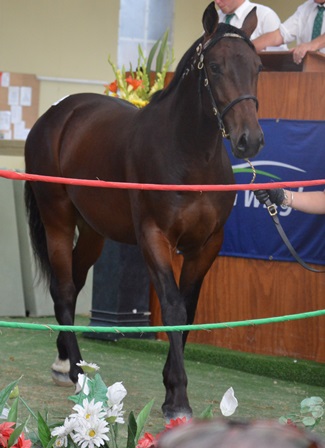
I ended up taking a less-than-virtual interest in one yearling, which I now have a quarter share in. His named is Father Frank, and he was lot 223, a Real Desire colt out of an Armbro Operative mare who is the grand-daughter of Our Stretto, the 35-win mare who performed very consistently in Australia in the late 1980s. Father Frank was bought by Frank and Ann Cooney for $12,500. He was one I had picked out for myself on type as much as breeding, and neither the Cooneys nor I have anything bad to say about the Real Desires. My own one (sold at Karaka) was a cracker of a yearling and I have much admiration for what the sire adds to the right mares. I approached the Cooneys after the sale to see if they would welcome my interest in him. Of course Frank co-trains and the Cooneys part-own the Real Desire racehorse Let’s Elope, whose run in the Auckland Cup was full of merit I thought, with a patient drive by Maurice McKendry allowing him to be (with Saveapatrol) the only horses really running on strongly behind Terror To Love and Adore Me in a 28.2 last quarter.

Two other yearlings in Christchurch interested me enough to make some serious enquiries – lot 142 Magnifico Denario, an Art Major filly from Averil’s Atom which makes her a half to Averil’s Quest. She went for $46,000 to

Lot 288 One Big Fella by Mister Big

Lot 288 One Big Fella by Mister Big

Australian buyers, which was outside the budget.  The other one was lot 288 (One Big Fella) an outstanding youngster by Mister Big from Falcon Seelster mare Killarney (dam of Bondy) also caught my eye enough in the parade to get him checked out. The only lot by Mister Big in the sales, he is a 20 December foal but very well put together and a lovely temperament. I wasn’t the only one taken by him – in the end he went to Nigel McGrath for $54,000.

So I’ve got 3 Christchurch yearlings for my virtual and not-so-virtual stable sorted.
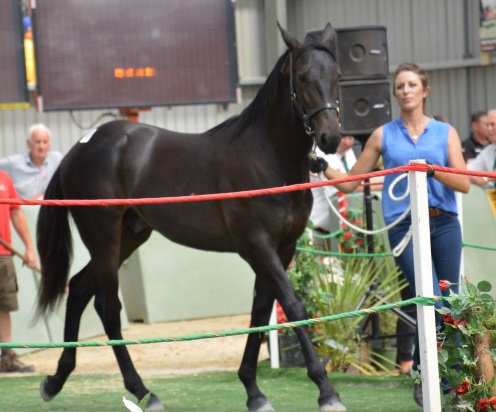
Lot 36 Christchurch - Pacific Arden by Panspacificflight from Scherger Rein

Lot 36 Christchurch – Pacific Arden by Panspacificflight from Scherger Rein

Among many others from Christchurch that could easily have put their hooves in my stable were lot 31 (Freedom Fighter), a springy colt by Courage Under Fire from New York Motoring mare Rafiki, bought by Robert Dunn for $48,000; lot 36 (Pacific Arden), a lovely type of colt by Panspacificflight from 5-win Sir Vancelot mare Scherger Rein, bought by Brian Hughes for $17,000; lot 42 (Trusty Bromac), a Falcon Seelster colt from Badlands Hanover mare Taffeta Bromac, one of the Burgundy Lass family which sold for $11,000; and lot 128 (Al Coda), an athletic looking colt by Changeover from a Washington VC mare, bought by the McCutcheons for $21,000.

And for fillies, Lot 327 (Champagne Reign), an lovely alert strong filly by Christian Cullen from Camtastic mare Mainland Reign, which went for $60,000; lot 302 (Loren Franco), a good sized filly by Changeover from a Bettor’s Delight mare from a good branch of the Lancia family that was passed in to vendor’s bid at $6000 (reserve $12,000).  That was tempting! I liked lot 199 (Don’t Pass I’m Fast), an Art Official filly from Wingspread mare Fast Winger who has had 6 foals to race for 6 winners but the one that looked the most promising (Almost A Christian) died at 3. This was a bigger type of Art Officials, whose yearlings I thought generally were selling for less than they should because we struggle to like the finer but very correct type he is producing. Mind you, it was hard to get a line on buyer preferences for type, as some of the bolder types of Changeovers and Shark Gestures went for less than what I thought they were worth too. More on that later, when I look at the overall trends.

Another colt on breeding and type that I liked (and there were many) was lot 313 Goforjack out of the great mare Laurent Perrier. He looked big, boyish and a delightful racing prospect (photo bottom of this blog) but was sold to the Mitchells of Timaru for only $14,000.  A steal!

There were so many nice horses in Christchurch, a credit to preparers, and a bonus for the buyers who got many for less than cost. I had a feast of looking in Christchurch, and most of my picks are this time based on type alone. I took a lot of photos and I will share more and look at the new sires next week. “If dreams were horses, I’d have a stable…”

Please feel free to use the comment/response function to add your “tips” and “picks” of the yearling sales 2014. I will still keep tracking them as we go along.
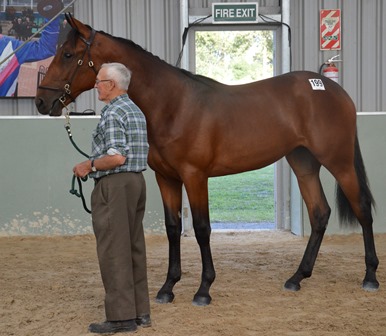
Lot 191 Art Official filly don't Pass I'm Fast

Lot 191 Art Official filly Don’t Pass I’m Fast
Lot 313 Goforjack Real Desire colt
Lot 313 Goforjack Real Desire colt
Tip o’ the hat to long-term trotting sire Armbro Invasion who died recently of a heart attack at 27 years of age.

Harnesslink carried an article which reminds us of the top quality trotters he produced over many years.

The most recent highlight was Stig winning the 2013 Rowe Cup at the great age of 11. A hugely popular victory.

Armbro Invasion is best remembered as a sire for consistency and durability of his own siring record and the qualities of his progeny. His New Zealand statistics reflect that. His first crop was born in 1993 and he’s had over 800 live foals here over those 18 years. His time at stud was in parallel to the great Sundon, and the cross has been well used as a blend of durability and speed.

Just looking over the past 10 years his starter to winner ratios have been hovering around the 2:1 – 3:1 mark annually.
2005 (86/40), 2006 (92/47), 2007 (81/41), 2008 (79/38), 2009 (80/50), 2010 (84/37), 2011 (80/44), 2012 (57/26), 2013 46/24) and so far this season 41/17.

That’s why a lot of owners and trainers enjoyed his trotters – if you have a starter, you have a good chance of a winner.

He was never known as a producer of early types or high speed, but once they got going they were often tough and durable. His youngest crop here (before he moved to Australia) are now 3yos, and one recent qualifier I will be watching is the filly Rattle (Ambro Invasion – Scuffle) who is a grand-daughter of the great Tussle, one of my favourite racemares ever.

He’s done a great job as a broodmare sire too – one of his best known credits here is Charlemagne, the dual Jewels winner bred by Tony Dickinson of Alta Lodge and owned/trained by Colin Butler in the Waikato.

Armbro Invasion’s own breeding was tops – by Speedy Crown from the great mare Delmegan (by Super Bowl) who won $469,593, and his grandam was Delmonica Hanover (by Speedy Count) who was a sensational racehorse winning $832,925.

His family is an interesting one to track on Classic Families database (free access on Peppertree Farm website) to see how other branches of his great dam and grandam have fared both in America and Europe.

Armbro Invasion was by no means the best performer of Delmegan’s foals. His own record is only 14 starts from 2 to 4yo and a total stakes of only $13,226. These days he would probably never be given a chance at stud!

My eye was caught by tomorrow’s Gore harness meeting on the grass – Race 4, a 2yo by Panspacificflight will be racing.

Panspacificflight

Panspacificflight

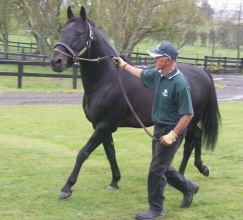
I’m just about to do a blog on Panspacificflight, having seen quite a few of his progeny at the yearling sales this year, and following the 2yo starters he’s had to date – which is is oldest crop here in New Zealand. He’s a sire that impresses me.

The young gelding racing at Gore is named First Flight In, and his formline so far reads 747, which is a lovely coincidence when it comes to airplanes. This horse has a wee bit more ability than that formline shows, and he’s certainly no Fokker Friendship labouring down the runway.

He’s won a couple of Invercargill trials. He was 7th when he galloped at the beginning of his first start and lost all chance. His fourth looked promising. And his last race for 7th was the Kindergarten Stakes where he drew 8 and was never near the front but stuck on well to take a personal best time of 1.55.3.

His maternal family is an old one tracing back to Dream Star, Royden Dream and other Roydon Lodge broodmares.  His immediate dam is Sharjanter, a Christian Cullen mare, and her dam Falcon Magic was also leased by Brent and Sheree McIntyre a few years ago for two breedings to Panspacificflight. A Live Or Die half sister to Falcon Magic is Love To Live, the dam of Terror To Love.

Trainer Phil Devery bought him on type at last year’s yearling sales (Lot 253 Christshurch) for about $11,000, but he proved not easy to break in, being a bit of a nervy type. Phil says he’s a good gaited horse with ability, and it will just be a matter of waiting for him to “grow into his mind and get a bit of maturity.” Looking at the videos of his races, I’d agree with that. He’s got a lovely stride, good reach, but as Phil says it will be a bit unknown on the grass at Gore particularly as he has drawn bang in the middle of the mobile gate, so there is no unruly mark to assist if he gets stirred up.

Phil says he will have to get a line on him over the next month or so and see whether it is worth keeping on for the bigger races or giving him a break and bringing him back as a nice 3yo.

Although his sire is well over 16hh, Phil says First Flight In is not a big horse, but is a good looking one.

So not a Jumbo Jet and not a Fokker. I will be watching tomorrow to see how the formline develops!

From article by Matt Smith Otago Daily Times when the horse qualified late December 2013:

Macca Lodge sire Panspacificflight sired his first qualifier at the Roxburgh Trotting Club trials on Sunday.

The American-bred sire, who won his first four starts as a 2yr-old, left a similar ability to run early on his 2yr-old crops in the United States. The son of Panderosa is only available through frozen semen at the Gore-based breeding operation, but has produced 62 live foals from 102 mares served in his three seasons in New Zealand.

His first qualifier, First Flight In, is out of the unraced Christian Cullen mare, Sharjanter. First Flight In’s time of 2.01.5 for the one mile was a comfortable 4.9sec inside the required time to qualify for driver Andrew Armour and Invercargill trainer Phil Devery.

Update post race: Phillip Devery would have been a bit frustrated as the race gave no better line on the real ability of this horse, with a false start caused by another horse probably stirring the youngster up. When they got underway again, he broke and caught the field easily, but broke again and was out of play after that. If he can develop some maturity to handle that sort of situation, he will change his formline around. I’m not the only one noting him – he went out favourite.

Kym with Sun Isa

Kym with Sun Isa

The Pegasus Spur x Sun Isa colt bred by Kym Kearns is the new Australasian record holder for the mile trot.

As Michael Guerin says, it indicates how unlucky he was to miss a spot in the big trot on Interdominion day.

Congratulations to the owners, some of whom bought the full brother at the Karaka yearling sales three weeks ago.

Read more about Kym and the Sun Isa family here

On the same day as the Interdominion Final and Chariots of Fire was run, I also checked out the harness racing at Addington for the Cheviot Club and spotted two well regarded Falcon Seelster youngsters going around. The first was Free Falling, a 3yo colt who blitzed his field by over 12 lengths and a 57 last half, and then there was a 2yo Falcon Seelster filly who went out favourite and got 3rd, but looks a nice sort indeed. As I’ve mentioned in a previous blog, there are still a few hitting the racetracks each year, even though the sire himself has passed away in 2011.

Falcon Seelster is available via frozen semen.

So if you have a mare or can lease a mare that is a good potential cross with this sire, this coming season will be one of the last opportunities.

Bob McArdle says he has about 50  straws here and 50 in Australia – the details/contacts are available here on the Bromac Lodge/Stallions web page. Or talk with Bob direct, his phone number is on that website.


Post Interdominion Finals day it is nice to see that the spoils were shared around, and there were some nice return to be had if you punted outside the “obvious” horses. Did you like the run of Seel N Print for second in the big race? What a patient drive and a good finish. Well, I have to have a little brag at picking that one out to highlight in my last blog, and I did have a sneaky bet on him.

One of our New Zealand Trackside continuity announcers, admittedly a galloping enthusiast, kept saying what a great day it was for the great sire Bettor’s Delight.  Yes Bettor’s Delight had two wonderful wins, which is probably appropriate for his dominance in terms of numbers and quality, but other sires got a look in – and not just ones many might see as “the next best thing”. As I said last time, that’s why the great staying races and the top sprints for top horses tend to find quality wherever it comes from.

The sires of the winners on Interdom Final day were (in order of the racebook): Armbro Operative, Presidential Ball, Jereme’s Jet, Village Jasper, Art Major, Artsplace, Bettor’s Delight, Bettor’s Delight, Dr Donerail for the trot, and Aces N Sevens. In terms of overall results, Art Major had a good day as a sire, as did American Ideal. Great to see Live Or Die and Courage Under Fire still flying good flags.

The Interdom winner is a bit of a stranger for me regarding his maternal line, and I’m hoping some of my Australian readers can throw light on that – Beautide is by Bettor’s Delight from Gorse Bush, a very nice producing mare who won 10 races herself. She’s by an American bred sire called Ticket To Heaven whom I’ve not heard of before, and from a mare by another American bred sire called Holly Sand. I am not sure at what point the family or these sires came out to Australia but would love to find out more.

Please let me know.

(Update: Thanks to Gary Newton I know a heap more about Beautide’s family – check out his comment below)

Big day at Menangle today, but rather than analyse the form or predict the race tactics, I’ll just give a quick overview on the breeding side of things.

Here is a gathering of many of the top horses in Australia and New Zealand and they are performing at staying distances.

That’s a true test of a horse.

What appeals to me is that, in spite of the dominance of some sires over the years, the fields for these sorts of races always display a range of breeding choice.

So although the Chariots of Fire will be a cracker of a race over the mile, half of that field is either by Bettor’s Delight or Art Major.

But in the staying races, it is a lot more evenly spread.

In the Interdominion Final, there is a 14 horse field, with 3 Bettor’s Delights, 2 Art Majors, 2 Courage Under Fires, and the rest have just one representative – Washington VC, Dream Away, Falcon Seelster, Christian Cullen, Famous Forever, Mach Three and Western Terror. Or looking at it in terms of siring lines – the Cam Fella line has 5 runners representing it (Bettor’s Delight, Washington VC and Famous Forever), the Direct Scooter line has 4 (Christian Cullen, courage Under Fire and Mach Three), the Abercrombie/Artsplace line has 3 (Art Major, Dream Away), and the others are from the No Nukes/Western Hanover line (Western Terror), and Bret

Seel N Print (Falcon Seelster 6yo from a Go For Grins mare) was an outsider when winning his interdominion heat but has $406,000 to his name and a good draw in the final.

Seel N Print (Falcon Seelster 6yo from a Go For Grins mare) was an outsider when winning his interdominion heat but has $406,000 to his name and a good draw in the final.

Hanover/Warm Breeze line (Seel N Print).

On the maternal side, there is a mix of deep families and families that have popped up a brilliant one almost from nowhere. However there are some quality damsires adding value here: Soky’s Atom (Im Victorious, Wartime Sweetheart), In The Pocket (Livingontheinterest and The Gold Ace), Safely Kept (Keayang Cullen, Smolda, Caribbean Blaster), Falcon Seelster (Mach Beauty and did have the first emergency Franco Nelson), plus Fake Left (For A Reason), Bookmaker (Forever Gold), DM Dilinger (Restrepo) and Go For Grins (Seel N Print).

Overall, the message for breeders from top staying races is that so-called golden crosses are really about statistics for larger populations of horses. They don’t help us predict which horses will rise above the rest and become an Interdominion champion. And they don’t necessarily work for particular families and mares.

The NSW Oaks field today also throws up a wide range of sires. Bettor’s Delight and Art Major have 2 each in the 10-horse field, and sheer weight of numbers of foals means that should be no surprise. But one of the favourites will be the McArdle filly Nike Franco, out of the great staying Badlands Hanover mare Nearea Franco who belongs to the Shy Ann family. There’s also a Live Or Die filly, a Jereme’s Jet filly, a Troublemaker filly and yes, even a Flashing Red filly.

The NSW Derby is a little different. Art Major has 3, Christian Cullen has 2, so that is half the field. But after that you get a good smattering of others with 1 each – McArdle, Bettor’s Delight, American Ideal, Jereme’s Jet, and Julius Caesar, the much less commercial brother of Christian Cullen.

There are many breeders and owners whose aim is still to breed horses that can win those classic staying races – the oaks, the derbies – and who love seeing their horse given the time to mature into a potential cup and interdominion type.

History shows that the interdominion and major cups winners can fly the flag for sires and families that would struggle to get a bid at the yearling sales!

KONICA MINOLTA DIGITAL CAMERA

Bettor’s Delight – outstanding siring son of Cam’s Card shark

Just announced by Hanover Shoe Farms today – Cam’s Card Shark has been retired from stud duties.

Interesting to see what a strong sire line that has become.

Will it be continued with Bettor’s Delight leaving a great siring son? We’ll have to wait and see. I’ve blogged on that before and it is quite intriguing.

Hanover shoe Farms has also done a deal to stand at stud there:

Myron Bell, the racing manager of the outstanding pacing colt Captaintreacherous and Jim Simpson, President of Hanover Shoe Farms today announced that an agreement has been reached for the great son of Somebeachsomewhere to stand at stud at Harness Racing’s greatest breeding farm beginning with the season of 2015.

Present plans call for “The Captain” to continue racing for the duration of 2013 and through the entire racing season of 2014.


Will post again shortly (I’m head down with day job at the moment) but in the meantime please have a look around past blogs as they cover a wide range of topics.

You can use the “Search” facility at the top right corner of my blog to enter in topics you are interested in – keep in simple like names of sires or families Rich N Elegant, Nedda, Tintin In America, yearling sales, Shadow Wave, Overtrick etc.

It will help you find topics of interest that I have covered in the past few years.

Maths was never my strong suit. Thanks to Helen Smith, my maths teacher who took extra classes after school, I squeezed through School Certificate maths with 54%.  And then I had to do a statistics course at university when I majored in geography. It was torture.

But at least I know the difference between “average” and “median”. Which is useful, because they can tell quite different stories about prices at the yearling sales, both overall and for individual vendors.

PGG Wrightson (who run the sales) uses averages to monitor how the sales went. It is a useful tracking tool over time, and it does indicate if there is a strong trend in one direction or another. However we know that if 5 horses sell for $10,000 and 1 sells for $100,000, the average for the 6 is $25,000. Does that really reflect what happened? If those results are for one vendor, it is a useful indicator that overall they have well covered their costs per horse and probably made a small but welcome profit, thanks to one outstanding sale. But across a day of sales or three days of sales, I am not convinced that averages mean that much.

Before I get on to “medians” here are some quotes from PGG Wrightson about the averages for this year’s sales:

(Day 1 Christchurch) A strong middle market on the first day of the two-day New Zealand Premier Sale in Christchurch yesterday (Tuesday) saw the average price lift from $22,186 in 2013 to $25,191 in 2014. Canterbury rep for PGG Wrightson, Bruce Barlass put the 14 per cent rise in prices down to a strong Canterbury and Southland presence, as well as the healthy state of dairy farming in the South Island.

(Day 2 Christchurch) The average was also well up, rising 10% to $24,536, which came down to the large number of lots which sold within the $30-$90K bracket.
“There wasn’t as many $100,000 plus yearlings as there has been in years gone by, but the middle to top market was very strong,” said PGG Wrightson’s Rachel Deegan.

Good observations, but it is interesting how the “middle market” has now been defined as around $30-40,000, which is above the average.

I understand that the Australasian Classic at Karaka had an average of $31,577 this year.

Now let’s look at what medians can tell us. The median is the middle of a range of numbers – basically the point where there are an equal number above and below it. So in terms of yearling sales, it gives a more accurate indication of how many vendors achieved a price higher or lower than that for their horse. In all cases it covers only horses sold at the auctions, not those passed in.

Add in the fact that just to cover costs a yearling probably needs to achieve $15,000 (if you have gone to a moderately priced sire and are doing the raising and preparation yourself) or over $20,000 (if you have gone to an expensive sire and are being charged for raising and preparation).  These are ballpark figures, but they give a steer on what a vendor needs as a realistic return on investment.

The median at the Australasian Classic (Karaka) sale this year was $26,000. In other words, an equal number of horses sold for less than that, and more than that.

For the total Premier (Christchurch) sale the median was $16,000. That indicates that about 126 horses sold for less and 126 horses sold for more. That’s a lot of horses not making it to break-even.

So medians paint quite a different picture compared to averages.

Father Frank a Real Desire colt

Father Frank, Christchurch Lot 223, a lovely Real Desire colt sold for only $12,500 – appropriately to Frank and Ann Cooney.

I’ll dig a little deeper, using $15,000 bands – of the almost 100 lots sold by auction at Karaka, 31 were $15,000 or less, 29 were between $16,000 and $30,000, and another 18 were between $31,000 and $45,000.  That’s about 60% of horses selling for less than $31,000, and 78% for less than $46,000. About 30% probably hardly covered costs and certainly wouldn’t have made a decent return on investment and risk.

Same story in Christchurch. 126 lots sold for less than $15,000. That’s about 50% of the lots that were sold by auction on the day. Another 87 sold between $16,000 and $30,000. That’s just over 80% of lots selling for less than $30,000.

So you can start to see why vendors were feeling a bit mixed about the results by the end of it. So much depended on whether you had enough good results or one really excellent one to average out your overall return.

Or looking at it from the other side of the business, it was a buyer’s market. Yes, there was good competition for the top end horses. But you could sense the effort required to get bidding beyond $10,000, and again to shift it over $20,000. Once over $30,000, the bigger bidders came in – and that is why many buyers with smaller pockets felt they could not get a decent look-in at the better quality, more commercially bred horses. On the other hand, they had a wealth of opportunity to pick up some very well raised attractive individuals at quite cheap prices, if they had done their homework.

The lower end prices were not necessarily a reflection on the individual product.

Often it was just a case of type, family and sire. It is such a conservative buying market. I’ll look at that in more detail next time.

Once again, these figures don’t include the passed in lots that were later sold (and quite of few of them were in the higher range). But the sheer volume of <$15,000 lots in unlikely to alter very much at all.