Feeds:
Posts
Comments

Archive for the ‘Horses’ Category

In this blog I want to share some thought-provoking ideas about selective breeding to improve the quality of racehorses and the genetic stock of mares. It comes from the thoroughbred side of life – but don’t let that put you off. I don’t agree with some of it, and will say why.

What’s more important is keeping open minds and encouraging discussion. That’s often not a strength of our industry, but it is what my blog tries to do. So read on, and have a think about it. And please respond if you want.

NZSBA chair John Mooney sent me an extract from a book he’s been reading called Thoroughbred Breeding – pedigree theories and the science of genetics, by Dr Matthew Binns and Tony Morris. One chapter looks at how selection of breeding males is intense and only a small, select few go on to be successful sires – but they have a significant impact on the breed through the production of large numbers of offspring and the establishment of breeding lines.  The improvement of females through selection is much weaker, with lower grade mares lacking performance and soundness having often been allowed to breed to meet the market for numbers of racehorses, at least until the recession bit from 2008.

The authors go on to say:

The lack of selection on the distaff side in Thoroughbred breeding inevitably presents a major barrier to genetic improvement, and although the recession…will doubtless lead to many inferior females being withdrawn from the production line, their removal will make little difference; a technique which could bring advances has been developed and is available, but it has not been sanctioned by the Stud Book authorities who control the breeding of Thoroughbreds.

Embryo transfer…is a procedure which would enable better-quality mares to produce several offspring per year instead of the one decreed by Nature. In this way the number of foals born might be retained while improving the overall quality of the breed, but current regulations do not even allow foals to be conceived by artificial insemination, so the introduction of embryo transfer is something for the distant future, if ever.

Readers of my blog will know that I advocate for full consideration of a system for standardbred breeding that allows 2 foals in a season from the same mare, one carried by that mare and the other by embryo transfer to a surrogate mare.  So it is interesting to see this issue being raised in a different context – for improved breeding of thoroughbreds.

Having said that, I’m very aware how different the thoroughbred situation is from ours – we have already introduced artificial insemination and allow some embryo transfers.

However I don’t agree that genetic selection to improve the breed is what should drive the decision to allow more than one foal per mare.  I’m more interested in it as a way of keeping breeding numbers up, increasing diversity and providing commercially focused breeders with better opportunities to get a return on their risky investment.  There is, in my view, a need to maintain a level of genetic diversity (however limited it is within our very inbred industry) rather than a simplistic “breed the best to the best” approach.  That is one reason I have suggested two foals per season as reasonable (and from different sires, so that breeders are encouraged to be more adventurous in their selection of sires for more commercial mares).

The authors go on in the same chapter (Selective Breeding) to discuss how financial drivers of breeding have also held back good selective breeding practice:

In the old days, when racing was dominated by wealthy owner-breeders, the breeding goal was to produce the best racehorse possible. The breeding goal of most Thoroughbred producers now is an animal who will generate a high price at the yearling sales. This leads to mating plans based on fashion, and, in defiance of logic, the most fashionable stallions are often the newest recruits to the ranks. Although everyone is aware that the vast majority of stallions are destined to be relatively unsuccessful at stud, breeders routinely place their trust in unproven horses to the extent that some 40 per cent of most foal crops have sires whose progeny have not been tested on the racecourse. Given the large books of mares covered by many of these unproven stallions, some may have 500 foals before it becomes clear that they are failures. Many of the females produced find their way into the breeding population to disseminate unfavourable genetic combinations. While the production of commercial yearlings takes precedence over the goal of producing successful racehorses, the breeding industry will not develop Thoroughbreds of greater genetic strength.

Do New Zealand standardbred breeders look for fashionable new sires? In some cases, but overall it’s not a driving factor in breeding decisions in New Zealand.

What is fashionable?

New Zealand breeders are notoriously conservative in their selections and will usually opt for proven sires against “fashionable” new sires, rewarding sires like Mach Three, Christian Cullen, Falcon Seelster and Bettor’s Delight with incredible support for many years, while other “fashionable” new sires come and go.  New Zealand breeders are reluctant to experiment with sires (even those who are top-rated overseas like Life Sign, Artsplace and Western Ideal) and it is rare that they get a flood of support when they become available here. “Yeah, nah, I’ll let someone else have a go first, mate and see how they do on the track.”

Yes, many of the trainer-buyers at our standardbred yearling sales are looking for fashionably bred yearlings to ‘sell on’ to owners because those owners will view more positively having Somebeachsomewhere to brag about, even though the best yearling on type was a Live Or Die or a Grinfromeartoear.

So “fashionable” tends to translate as “most popular and proven” in this part of the world, rather than newest sire on the block.  (Note: The buying and selling of older horses outside of the yearling sales has always been a very important commercial factor here, and provides a balance to the more fickle factors that drive the yearling sales environment.)

In the standardbred world, the North American hype around first season sires is driven not so much by breeders looking for ‘fashionable’ sires, but more by the owners of the recently retired racehorse and the stud who has a vested interest in him. They are desperately needing their horse to become “fashionable”. In reality, very few horses carry such an aura off the track that they capture global enthusiasm. Somebeachsomewhere and Rock N Roll Heaven would be recent examples, and of course SBSW has now moved into a “proven” category in North American (which may or may not be reflected in success in the southern hemisphere). But many other top racehorses who become first season sires are not likely to be viewed so confidently. They will struggle to get a toe-hold in a market that is over-supplied with new sires.

So our situation is quite different from that outlined by Binns and Morris in the quote above.

Binns and Morris also say that favouring new, unproven sires is working against the long-term genetic improvement of a breed.

I’m not at all worried about breeders experimenting with new season sires – in fact I encourage it. How are stallions expected to show what they can produce if they don’t get a decent number and range of mares?

If selective breeding means concentrating on proven mares crossed with proven sires, I can feel a big yawn coming on. Playing safe is wise but not necessarily how nature has made significant advances!

We might end up with an improved genetic product, but we may miss important contributions coming from left field.

After all “successful sires” and “successful mares” are only those we identify in hindsight. History shows us many examples of sires that were not valued/fashionable or not overwhelmingly successful as a sire, but later added an important injection of genes into our breed. Well, locally look at our beloved sire Vance Hanover, who was unraced and unproven, an imported son of Albatross from a good family, who attracted his first big books of “nondescript” mares here through an extremely affordable service fee, and went on to set siring records for many years.

It’s stimulating to think about these things.

In my next blog I will look at a good point Binns and Morris raise: What is our breeding goal?  
Read Full Post »

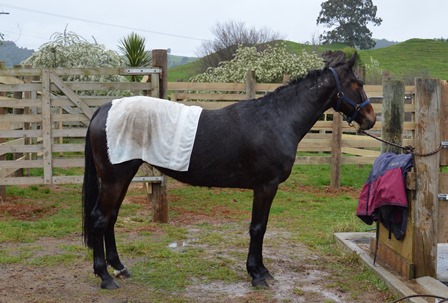
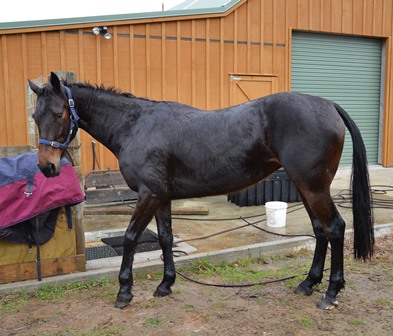
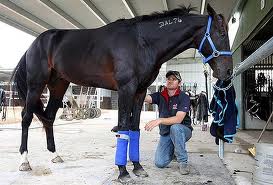
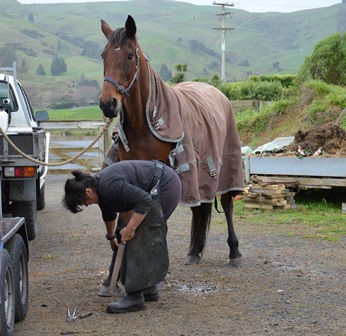
Manicure, shower and massage for two of our mares yesterday as we moved them from one of our “virtual farm” paddocks to another.

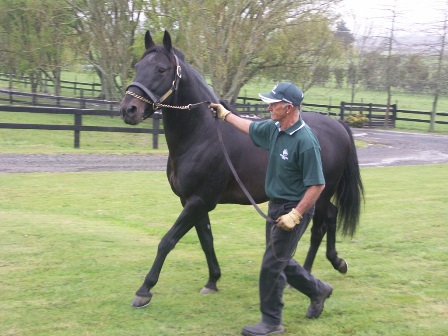
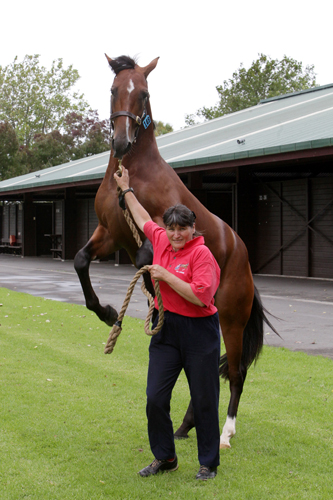
Who is this rather handsome looking mare getting a hoof trim and wash by owner Kym Kearns?

It’s 26 year-old Isa Countessa (Krissy) the much loved dam of Sun Isa and so  grandam of Flying Isa (the colt who won the Australasian 2yo Trotters Breeders Crown in 2011).

The bottom two photos are of my mare The Blue Lotus, whose pedigree was shown in the last blog.  Her first foal took a lot out of her, and it has been a work-in-progress to get her condition and confidence back up. She’s feeling a lot better now that she’s got her figure back!

Isa Countessa

26yo Isa Countessa gets a manicure

Isa Countessa mare

Isa Countessa at Isa Lodge

The Blue Lotus mare

6yo mare The Blue Lotus enjoying the TLC at Isa Lodge

The Blue Lotus mare

The Blue Lotus aka Lottie wants a bit more attention please!

Looking after your mares is such an important part of breeding. You cannot expect them to deliver unless you put the time, effort and nutrients into them – or make sure good people are doing so on your behalf.

Our mares have been very good to us, and in return we are good to them.

Read Full Post »

Harvey tweeted this question: “Got a conundrum for you. Bettor’s Delight=great stallion. Falcon Seelster=great broodmare sire. In USA, Falcon Seelster mares have crossed exceptionally well with Bettor’s Delight. In Aust/NZ, the cross has been very average. Why do you think this is so?”

I don’t want to approach this like a train spotter. More a helicopter view of the railway network. I don’t have a nice clean answer.

Comparing stats from different hemispheres or even countries can be tricky. Just as tricky as comparing horses from different eras.

Bettor's Delight at Woodlands Stud NZ

Bettor’s Delight at Woodlands Stud in New Zealand

The latest USTA stats I’ve got indicate Bettor’s Delight x Falcon Seelster mares has delivered 22 foals of racing age, all have started, 21 have won, and half of them have won $100,000 plus. Those are amazing statistics.

Therefore it seems a big drop down to find, via the HRNZ current statistics on Info Horse, that Bettor’s Delight’s foals 2yo and older out of Falcon Seelster mares have numbered 51, for 20 winners to date. Which is a foals to winners percentage of 39%. Sorry haven’t had time to check the Australian equivalents.

Using the latest published Crosses of Gold stats on the NZSBA website (at end of 2011/12 season) the stats are 43 foals of racing age, 17 starters (39%), 13 winners (30%), and 1 (2%) winning $50,000 plus. Compare that to Falcon Seelster’s stats as a broodmare sire for all sires – 49% starters and 35% winners.  And Bettor’s Delights stats as a sire with all broodmare sires – 47% starters and 33% winners.

When figures from North America and Australasia get so far out of alignment, I would look to three possible reasons:

  1. The different types of racing which may skew results e.g. less emphasis here on 2yo racing, different types of tracks and distances, etc etc.
  2. Different genetic pool. Even though the sire and damsire are the same, it ignores the very different genetic maternal lines an grandamsire lines that we have in New Zealand, and different again in Australia. These may have as much influence on the success of a pedigree match as the more obvious sire/damsire cross.
  3. The statistics themselves – are we comparing apples with apples? How are the stats compiled and what are they saying?

I don’t know the answer to the conundrum, if there is one. I’m not so sure that the statistics for Australia and New Zealand are that bad, just average so far, remembering that Bettor’s Delight has some big crops still to move through the 2-5 yo age groups. It seems more to me that the US stats are remarkably good. And not just for Falcon Seelster as a damsire. Looking down the list of other damsires Bettor’s Delight has crossed with in America, starter percentages are mainly in the 80-100% and winner percentages in the 70-100% range. These would be extraordinarily rare in New Zealand.

Let’s look at some of our other top or enduring sires:

  • Live Or Die for example comes up with 51% starters to foals and 36% winners to foals. (56% and 43% with Falcon Seelster as a damsire)
  • Mach Three at 51% and 38% (46% and 32% with Falcon Seelster as a damsire)
  • Christian Cullen shone at 67% and 50% (70% and 56% with Falcon Seelster as a damsire)

So even where Falcon Seelster mares really seems to have clicked with a top sire, the percentages for starters/foals and winners/foals is much lower than commonly seen in the USTA statistics.

Let’s have a look at another 100% USTA statistic for Bettor’s Delight – Beach Towel as a damsire – 11 foals, 11 starters, 11 winners. But in New Zealand? The stats so far for that cross are 50% and 40% – 10 foals for 5 starters and 4 winners. Other 100% US winner crosses with Bettor’s Delight are Laag, Goalie Jeff, Presidential Ball, On The Road Again and Sonsam. In The Pocket has 100% starters as a damsire for Bettor’s Delight in the USTA stats, but only only 47% here in NZ – and yet is regarded as a potent cross here. It certainly rates well compared to our average ratios – but compared to what is “a cross of gold” in the US, we are far behind.

What makes the US stats so much higher? That’s the puzzle I have buzzing around in my Bee brain.

I don’t think the answer lies with Bettor’s Delight and Falcon Seelster. I don’t think the conundrum is unique to that cross.

There’s the a conundrum that crossing a great sire with a great damsire will not necessarily be the most compatible match. But that still doesn’t explain the difference in statistics between the hemispheres.

So the question for me is more: How come US achieves such high starters/winners to foals statistics?

I’d like to throw the original conundrum and also my own question out to readers for some wider responses and insights.

What answers do you have?

(Use the Respond/comments facility at the bottom of each blog to add your views, or you can email me direct at bee.raglan@xtra.co.nz and I’ll collate some replies and add to the blog.

Read Full Post »

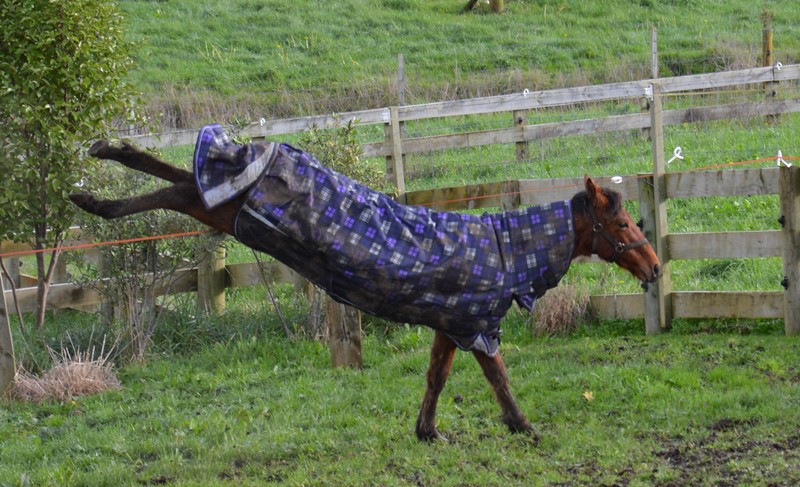
Here’s a photo that captures the joie de vivre of young horses, given a bit of sunshine in the middle of winter.

The happy chappy is a weanling colt from bred by Kym Kearns at Isa Lodge, and a full brother to Flying Isa (Pegasus Spur x Sun Isa), and is aptly named Isaputtingonmytophat, after the song “Top hat, white tie and tails” made famous by the likes of Fred Astaire, Tony Bennett and Ella Fitzgerald, but originally written by Irving Berlin.

The full lyrics are below the photo. But I love the line “And I trust that you’ll excuse my dust when I step on the gas…”

Isaputtingonmytophat

Top Hat, White Tie and Tails

I just got an invitation through the mails:
“Your presence requested this evening, it’s formal
A top hat, a white tie and tails”
Nothing now could take the wind out of my sails
Because I’m invited to step out this evening
With top hat, white tie and tails

I’m putting on my top hat
Tying up my white tie
Brushing off my tails

I’m dudeing up my shirt front
Putting in the shirt studs
Polishing my nails

I’m stepping out, my dear
To breathe an atmosphere that simply reeks with class
And I trust that you’ll excuse my dust when I step on the gas

For I’ll be there
Putting down my top hat
Mussing up my white tie
Dancing in my tails.

Read Full Post »

Destination Moon racehorse

Take off – Destination Moon at 2012 yearling sales with Kym Kearns

He’s named after a book about flying to the moon. And from the photo, you can see he was keen to take off long before race day!

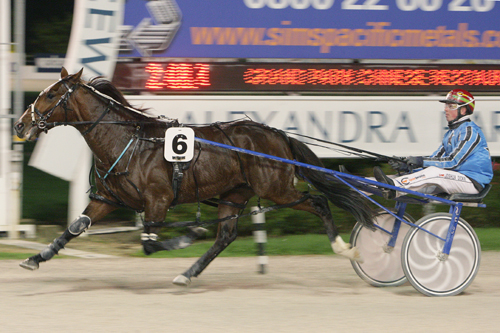
It was great to see Destination Moon get his first win last Friday at Alexander Park. The field was not nearly as strong as his first race a couple of weeks earlier, which was a Sires Stakes heat with the speed on, but the way he won was impressive.

He reached the front early and ran confidently in the lead, not switching off, keeping a good margin to the others and pulling away to win by over 2 lengths with little encouragement needed from Joshua Dickie in the bike.

Destination Moon is the half brother to Tintin In America and full brother to The Blue Lotus (3rd in Sires Stakes Fillies 3yo final), from my wonderful mare Zenterfold. His sire Grinfromeartoear is not highly commercial but if you get the right match he adds a lot of value and leaves some tough horses with speed.  “Duncan” (as we nicknamed Destination Moon) was a lovely type as a yearling and sold for $68,000 to Rosslands Stud Ltd (Kerry Hoggard) at the 2012 yearing sales.

He has shown up in his workouts and qualifying trial just prior to racing, but pleasing to see there wasn’t a rush to get him into the 2yo Sires Stakes if he wasn’t ready.

Recently I spoke to trainer Steven Reid about Destination Moon’s next steps, and he says he will be racing till the end of June then have a spell before being aimed at the 3yo Sires Stakes heats, which come up early in the new season and culminate around NZ Cup time.

Destination Moon pacer

Destination Moon wins on 24 May 2013 at Alexandra Park

Steven says he was “rapt” with the win – “He just cruised that, and it is how he’s been working at home.”

He describes Destination Moon as having the potential to step up and be quite a good horse.

Tintin In America and The Blue Lotus now have a Real Desire half brother weanling who is hanging out in our paddock with a full brother to Flying Isa, great mates.

More about him and an update on other branches of the family coming in a blog soon.

Destination Moon’s pedigree is one I wanted because Grin offers some physical and genetic influences that really complement his dam Zenterfold.  I have always taken on board Aria Small’s advice that the family love the old blood – the Spinster/Old Maid/Scotland connections, which it has on its bottom line through Bachelor Hanover. And that has been a touchstone for me in getting a good nick for the mare. Grin hauls that old blood up through his remarkably close-up Storm Damage damsire, and also in his maternal line through Shifting Scene and Race Time (a son of Breath O Spring and half brother of Storm Damage). Shifting Scene is part of the lovely Golden Miss maternal line that you see in many classy families (Rich N Elegant, Real Desire’s maternal line etc) and of course the overlooked element in that line is my dear old Shadow Wave.  In Zenterfold’s pedigree, Shadow Wave pops up promptly as the damsire of New York Motoring, who I believe is a key figure in what have developed into the two best branches of the Zenover family – Interchange and Zenola Star, both sired by New York Motoring. Finally you have the Direct Scooter and Tar Heel influences of In The Pocket, the sire of Zenterfold and so grandamsire of Destination Moon. These are again classy old bloodlines and with a fairly up close dose of trotting blood and both are descending from Volomite and maternally tracing to the wonderful Roya McKinney and Scotland/Rose Scott. Zenterfold’s grandam Now And Zen is also chokka with trotting blood via her sire Chiola Hanover. Chiola Hanover goes back to Volomite and the Scotland influences as well. But none of that is an issue for Grin, thanks to his breeding, especially Storm Damage who is described by John Bradley as having “some of the oldest bloodlines still available for pacers” – his dam was 24 years old when she foaled him, and he is a remarkable “sleeper” in the pedigree of a modern day sire.

Phew! that’s a little peep into some deep old echos in a 2yo pacer just launching his career.

Of course what I also liked about Grin was his ability to leave guts, character and grittiness, which The Blue Lotus showed in her races too. That gave the Zenterfold speed-at-all-cost attitude something to hang its hat on.

Cover Destination Moon book

Cover of Tintin book

It’s what might work for a particular family that counts. And that’s what I think about, more than what is the most fashionable option at the time.

Destination Moon has a long, long way to go. The rocket is just launched, yet to fire the booster engines and go into the statosphere.

I hope he ends up amongst the stars.

Read Full Post »

A bonus from my trip to the NZSBA breeders conference in Christchurch was the opportunity to visit Nevele R Stud and see Tintin In America, whom I bred, and some of his weanlings.

My visit was a lovely echo of my only other trip to Nevele R, which happened the year I decided to put Zenterfold to McArdle, which resulted in Tintin In America being born.

That day was just the same – raining, and the array of famous racehorses/sires standing in their paddocks with their covers on, looking just like any horse. I particularly recall Courage Under Fire (standing at Nevele R at that stage) who looked almost lost under his cover, being the small horse he is, as the rain poured down around us.

Tintin In America, Sire

Breeder Bee Pears with Tintin In America at Nevele R Stud, May 2013

That was about 8 years ago. Kym and I were shown around personally by Bob McArdle;  it was a fascinating tour with plenty of commentary by Bob, followed by a fairly robust discussion as we all sheltered in our Hilux ute and debated the merits of putting my mare Zenterfold to Falcon Seelster (which Bob advocated) or McArdle (which I was more interested in doing).

As history shows us, I stuck with McArdle.

So it was lovely last Saturday to come full circle and be standing alongside Tintin In America the sire, in the rain, at Nevele R all these years later.

Tintin retired very sore in one leg joint after super seasons as one of our top racehorses from 2yo to 4yo, and almost reaching a million dollars of earnings.

The good news is: he is very well in himself and full of attitude in the paddock, and very fertile in the barn. Thanks to Nevele R in doing such a good job in settling him in to his new career.

There’s no doubt what sticks in people’s mind about Tintin is his incredible acceleration and speed.  As he grew older he developed the strength to hold that sprint longer. At times, he appeared to be low flying down the home straight. That sort of acceleration is hard to come by.

He was a medium sized horse, but a first foal from a medium sized mare. From what I have seen, his foals are quite striking types of good size. I saw two at Nevele R and both had white blazes which could be their own family influences but I have also noted the blaze/snip influence in Tintin’s family. Interesting.

I’d love to hear from people who have foals/weanlings by Tintin. Email me at bee.raglan@xtra.co.nz and tell me about them.

Personally, I am negotiating a share in a well bred weanling filly by Tintin In America, and have leased another mare to put to him with a very interesting pedigree match. But more about those  at a later date.

I’m a careful and thoughtful breeder and I believe he’s worth a good punt as a sire.

Read Full Post »

I’ve just returned from the NZ Standardbred Breeders Conference in Christchurch on Friday 17 May. I applaud the organisers for gathering a great line up to get us thinking, and tip o’ the hat to Michael Guerin – his Q&A sessions with Karen Parsons and Cran Dalgety were a highlight, and his summing up at the end of the conference was a call to action that would have set the conference alight if it had come at lunchtime.

My only quibble with an otherwise very good conference:  poor timing at the start meant the workshop/discussion session at the end was truncated and lacking focus. It was an ideal opportunity for John Mooney et al to get some support and direction from active and interested breeders through real workshopping of ideas. Having that number of well informed breeders from different parts of the country in the same room is rare. It creates an exchange of ideas that surveys and submissions can never achieve.

Perhaps a raft of workshops on specific ideas arising from the conference (and elsewhere) could be held around the country over the next 6 months to put some flesh on the bones and give some life to Mick Guerin’s apt comment that the breeding industry must settle on its priorities and get much more coordinated and clever about its tactics to push those into the wider harness racing (or general racing) agenda.

A quick note on two of the presentations:

Dr Jenny Cahill spoke on the importance of genetics. Her recap on the basic principle of “pairs” was an apt salute to the equal importance of sire and mare. It takes two to tango, right down to the chromosone level! She also placed a realistic perspective on the contribution of genetic making up to a performance horse, noting that complex inherited traits ( e.g. some performance measures, height, temperament, and a number of diseases) are affected by a number of genes and usually also modified by environmental factors (such as training and nutrition).

As equine genetic research moves into the field of complex traits, Dr Cahill said breeders need to feed into research programmes what they are most interested in finding out. For example, the dairy and beef industries are further down that path and have clear objectives of what research can help them produce better products for a changing market.

For some equine breeders, genetic research will be a step too far to contemplate, but it is going to happen. We must embrace and direct it, or we are just burying our heads in the sand. Dr Cahill says “the ultimate goal of this research is to be able to use the information gained for the good of the horse, owners, breeders and trainers and to be able to screen individual horses for these traits.”  This would include testing for heritable conformation faults and diseases, and also good gaitedness and even the type of performance they are “wired” to achieve (speedy sprint, medium distance fast, stamina/slow).

All this has HUGE implications for breeders, buyers and sellers. Some thoroughbred markets are already using available information. How would we use it? What impact would it have on numbers bred and sold if we cut out all those horses in advance who will only make up the numbers in a race? How would it change our yearling sales, if overnight buyer-requested testing became available? Fascinating stuff to ponder!

Dr Clarissa Brown Douglas, speaking on nutrition of the mare and foal, gave a wealth of useful information, emphasising the importance of feeding correctly in those critical formative times. Her take-out messages were simple: Managing growth is a balancing act. The last trimester is a vital time to ensure the foal gets the minerals, trace elements and vitamins required. Get to know the nutritional value of what you are using – pasture and hay as well as commercial feeds and balancers.

Some of the facts that stood out for me:

  1. Mares milk lacks minerals so in that vital last trimester, the foal stores the minerals it needs in its liver for use during the first 90 days of its life.
  2. A foal is born with only 17% of mature bone mineral content, and maximum bone mineral content is not achieved until a horse is about 5 years old.
  3. The 6-12 month period of feeding a weanling is a “window of opportunity” and you need to monitor growth rate so you don’t overload the immature skeleton structure.
  4. Yearling preparation is best done gradually over 90 days.
  5. Be aware of the potential for high glucose/insulin response in young horses – low glycemic feeds are a good way to prevent this.

So it really makes you think about the pressure we put on such an undeveloped creature when we race horses as 2yos! And if we continue to do that, it places a big responsibility on breeders to lay the best foundation possible.

I am sure NZSBA will be publishing the papers presented by all speakers at the conference on their website. It’s great food for thought.

The industry analysis (both harness racing in general by Edward Renall, and breeding industry by John Mooney) provides some good basis for discussion.

But as Mick Guerin said, we need to pin down and agree on our priorities, and push our agenda forward in a united way. We will get nowhere by griping and sniping, riding the ocean like flotsam and jetsam, carried on currents that seem out of our control.

I grabbed a chance right at the end to raise my idea of increasing the breeding option to one foal and one ET per mare per season, outlined in other blogs. I got a strong positive response from several breeders to this suggestion – including a commitment from John Mooney to start following it up.

Likewise Brian West raised the need to get a monetary return into breeders’ hands via a % slice of stakes, as they do in France where breeders are recognised as the key investors in the industry’s product.

These ideas are not as “out of the box” as we might think. As I said, a series of workshops or think tanks around the country could pull together some recommendations.

Let’s get some fresh voices and fresh ideas in the mix.

Great conference, exciting times!

Read Full Post »

If ever there was a horse that epitomises the Anzac spirit in the modern era, it is Courage Under Fire.

Courage Under Fire in action

Courage Under Fire in action

Aptly named, Courage Under Fire was a racehorse loved and respected in both New Zealand and Australia for his heart, gait and sheer willpower which overcame his pint-sized (14.3h at a push) frame.

He was born (1995) and developed in New Zealand, owned by Australian Greg Brodie, and raced at the top level in both countries.

He was simply a superb racehorse as a 2, 3 and 4yo, winning 24 out of 24 starts in a run that reminds us currently of Black Caviar – and “The Pocket Rocket” was just as much a crowd pleaser.

A really lovely summary of his racing career by Adam Hamilton can be found here on the excellent Addington Raceway Timeline webpages, written when Courage Under Fire retired.

The admiration he had earned “under fire” on the racetrack continued on both sides of the Tasman Sea when he went to stud.

He’s left 10 crops of foals so far (2002-2012) – it’s a milestone worth celebrating. His NZ bred foals have just topped the 1000 mark, and in Australia now exceed 500 and many more to come I hope! His oldest progeny are now 9yos. He’s got the ability to leave really good horses, and to inject a needed element of speed and toughness. And he hasn’t stamped his small size.

His popularity in Australia as a sire is undiminished, and he is still getting full books there, with good supplementary bookings for his chilled semen coming from New Zealand.  He first stood at Nevele R in New Zealand for several years, then after a stint under the Stallion Station he has found a home more recently at Alabar Australia. He is currently standing at a $6000 service fee which indicates how well he is regarded at this stage of his career.

His siring career could be headed in the same direction as his damsire the great Vance Hanover, carving out a great reputation over a long period, not leaving a major siring dynasty in his own right, but likely to provide some very good broodmares in the future.  Many of his best sons are geldings – Pembrook Benny, Sleepy Tripp, Smolda.

Thoughts on Anzac Day

Completely on a different tack, I’d like to give a tip o’ the hat to the horses who have literally performed under fire through many different wars. Forget the awful Spielberg movie and search out some of the real stories to be found about these horses and their handlers.  I hate war for what it does to people, to animals, to the environment. It’s a soul-destroying aspect of life, and its only good side is the other part of the human condition it reveals – courage, resiliance, and humanity shown by individuals against all odds. That’s what I think about on Anzac Day.

Read Full Post »

This is part 2, following my previous blog, and a part 3 is coming….(Yes, I intended to get it all written today, but I got completely diverted building another chook house in the rain. I wish weekends were longer!)

In my last blog I recalled Mr Feelgood’s Little Brown Jug win, and the fact he had then gone on to an exceptional career as a mature horse – he earned over $3 million from a 2yo through to a 9yo, racing in three different countries and adapting to completely different hemisphere styles of racing.

What he has earned, in addition to the money, is a huge amount of respect.

And that, in my view, is one of his strengths as he takes on all comers in the race for success as a sire.

Because standing as a sire is just as competitive and challenging as any part of Mr Feelgood’s racing career.

There are many other horses who have similar attributes – a solid maternal family, closely related to excellent horses, performance statistics that confirm both speed and toughness at the highest level…

But as far as I am aware, there are very few horses that has achieved what he has – two successful careers at the top level, one in the northern hemisphere and one in the southern hemisphere, and in races that even on their own would have earned him the respect of trainers, punters and breeders. Combine Mr Feelgood’s achievements in one curriculum vitae, and you can see why this horse is so exceptional.

Mr Feelgood

Trainer Luke McCarthy runs his eye over 2011 Len Smith Mile hopeful Mr Feelgood at his Cobbitty property yesterday.
Photo: Jonathan Ng

The only hiccup in Mr Feelgood’s racing record is that his initial sojourn in New Zealand in 2009 was not particularly successful, as he came to terms with the new environment and, under Tim Butt’s guidance, learned a new style of racing. His southern hemisphere career has been mainly based in Australia, with the McCarthys, and that is where he has built an enduring and successful second career at the very top echelon of open class racing. (He did return to New Zealand on a raid from Australia in 2011, when he came 2nd in the Auckland Cup and 4th in the Christchurch Interdominion Finals.)

Raids to another hemisphere always capture interest. The incredible journeys of Graham Pearson and Under Cover Lover, of Graham Brunton and Lyell Creek, of Mark Purdon and Pride Of  Petite, are some New Zealand examples from the past 20 years or so.

But as Auckland Reactor found, it is quite a different thing to move from one hemisphere to another and build a second career there at the very top level.

There is one great New Zealand horse that has achieved it, and that is Cardigan Bay in the 1960s. He won the very top races in 3 different countries (NZ Cup, Auckland Cup), and in Australia (Interdominions), and then moved to North America at the age of 8 and over the next 4 years he beat the likes of Bret Hanover and Overtrick, and was twice US Pacer of the Year – there’s plenty about “Cardy” on the internet, just google Cardigan Bay and refresh you memories of this truly great campaigner!

[In hindsight I would add Lyell Creek to the list of those horses that made top level careers in two hemispheres – he was in Nth America for two years and competed against the top trotters, winning or placing many times.]

Mr Feelgood has something Cardigan Bay and Lyell Creek (both geldings) could not achieve – the opportunity to become a successful sire.

Remarkably, Mr Feelgood has already had two shots at it, once when he was first retired in America and once with frozen semen while he was still racing in Australia – for some very interesting and promising results.

In the United States the entire served a book of mares 31 which produced 25 live foals. From the small crop he has left three $100,000 winners to date, two of which won the Colts and Gelding and Fillies 3YO divisions of the $250,000 Kentucky Sires Stakes Finals, namely I’m Feelin Good and Feels Good. Then when Mr Feelgood was racing in the southern hemisphere he produced 17 live foals through frozen semen, three have since died and the remaining 14 turned 2yos from 1 September this year.

Mr Feelgood is standing at Yirribee Stud in New South Wales but under Alabar’s management.

In racing “world champions”, “sensational”, and many other marketing hyperboles are all too common, Mr Feelgood has proved he much more than a Little Brown Jug 3yo winner. He is, in my view, an exceptional racehorse.

Will he be an exceptional sire? In my next blog I’ll look at that, and share some insights from Alabar’s John Coffey.

Comments always welcome – and examples of other horses you know of who have had top level careers in two hemispheres.

Read Full Post »

Only a week to go to the Little Brown Jug!

Six years ago I was on track to see Mr Feelgood win the Jug. This post and the next one tomorrow are a ‘tip o’ the hat’ to that wonderful event and to a wonderful horse – who is now tackling his next challenge, to become a successful sire.

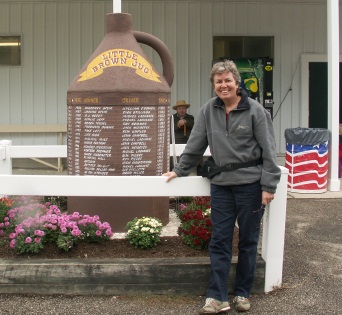
Bee Pears alongside the Little Brown Jug

Bee Pears alongside the Little Brown Jug

2006, a fine but cool late September day in Delaware, Ohio. The wind on track made me buy a souvenir polar fleece jacket to keep warm.

We found our online-purchased “seats” in the grandstand, indicated by numbers painted along the narrow benches at spacings which were optimistically close. Luckily our ‘neighbours’ were Don and his friend, great guys who,  like many at the Little Brown Jug,  booked the same seats each year, a tradition. Don was informative and friendly, and kept an eye on our gear and seats while we went exploring.

Kym Kearns with our friendly Little Brown Jug neighbour Don.

The Little Brown Jug is two days of experience I’ll never forget – and definitely recommend. It is a huge meeting – about 50,000 people descend on the small town of Delaware for the Grand Circuit Racing County Fair that features the Jugette (for 3yo fillies) on the first day and the Jug (for 3yo colts) on the second day, some other good stakes races and a lot of local fields.

The atmosphere is like a Motukarara Gold Nuggets day but 50 times bigger. It’s laid back, but electric. It’s country, not town. It’s casual, but incredibly well organised. Go to their website and you can tell that it retains an identity which avoids the sophisticated PR promotion you might expect for such a big occasion.

It is a great tradition – and a lot of fun.

You can walk all around the half mile oval – on the side opposite the grandstand, the back stretch, is an area where people have their own deck chairs – you get a great view of the horses coming out onto the track, and it is a popular social area. Hot dogs, burgers and goulash-type meals dominate the food hall area under the main grandstand and dotted around the course. Many of those attending stay in motorhomes parked in the county fair grounds – which would have been a better and cheaper option in hindsight than the Delaware hotel we booked in advance.

I wasn’t a close follower of North American racing, so many of the Jug elimination heat participants in 2006 were just names to me – but of course they are more familiar now – Jereme’s Jet, Armbro Deuce, Total Truth (all sires now),  and of course the eventual winner of the Jug, Mr Feelgood. Also racing on Jug and Jugette days – and winning – were Ponder, a very classy performance in 1.49, and the very good Bettor’s Delight 2yo filly Isabella Blue Chip (a US$40,000 yearling purchase who went on to earn just under US$800,000) and Bettor’s Delight Jugette winner Eternity’s Delight, who was owned by well known American breeders/owners Jules and Arlene Siegel – and it is worth quoting Jules Siegel on the Little Brown Jug as an event:

The Jug is a throwback to what racing was and should be today. The Delaware County Fair is the most exciting event in (harness) racing. My wife and I bring guests to Delaware each year who are not even involved in harness racing and they enjoy the racing as much as we do. Everything about Delaware is a credit to the sport.

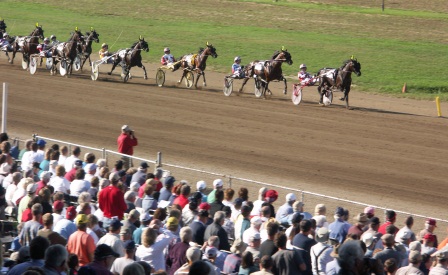
Little Brown Jug 2006

Big crowds, big excitement at the Little Brown Jug
Photo: Bee Pears

The county fair is in Ohio, which is a backwater in terms of top level racing and breeding, apart from this event. It is, however, a state where many bread and butter horses are bred and raced, with its own yearling sales (which we went to, and noticed the quality of the Pegasus Spur yearlings), and a number of sires standing locally or nearby who are not in the top league but popular and affordable for the state breeders. So the large proportion of horses competing over the 2-day county fair meeting have breeding much less familiar to us than that of the horses in the Jug, Jugette and other $50,000 plus stakes race fields on the day. These local sires in 2006 included Nobleland Sam, Stand Forever and Precious Bunny for pacers, and Master Lavec and Ilooklikemymom for the trotters.

In New Zealand we place high value on the Little Brown Jug as a true test of qualities we like to see in a sire – toughness, speed and heart (they race twice within the same afternoon, with three elimination heats producing the nine horses for the final, all over a mile of course and the tight half mile Delaware track). Some winners we admire in Australia and New Zealand include Armbro Operative, Fake Left, Life Sign and Bettor’s Delight, while more recent Jug winners in our siring ranks include P-Forty Seven, Shadow Play, Well Said, Rock N Roll Heaven and now Mr Feelgood.

On Jug day in 2006 we watched Mr Feelgood take out his elimination and then the final in grand style. In the final he was sitting behind Armbro Deuce on a fast pace that stretched the rest of the field, then came off the back of the leader as he started to tire, and blasted to the front with only Cactus Creek looking vaguely dangerous.

I have to confess my money was on 14.2h Doonbeg from Toronto, a very small horse with incredible ability who came last in the final, but has gone on to a fascinating career in Britain (in 2010 breaking the world record for the fastest mile on a track LESS than half a mile).

Of interest, Jereme’s Jet never made it to the final, having been burned in a 25.4 first quarter speed duel with Armbro Deuce in his elimination heat (the third heat) , so that makes Armbro Deuce’s performance for second in his elim and third in the final even more remarkable given the short timespan between those two races.

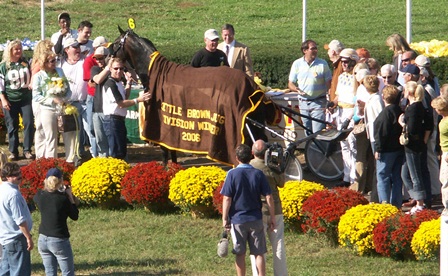
Mr Feelgood in the winners circle 2006

Mr Feelgood in the winners circle, 2006 Little Brown Jug
Photo: Bee Pears

Mr Feelgood is a class act – he was on that day, and he has continued to be so in achieving outstanding results in two different hemispheres – with two different styles of racing over different distances.

The qualities that allowed him to win the Jug are the same qualities that enabled him to win the InterDominion Final and the Hunter Cup in Australia as a 6yo, and heats of the Interdominion at 8 and 9 years old. (See summary of his racing record)

The training feat by Jim Takter (USA), Anthony Butt (NZ) and then John McCarthy (Australia) played a large part in maintaining the will to win and soundness of Mr Feelgood over such a long and varied racing career.

In the next blog, I look at Mr Feelgood’s attributes as a sire – and share some frank observations and stories from John Coffey of Alabar Australia, where Mr Feelgood is standing.

Read Full Post »

« Newer Posts - Older Posts »